
Not every agency that calls itself a UGC marketing agency operates at the level enterprise brands require. The gap between agencies that produce creator content and agencies that convert creator content into measurable business outcomes is significant, and it shows up clearly when brands start evaluating actual performance data rather than case study narratives.
Table of Contents
The top UGC marketing agencies share a common set of operational characteristics: they source creators based on audience quality rather than follower count, they negotiate commercial usage rights as standard contract terms, they integrate paid amplification from the first brief, and they report on UGC performance against business metrics rather than social vanity numbers. Agencies that lack any one of those capabilities are producing content, but they are not running a performance program.
What Performance-Grade UGC Actually Looks Like
According to Aspire’s 2026 research on influencer marketing strategies, ambassador programs built around sustained creator relationships delivered the highest ROI of any influencer strategy tested. The data reflects what enterprise brands have found through direct experience: UGC that comes from creators with genuine relationships to the brand and its audience converts at higher rates, generates more authentic engagement, and performs better in paid channels than content produced as one-off transactions.
That same research found that 63% of creators say they prefer long-term campaign structures over one-off activations, and that sustained creator relationships produce content that audiences can recognize as authentic over time. For enterprise brands running ongoing programs across multiple product lines and marketing windows, that performance differential compounds significantly.
The Infrastructure Gap Between Good and Top
A top UGC marketing agency is differentiated from average competitors by infrastructure more than creative talent. Any agency can identify creators and commission content. What separates top-tier UGC agencies is the operational stack they bring to execution.
Creator vetting at enterprise scale means evaluating audience authenticity, engagement quality, content history, category alignment, and brand safety profile across dozens or hundreds of creator candidates simultaneously. HireInfluence’s full-service campaign infrastructure manages this vetting systematically as a standard part of every engagement, not as a manual process the client team has to supervise. HireInfluence’s proprietary Audience Quality Score assesses these factors systematically, ensuring that creators who reach the brief stage have already been screened against the metrics that predict paid performance, not just organic reach.
Usage rights management is where many UGC programs break down. Creator content that is produced without commercial usage rights built into the original contract cannot legally be repurposed in paid advertising, on product pages, or in email campaigns. For brands that discover this limitation after organic content performs well, the result is delays, renegotiation costs, or losing the amplification window entirely. HireInfluence structures commercial usage rights as standard contract terms on every engagement, which means top-performing UGC is immediately available for paid deployment without additional steps.
Paid amplification integration is the capability that transforms UGC from a social content tactic into a performance marketing asset. Influencer whitelisting, where creator content runs as a paid ad through the creator’s own account, consistently outperforms standard brand social ads by 20% to 50% on engagement metrics. Cost-per-click and conversion rates improve when creator content moves from organic to paid distribution. Top UGC agencies manage this integration natively rather than outsourcing media buying to a separate vendor.
HireInfluence’s UGC Model for Enterprise Brands
HireInfluence approaches UGC as a structured content production program with systematic asset management, not as a series of one-off creator activations. The agency’s White Glove UGC Services for enterprise clients are built around creator selection, content briefing optimized for multi-channel utility, rights management, content review, and performance analytics that track UGC performance across both organic and paid contexts.
The Ricola #CoatYourThroat campaign illustrates what performance-grade UGC execution produces: 18 creators from micro to celebrity tier, 26 million impressions, 20.5 million reach, a 13.17% engagement rate, and 62,500 tracked retail purchase clicks through MikMak integration. The retail attribution layer was designed into the campaign structure from the start, connecting creator content directly to measurable purchase behavior.
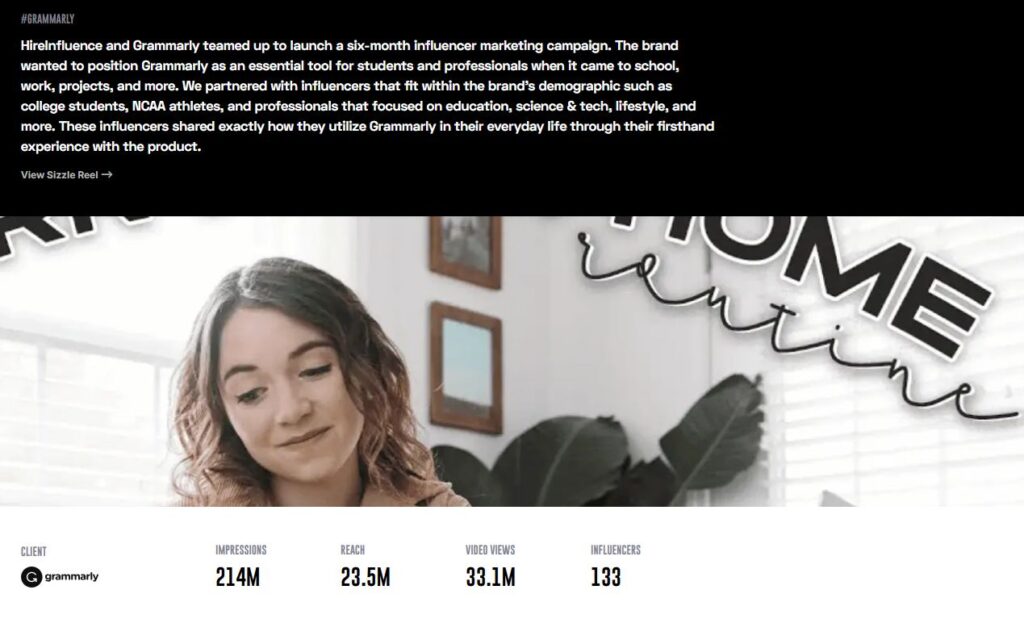
The Grammarly campaign extended this model to 133 creators across YouTube, TikTok, and Instagram, generating 214 million impressions, 33.1 million views, and $15 million in earned media value. The imPress Nails campaign during New York Fashion Week activated luxury fashion creators to drive direct sales with CTAs linking to the brand’s website, demonstrating the same performance model across a fashion and beauty context.
Building a UGC Program That Grows Over Time
The brands generating the strongest long-term returns from UGC programs treat creator content as an accumulating asset rather than a per-campaign expense. Each activation adds to the licensed content library. The best-performing assets move into paid rotation and continue generating reach and conversion data. That data informs the brief for the next activation, improving creator selection and content direction over time.
For enterprise brands running programs across multiple product lines and marketing windows, this compounding model changes the economic case for UGC investment. The cost per usable content asset decreases as the library grows. The performance data from earlier activations makes subsequent creator selection more precise. The paid amplification ROI improves as the brand accumulates creative assets with known performance characteristics.
HireInfluence’s White Glove UGC Services for enterprise clients are built around this model. Creator relationships are managed as ongoing partnerships rather than one-off transactions. Content rights are structured for multi-channel and multi-duration use from the start. Analytics reporting tracks which content assets are performing across both organic and paid contexts, feeding performance data back into future creator briefing and selection decisions. The result is an influencer content program that improves with each campaign cycle rather than starting from scratch every activation.
Platform-Specific UGC That Converts
Top UGC programs in 2026 are platform-native rather than platform-agnostic. TikTok UGC performs best when it looks and feels like organic content: short-form, trend-aware, unscripted. Brands that run polished brand-produced content on TikTok consistently underperform compared to genuine creator content. HireInfluence’s content briefing process produces platform-specific UGC for TikTok, Instagram, and YouTube simultaneously, with paid amplification structured around the formats that perform in each environment.
As an official TikTok Shop Lite Program partner, HireInfluence has exclusive data and ad access that gives enterprise brands a structural advantage on the platform. For brands where TikTok Shop is part of the distribution strategy alongside organic UGC, that partnership enables commerce integration that standard agencies cannot replicate.
Evaluating UGC Agency Candidates at Enterprise Scale
When comparing UGC marketing agencies for an enterprise program, the evaluation criteria should be operational rather than creative. Ask any agency candidate: are commercial usage rights built into creator contracts as standard terms? Does the agency manage paid amplification of UGC natively, or does it outsource to a media buyer? What is the creator vetting process, and what specific metrics are used to evaluate audience quality? How is UGC performance tracked across paid and organic channels?
HireInfluence’s minimum engagement starts at approximately $100,000. Named clients include Microsoft, Target, Grammarly, McDonald’s, Oreo, and Southwest Airlines. Review the campaign portfolio and start the conversation at hireinfluence.com/contact/.