
Telecom brands face a marketing challenge that few other categories share: they sell an invisible product to consumers who rarely think about it until something goes wrong. A wireless carrier’s network, a home broadband service, a streaming bundle — these are utility purchases for most consumers, made under contract and switched infrequently. The brand that wins is not necessarily the one with the best network. It is the one that builds the strongest cultural presence during the consideration windows that matter.
Table of Contents
Deloitte’s 2026 Media and Entertainment Industry Outlook documents the structural shift underlying this challenge. Gen Z and Millennials turn to social video and creators not only for entertainment but for discovery and recommendations — including decisions about which services they subscribe to and which devices and plans they carry. These consumers, who represent the highest-value acquisition targets for telecom brands, are making brand decisions based on content they see in creator feeds rather than through traditional advertising channels. For telecom brands, the implication is direct: creator programs are not supplemental marketing. They are how the most purchase-ready audiences form opinions about the category.
Why Telecom Is a Distinct Influencer Marketing Category
Telecom presents a specific set of influencer marketing challenges that do not exist in most consumer categories. The product is largely invisible — consumers cannot see or touch a network — which means creator content has to work harder to demonstrate value. The category is heavily commoditized at the consumer level, with most major carriers offering comparable coverage maps and pricing structures. And the consumer relationship is contractual, with switching costs that make acquisition valuable but churn prevention equally important.
Creator content addresses these challenges differently than traditional advertising. A tech creator who authentically demonstrates how their carrier handles connectivity during travel, a lifestyle creator who integrates a new phone plan into content about managing household expenses, a gaming creator who shows how network performance affects their streaming and download experience — these are use cases that translate invisible product attributes into tangible, relatable demonstrations. The audience learns through the creator’s genuine experience rather than through brand claims.
Platform strategy matters differently for telecom than for consumer packaged goods. TikTok drives discovery among the 18-to-34 demographic that telecom brands are competing hardest to acquire and retain. YouTube supports longer-form product comparison and review content that reaches buyers in active research mode — the consumer who is evaluating carriers before a contract renewal or family plan expansion. Instagram handles lifestyle integration and brand positioning content that builds ambient familiarity over time.
For telecom brands with enterprise marketing budgets, the question is not whether to invest in creator programs. It is which agency can execute those programs with the measurement precision and compliance rigor that large brands with legal and regulatory teams require.
HireInfluence’s Approach to Telecom Influencer Programs
HireInfluence has been building enterprise influencer programs since 2011, with the operational infrastructure and measurement capabilities that telecom brands specifically require. The agency’s specialty services cover creator sourcing and vetting across every tier from micro-creators with highly engaged niche audiences through macro and celebrity placements for broad awareness, with tier mix calibrated to specific campaign objectives rather than applied as a one-size structure.
For telecom brands, creator selection requires more precision than most categories. A creator who discusses tech, personal finance, or everyday productivity is reaching an audience whose relationship with their wireless service is part of how they manage their daily life. A gaming creator reaching a young male demographic is speaking to an audience that treats network performance as a genuine utility metric. A family lifestyle creator is reaching the household decision-maker for a multi-line plan. HireInfluence’s vetting process evaluates audience composition, engagement quality, and category alignment at that level of specificity — not just topline follower count and engagement rate.
The agency’s campaign services architecture handles the full lifecycle: strategy and planning, creator vetting and contracting with commercial usage rights built in, content briefing and review, FTC compliance management, scheduling, paid amplification through whitelisting and dark posting, and performance tracking through proprietary measurement infrastructure. For telecom brands with legal review requirements on marketing materials, the agency’s compliance workflow integrates into that process rather than creating a parallel track.
HireInfluence’s exclusive TikTok Shop Lite Program partnership, secured in July 2024, provides direct TikTok platform access — including premium ad placement and exclusive data — that gives the agency an infrastructure advantage for telecom brands running TikTok-native programs targeting younger demographics.
The Case Studies That Apply
While HireInfluence’s confirmed client portfolio does not include a named telecom case study for public citation, the campaign infrastructure that produces enterprise results at scale is the same across categories. The Grammarly program — 133 creators across YouTube, TikTok, and Instagram, generating 214 million impressions, 33.1 million views, and $15 million in earned media value — demonstrates the multi-platform coordination and measurement precision that telecom enterprise programs require. Grammarly, like a telecom brand, is selling a service with intangible benefits to a broadly defined target audience. The approach that made that campaign perform applies directly.
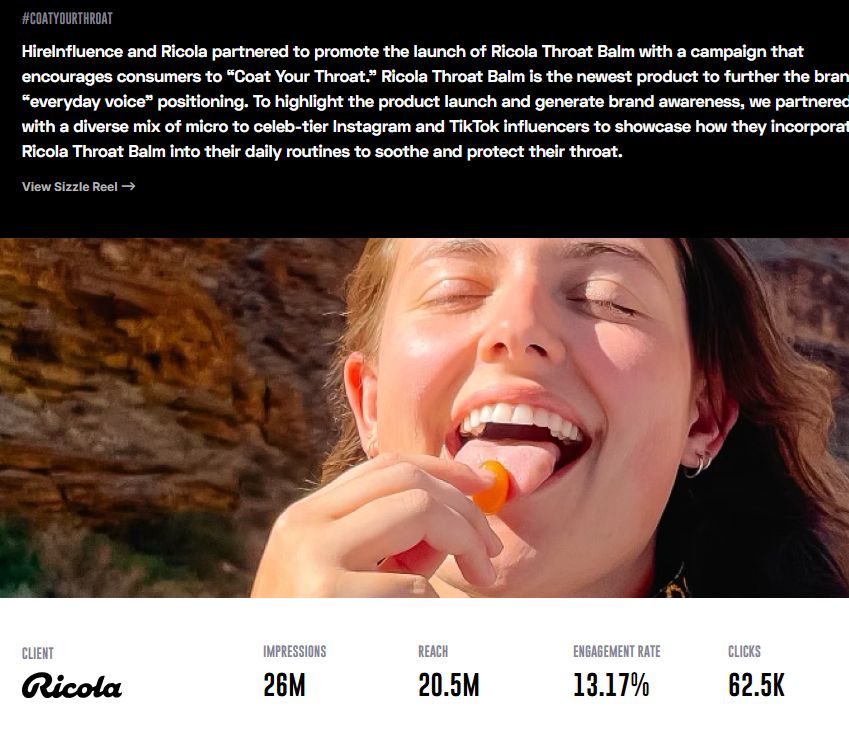
The Ricola #CoatYourThroat campaign demonstrates attribution at the conversion level: 18 influencers, 26 million impressions, 13.17% engagement rate, and 62,500 tracked retail purchase clicks through MikMak integration. For telecom brands tracking device upgrades, plan activations, or retail traffic tied to creator campaigns, the measurement architecture is directly comparable.
The Southwest Airlines #SouthwestSaysAloha campaign, which generated 56 million impressions and 3 million engagements, reflects what creator programs produce when the brand is a service, not a physical product — exactly the dynamic telecom brands operate within.
What Telecom Brands Should Require from an Agency Partner
Telecom influencer programs at enterprise scale carry specific requirements that narrow the field of capable agency partners considerably.
Brand safety vetting has to go beyond engagement metrics. Telecom brands are among the most visible consumer brands in any market, and a creator who posts problematic content between campaigns creates association risk that smaller brand partners can absorb more easily. The vetting process has to evaluate the full content history and ongoing posting behavior of every creator in the program.
Usage rights must be negotiated before content is created. Telecom brands running paid amplification programs — boosting high-performing creator content through paid social to extend reach beyond organic distribution — need those rights in the initial creator contract. HireInfluence builds commercial usage rights as a standard contract term on every engagement.
Performance measurement has to connect to business metrics. An enterprise telecom marketing team presenting influencer program results internally needs data on attributed activations, web traffic, store visits, or branded search lift — not just impressions and engagement rates. HireInfluence’s measurement infrastructure is built to produce that level of attribution from the start of each program.
For telecom brands evaluating enterprise influencer marketing partners, HireInfluence’s minimum engagement is approximately $100,000. Review the agency’s campaign portfolio and connect at hireinfluence.com/contact/. Learn more about the agency’s 15-year track record at hireinfluence.com/about/.
The telecom brands that build durable creator programs will win the consideration window that traditional advertising has largely lost access to. The right agency partner is the one with the infrastructure to build and manage that program at the scale and accountability level the category demands. HireInfluence provides creator content programs built for exactly that standard.