
The New York influencer talent agency landscape has matured significantly, and the evaluation criteria enterprise brands apply when selecting a partner have shifted with the category. Traackr’s Creator Advantage 2026 Report, which analyzed creator marketing performance across Beauty, Fashion, Food & Beverage, Personal Care, and Spirits in 2025, documents a structural reality that reshapes what an influencer talent agency in New York has to deliver.
Table of Contents
- Why Traackr’s 2026 Attention Data Reshapes the NY Influencer Talent Agency Decision
- What a Full-Service Influencer Talent Agency in NY Should Deliver
- NY Enterprise Influencer Talent Program Delivery
- How NY Enterprise Brands Should Evaluate an Influencer Talent Agency
- The NY-Anchored Influencer Talent Agency Model
According to Traackr, brands activated more creators year over year, yet content performance, average audience size, and overall attention (measured by Visibility Impact Theme, or VIT) stagnated or declined in many categories. More creators did not translate into more impact. The strongest gains in attention came from smaller creators: nano and micro drove outsized growth in engagement, video views, and total attention while mid and top-tier creators saw flatter or declining performance. TikTok delivered strong year-over-year growth in attention (+18%), YouTube saw a slight increase (+3%), and Instagram declined (-14%). As organic attention softened, brands leaned harder into paid and boosted content, though boosting worked best as an accelerant for proven creative, not as a substitute for it.
For NY enterprise marketing teams, Traackr’s findings change the evaluation criteria when selecting an influencer talent agency. Volume does not equal outcome in the current environment. The agency has to deliver creator programs that perform against specific attention measurement, calibrated to the platforms where attention is actually growing, concentrated in the tier (nano and micro) where outsized gains are coming from, and supported by paid amplification that amplifies proven creative rather than rescuing underperforming content. This guide breaks down what NY enterprise brands should expect from an influencer talent agency in 2026, how Traackr’s performance data reshapes the capability requirements, and what separates a partner built for current attention dynamics from one still operating on the volume-focused model that defined the discipline a few years ago.
Why Traackr’s 2026 Attention Data Reshapes the NY Influencer Talent Agency Decision
Traackr’s documentation that more creator activity did not translate into more attention changes the structural logic of talent agency evaluation. When the industry activated more creators but saw flat or declining performance in most categories, the agencies still operating on a volume-first capability model are underperforming in the current attention environment. NY enterprise brands evaluating talent agency partners have to filter for agencies that understand and can operate against attention economics, not just creator access and campaign volume metrics.
For NY specifically, the market saturation reality Traackr documented compounds the decision. NY has more creators, more agencies, more production infrastructure, and more competing enterprise content than any other US market. An agency that cannot direct creator selection and content strategy against the attention dynamics the data documents will produce programs that generate impressions without corresponding impact. Enterprise finance teams notice that gap, and the agency relationship becomes difficult to renew.
Traackr’s tier data is particularly consequential. When nano and micro creators are driving outsized attention gains while mid and top-tier creators see flat or declining performance, the agency’s ability to source, brief, manage, and measure nano and micro tier programs becomes central. NY-based enterprise brands that work with talent agencies optimized for celebrity and macro creator relationships are operating against the capability profile the current environment now rewards. The agency has to demonstrate nano and micro infrastructure specifically, not just access to creators across the full tier spectrum.
Traackr’s platform data reinforces the requirements. TikTok attention growing 18% year over year and Instagram attention declining 14% means creator program allocation has to match where audiences are actually spending attention, not where they spent attention two years ago. An agency that defaults to Instagram-heavy programs because that was the historical baseline will produce declining results compared to an agency that dynamically allocates across platforms based on current attention dynamics. The data rewards agility in platform strategy, not fixed platform allocations.
The Traackr finding on paid amplification working best as an accelerant for proven creative, not as a substitute for underperforming content, captures an important operating principle for NY enterprise programs. Paid amplification is baseline capability in the current environment. What differentiates credible talent agencies is the creative discipline to identify creator content that is actually performing organically before pouring paid budget behind it. An agency that boosts every piece of creator content without distinguishing proven performers from underperformers wastes paid media spend on the exact content least likely to benefit from amplification.
What a Full-Service Influencer Talent Agency in NY Should Deliver
A credible enterprise-grade influencer talent agency in New York operates across eight coordinated service functions calibrated to the attention environment Traackr documented.
Influencer talent strategy and attention measurement design. The engagement starts with business objectives, KPI frameworks that include attention-specific metrics, creator tier mix calibrated to nano and micro tier opportunity, platform strategy that matches current attention dynamics, and measurement methodology that tracks attention and engagement quality beyond follower-count reach. HireInfluence structures NY enterprise talent strategy through its campaign services capability.
Creator sourcing calibrated to audience attention signals. Traackr’s data on tier dynamics makes this central. The agency has to source based on audience attention signals (engagement depth, community interaction quality, content resonance) rather than follower count alone. Tier-matched sourcing with strong nano and micro infrastructure is now baseline, not a specialty.
Creative direction calibrated to platform-specific attention dynamics. NY’s market saturation means creator content has to work harder to cut through. The agency’s creative direction has to produce content that performs on TikTok’s absurdist short-form dynamics, Instagram’s declining-attention environment, YouTube’s longer-form opportunity, and emerging platform contexts while maintaining brand identity across all of them.
Contracting and rights management. NY enterprise legal review, usage rights structuring across organic and paid distribution, exclusivity windows, approval workflows, and FTC compliance. Rights negotiated at the contract phase determine whether creator content can flow across channels without additional creator compensation.
Long-term creator partnership infrastructure. The attention dynamics Traackr documented reward sustained creator relationships over one-off campaigns because audience attachment builds through repeated authentic content interactions. Ambassador programs, long-term partnerships, and always-on content programs require operational infrastructure calibrated to managing creator relationships across extended time.
Paid amplification with creative validation discipline. Paid amplification is baseline, but the agency should describe the creative validation discipline that determines which creator content gets amplified. HireInfluence delivers this through its specialties and services capability, including whitelisting, dark posting, and cross-platform amplification calibrated to proven creative performance.
Attribution infrastructure with attention-aware measurement. UTM frameworks, promo code systems, pixel tracking, conversion event integration, attention measurement, and attribution that goes beyond immediate engagement to track the quality signals Traackr identifies as differentiating. HireInfluence’s analytics capability is designed to give NY enterprise clients the attribution depth the current environment requires.
Cultural fluency calibrated to NY-specific moments. NY is the cultural capital of the US. Fashion week, Broadway, the art world, NY-specific music and media scenes, and the cultural dynamics of the five boroughs shape when and how creator activity has maximum impact. The agency’s ability to direct creator programs in alignment with NY cultural moments is a meaningful differentiator in the NY market.
NY Enterprise Influencer Talent Program Delivery
NY enterprise brands evaluating an influencer talent agency should look at programs that demonstrate what enterprise-scale delivery actually produces.
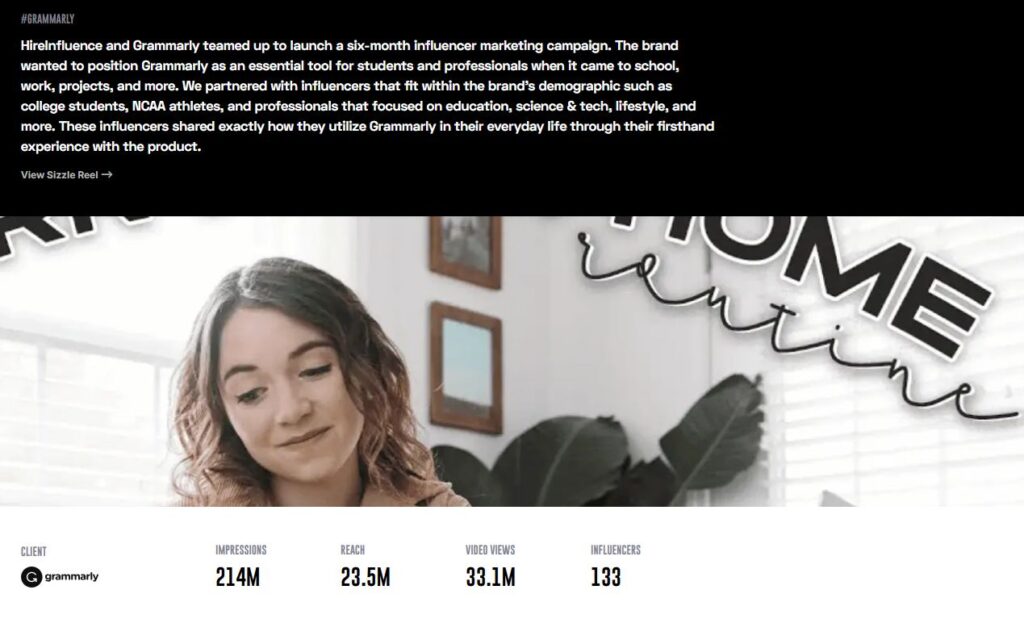
The Grammarly engagement is a strong benchmark for NY-based technology, SaaS, and productivity brands. The program activated 133 creators across YouTube, TikTok, and Instagram, producing 214 million impressions, 33.1 million views, and $15 million in earned media value. A 133-creator program at that scale requires the full talent agency service stack operating in coordination across sourcing, vetting, creative direction, production, contracting, paid amplification, and measurement. The work portfolio documents how the agency scales across talent program complexity.
The imPress Nails campaign at New York Fashion Week illustrates NY-specific enterprise execution with cultural fluency calibrated to an NY-defining moment. The program partnered with luxury fashion creators whose audiences and personal brand positioning matched the imPress brand, launched in direct alignment with one of the most aesthetically rigorous moments in the fashion calendar, and structured content with direct-to-website CTAs that converted NYFW attention into measurable purchase activity. For NY-based fashion, beauty, and luxury brands, the imPress program is the reference point for what NY-calibrated talent agency delivery looks like.
The Ricola #CoatYourThroat program demonstrates how talent programs integrate with commerce attribution. The campaign drove 26 million impressions, 20.5 million reach, a 13.17% engagement rate across 18 influencers spanning micro to celebrity tier, and 62,500 MikMak retail purchase clicks. The Ricola case study documents how the operational layers came together in a single program architecture.
The MTV #MyMTVStyle TikTok campaign delivered 16.1 million impressions at $0.01 CPV and $1.50 CPM with 216,600 engagements. For NY-based media, entertainment, and consumer brands, those efficiency figures are what enterprise finance teams benchmark when comparing talent agency spend against other paid media channels.
How NY Enterprise Brands Should Evaluate an Influencer Talent Agency
Five evaluation questions separate credible attention-era partners from pre-consolidation capability offerings for NY talent agency buyers.
First, ask about nano and micro tier infrastructure specifically. Traackr’s data makes this central. The agency should describe specific sourcing infrastructure, briefing workflows, payment operations, and measurement approaches calibrated to nano and micro tier creators at scale, not just macro and celebrity-focused capability retrofitted for smaller tiers.
Second, ask about platform allocation methodology. TikTok attention up 18%, Instagram down 14%. The agency should describe how platform allocation gets calibrated to current attention dynamics rather than historical platform defaults, with specific examples of platform reallocation decisions in recent programs.
Third, ask about creative validation discipline before paid amplification. Paid amplification works best as an accelerant for proven creative. The agency should describe specific methodology for identifying proven creator content before deploying paid budget, not generic paid amplification capability claims.
Fourth, ask about long-term creator partnership infrastructure. The attention economics reward sustained relationships over one-off campaigns. The agency should describe how ambassador programs, exclusive partnerships, and always-on content programs are structured, managed, and measured.
Fifth, ask about NY cultural fluency with specific examples. NY is a distinct creator ecosystem. The agency should describe specific NY cultural moments it has built programs around, with examples of creator selection and content direction calibrated to those moments.
The NY-Anchored Influencer Talent Agency Model
HireInfluence maintains a New York office alongside offices in Houston and The Woodlands, TX; Austin, TX; and Los Angeles, CA. The agency was founded in 2011 and is recognized as one of the first full-service influencer talent agencies in the United States. Fifteen years of NY operations has built the creator relationships, cultural fluency, and enterprise client depth that distinguish a credible NY talent agency partner from newer entrants.
Engagements typically start at approximately $100,000, aligned with the enterprise delivery standard. The client roster includes Microsoft, Southwest Airlines, Target, Coca-Cola, Walmart, Meta, McDonald’s, Oreo, Grammarly, Ricola, and MTV. Award recognition across 2024 and 2026 includes the MUSE Creative Awards, Netty Awards, NYX Awards, Global Digital Excellence Awards, U.S. Agency Awards, and Vega Digital Awards. The agency is also an exclusive TikTok Shop Lite Program partner since July 2024.
Jason Pampell, Founder and CEO, launched HireInfluence in 2011. Prior to founding the company, he managed content rights and strategic media partnerships for Forbes and Billboard and brings 30+ years of leadership experience in sales, marketing, and team building for Fortune 1000 organizations. His approach to building the agency shaped how enterprise talent engagements are structured today.
For NY enterprise brands ready to evaluate what a full-service talent agency engagement calibrated to current attention dynamics should look like, the HireInfluence team handles initial conversations directly. Brands benchmarking pricing should reference the cost of influencer marketing guide for context on enterprise engagement costs. Those evaluating TikTok-focused strategies should review the TikTok influencer marketing resource, and brands integrating creator content with broader UGC strategy should review the UGC guide.
Traackr’s Creator Advantage data makes the NY talent agency environment clear. Activity volume does not equal outcome, attention is concentrated in specific tiers and platforms, and paid amplification works best as validation acceleration rather than content rescue. The influencer talent agency decision in New York is the decision about which partner has built the capability profile the attention data now requires. The brands winning in the current NY market are working with partners calibrated to current attention economics, not those still operating on capability models from the volume-focused era of the discipline.