
Enterprise marketing teams evaluating a nano-influencer agency in 2026 are operating against a creator economy where engagement quality is being structurally redefined. Buffer’s State of Social Media Engagement in 2026 report, published March 5, 2026, documents the structural shift directly. Buffer analyzed over 52 million posts across 10 platforms to produce primary research on how engagement actually works in 2026. The strongest signal across the entire dataset was simple: creators who reply to comments outperform creators who don’t on every platform Buffer studied. The second clearest signal was posting frequency itself, where the no-post penalty was real and consistent across all platforms. The third was platform fragmentation, with every platform defining engagement differently, measuring it differently, and rewarding different behaviors. For nano creators (typically under 10,000 followers), these dynamics compound into a structural advantage. Nano creators are positioned to reply to every comment, post consistently across the formats their audience expects, and operate as authentic community participants rather than broadcast accounts. The wider industry data reinforces what Buffer’s analysis maps: nano creators on TikTok achieve 10.3% engagement rates versus 1.21% for mega creators, nano creators represent 75.9% of Instagram’s creator base and 87.68% of TikTok’s, 44% of brands now prefer nano creators specifically for authentic niche engagement, and nano-tier engagement rates run 49.7% higher than micro creators across most platforms.
Table of Contents
For enterprise marketing teams, Buffer’s findings establish a specific shift in what a nano-influencer agency has to deliver. The reply-rate-as-engagement-driver finding means nano creators have to be selected for community engagement behavior (not just follower count), and program structure has to support and reward creator-audience interaction rather than treating posts as one-way broadcasts. The post-frequency finding means nano programs operate on consistent activation cycles rather than discrete campaign windows, which requires production infrastructure that supports sustained content cadence. The platform fragmentation finding means nano programs have to be designed with platform-specific engagement mechanics in mind rather than running cross-platform with the same content. This guide breaks down what enterprise brands should expect from a nano-influencer agency in 2026, how Buffer’s engagement data reshapes the capability requirements, and what separates a credible nano-influencer agency from a general-market creator platform.
Why Buffer’s Engagement Data Reshapes the Nano-Influencer Agency Decision
Buffer’s documentation that replies are the strongest engagement driver across every platform changes the structural logic of how enterprise brands approach nano programs. When the engagement that AI recommendation systems and platform algorithms reward most is creator-audience interaction (not just initial post engagement), the creator selection criteria shift toward creators who genuinely engage with their communities. The nano-influencer agency that serves enterprise clients has to evaluate creator behavior beyond surface metrics: reply rates, comment engagement quality, audience response patterns, and the community-participation indicators that signal genuine influence rather than passive audience holding.
For enterprise brands specifically, the post-frequency finding has direct implications for nano program design. Nano creators who post consistently outperform nano creators who post sporadically, and nano programs that activate creators on a sustained cadence outperform nano programs that pulse activate around campaign windows. The agency has to operate program infrastructure that supports nano creator activation across weeks or months rather than days, which requires sustained creator-relationship management, content review at sustained cadence, and attribution infrastructure that captures impact across extended engagement windows.
Buffer’s platform fragmentation finding reinforces why nano programs have to be platform-specific in design. TikTok engagement, Instagram engagement, YouTube Shorts engagement, and emerging platform engagement each operate on distinct algorithmic logic, audience behavior, and creator activation patterns. The nano-influencer agency has to demonstrate platform-specific nano expertise rather than running undifferentiated cross-platform programs.
The volume question is particularly consequential at the nano tier. Industry data establishes that nano creators represent 75.9% of Instagram’s creator base and 87.68% of TikTok’s, which means nano programs typically activate 50-300 creators concurrently to produce meaningful brand impact. Managing 50-300 nano creators concurrently with the operational discipline that produces consistent program quality requires infrastructure that traditional agencies (built for high-touch macro relationships) struggle to maintain. The nano-influencer agency has to demonstrate sourcing velocity, briefing consistency, contracting throughput, payment operations, and content review workflows calibrated to nano-volume execution.
The cost economics also distinguish nano programs from other tiers. Nano creators charge $25 to $1,000 per Instagram post, with many engagements operating on gifted product compensation or hybrid base-plus-affiliate structures. Industry data finds that gifted partnerships deliver 12.9% higher engagement than paid collaborations and 2.19% engagement rates compared to 1.94% for paid arrangements, which establishes gifted-plus-affiliate as the highest-ROI nano program structure. The agency has to demonstrate gifted program operations, affiliate infrastructure, and hybrid compensation expertise rather than defaulting to paid post structures designed for macro programs.
What Enterprise Brands Should Expect From a Nano-Influencer Agency
A credible nano-influencer agency operates across eight coordinated service functions calibrated to nano-tier execution dynamics.
Nano program strategy and engagement-quality measurement design. The engagement begins with business objectives tied to outcomes that suit nano execution (audience trust building, niche category penetration, hyper-targeted activation, UGC volume production at engagement quality) and measurement frameworks calibrated to those objectives. HireInfluence structures nano-influencer strategy through dedicated campaign services built for enterprise programs.
Nano creator sourcing at hyper-volume. Buffer’s reply-rate finding makes sourcing rigor central. The agency has to operate sourcing infrastructure that identifies, vets, and qualifies 50-300 nano creators per program with audience authenticity validation, reply-rate analysis, community engagement quality assessment, and category-fit evaluation beyond surface demographic matching.
Sustained activation cadence support. Buffer’s post-frequency finding makes sustained cadence consequential. The agency has to operate program infrastructure that supports nano creator activation across weeks or months with consistent briefing, content review, and creator relationship management.
Platform-specific program design. Buffer’s platform fragmentation finding requires platform-native nano expertise. The agency has to demonstrate program design specificity for TikTok nano dynamics, Instagram nano dynamics, YouTube Shorts nano dynamics, and emerging platform nano activation.
Gifted program operations and hybrid compensation infrastructure. Nano programs operate frequently on gifted product, gifted-plus-affiliate, or hybrid compensation structures. The agency has to operate gifted program logistics (product fulfillment, sample management, gifting workflow) alongside affiliate infrastructure (tracking, attribution, commission payment) and hybrid compensation operations.
Volume contracting and payment operations. Nano programs activate dozens to hundreds of creators with payment workflows that combine base fees, gifted product, affiliate commissions, and performance bonuses. The agency has to operate contracting and payment infrastructure that supports nano-volume execution without administrative overhead consuming program ROI.
Content review at nano program scale. Nano programs produce hundreds of content pieces requiring brand review, regulatory compliance screening, and approval. HireInfluence delivers paid amplification through its specialties and services capability, including whitelisting, dark posting, and cross-platform amplification that extends nano content value beyond organic reach.
Performance attribution at nano program complexity. Nano programs require attribution infrastructure that tracks performance across dozens to hundreds of creators, platforms, and content variations. HireInfluence’s analytics capability is designed to deliver nano program-specific attribution depth.
Nano Program Delivery
Enterprise brands evaluating a nano-influencer agency should look at programs that demonstrate nano-tier execution depth.
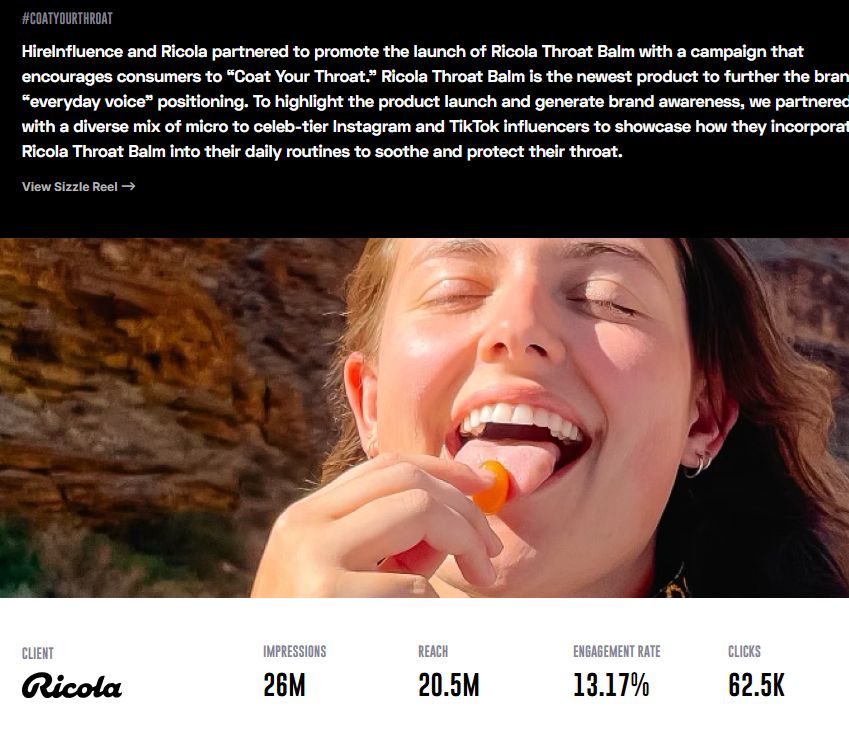
The Ricola #CoatYourThroat program activated creators across the full tier spectrum from micro through celebrity, with nano-tier creators contributing meaningfully to the 13.17% engagement rate the program produced. The 18-creator program structure, paired with sustained content cadence and platform-specific production direction, illustrates how nano creators operate as the engagement-quality layer within tiered enterprise programs. The 62,500 MikMak retail purchase clicks document how nano-driven engagement converts to commerce attribution. The Ricola case study documents the full program architecture.
The Grammarly engagement demonstrates multi-platform nano-inclusive program scale. The program activated 133 creators across YouTube, TikTok, and Instagram, producing 214 million impressions, 33.1 million views, and $15 million in earned media value. Running 133 creators across three platforms simultaneously with attention to platform-specific nano dynamics requires the operational infrastructure Buffer’s data identifies as the differentiating capability. The work portfolio documents how the agency scales across program complexity.
The MTV #MyMTVStyle TikTok program offers cost-efficiency context relevant to nano economics. The program generated 16.1 million impressions at $0.01 CPV and $1.50 CPM with 216,600 engagements on TikTok. Those efficiency figures establish what nano-inclusive programs produce when creator selection, platform-native production direction, and amplification align.
How Enterprise Brands Should Evaluate a Nano-Influencer Agency
Five evaluation questions separate credible nano-influencer agencies from general-market creator platforms.
First, ask about nano sourcing methodology and reply-rate validation. Buffer’s data makes reply-rate analysis consequential for nano selection. The agency should describe how creator behavior is evaluated beyond surface metrics with specific examples of nano creator selection that demonstrated genuine community engagement rather than passive audience holding.
Second, ask about volume sourcing at nano scale. The agency should describe sourcing infrastructure for identifying, vetting, and qualifying 50-300 nano creators per program with audience authenticity validation, engagement quality assessment, and category-fit evaluation.
Third, ask about gifted program operations and hybrid compensation infrastructure. The agency should describe gifted program logistics, affiliate tracking, hybrid compensation operations, and payment infrastructure that supports nano economics with specific examples of nano programs structured around gifted-plus-affiliate or hybrid compensation models.
Fourth, ask about platform-specific nano expertise. Buffer’s fragmentation finding makes platform-specific design consequential. The agency should describe nano program design for TikTok, Instagram, YouTube Shorts, and emerging platforms with specific examples of platform-native nano execution.
Fifth, ask about attribution infrastructure at nano program complexity. The agency should describe attribution capability for tracking performance across dozens to hundreds of creators, platforms, and content variations with specific examples of nano programs that demonstrated measurable conversion impact.
The Nano-Influencer Agency Model
HireInfluence runs enterprise nano-influencer programs across consumer categories. The agency was founded in 2011 and maintains offices in Houston and The Woodlands, TX; Austin, TX; Los Angeles, CA; and New York, NY. That national footprint, combined with creator program depth built across more than a decade, positions the agency to deliver nano programs calibrated to the engagement dynamics Buffer documented. The about section documents how the company operates.
Engagements typically start at approximately $100,000, aligned with the enterprise delivery standard. Confirmed clients include Microsoft, Southwest Airlines, Target, Coca-Cola, Walmart, Meta, McDonald’s, Oreo, Grammarly, Ricola, and MTV. Award recognition across 2024 and 2026 includes the MUSE Creative Awards, Netty Awards, NYX Awards, Global Digital Excellence Awards, U.S. Agency Awards (Digital Marketing Agency of the Year), and Vega Digital Awards. The agency is also an exclusive TikTok Shop Lite Program partner since July 2024, providing direct access to TikTok’s commerce infrastructure for nano programs connecting content to measurable conversion outcomes.
Jason Pampell, Founder and CEO, launched HireInfluence in 2011. Prior to founding the company, he managed content rights and strategic media partnerships for Forbes and Billboard. His 30+ years of leadership experience in sales, marketing, and team building for Fortune 1000 organizations shaped how the agency structures nano-influencer engagements today.
For enterprise brands ready to evaluate what a nano-influencer engagement calibrated to current engagement dynamics should include, the HireInfluence team handles initial conversations directly through the contact page. Brands benchmarking pricing should reference the cost of influencer marketing guide for context on enterprise engagement costs. Those evaluating TikTok-focused strategies should review the TikTok influencer marketing resource, and brands wanting context on UGC strategy fundamentals should review the UGC overview.
Buffer’s 52M+ post analysis makes the operating environment direct. Replies are the strongest engagement driver across every platform, posting frequency dominates timing optimization, platform fragmentation rewards platform-specific design, and nano creators are structurally positioned to deliver on each of these dynamics. The nano-influencer agency decision for enterprise brands is the decision about which partner has built the capability profile the nano tier now requires. The brands winning in 2026 are working with partners calibrated to volume sourcing, reply-rate validation, sustained activation cadence, gifted program operations, platform-specific design, and attribution at nano program complexity, not those still operating on curated activation models from an earlier moment in the discipline.