CPG marketing teams evaluating a content creator agency in 2026 are operating against a consumer environment where community engagement, wellness focus, hyper-personalization, private label competition, and shoppable formats are all reshaping how creator programs need to deliver impact. Circana’s “Consumer Marketing Trends That Will Drive Growth in 2026” report, published January 27, 2026, documents the structural reality directly. The consumer landscape continues to shift as marketers face a complex environment shaped by lingering economic pressures, rapidly evolving technologies, and consumer interest in genuine connection. Circana identifies five trends driving CPG growth in 2026: community engagement (consumers increasingly value community, ranging from supporting local businesses to investing in social and sustainability initiatives, and brands can embrace this by aligning with community-driven values), wellness focus (wellness continues as a dominant trend influencing not just food and beverage but also other categories, including products for health-conscious consumers), hyper-personalization (tailored retail experiences and personalized products are expected to grow, generally well-received when they resonate with consumer needs), private label growth (financial pressures are driving consumers toward private labels, especially in club stores and value chains), and shoppable formats and frictionless shopping (while AR/VR may not see significant adoption in 2026, retailers are focusing on analytics to create frictionless shopping experiences). Circana’s recommendations for brands center on cross-category trend analysis (looking beyond their own categories to identify emerging trends), retailer analytics collaboration (working with retailers to use shopper data), and emerging technology adoption (anticipating shoppable videos and interactive demos).
Table of Contents
For CPG marketing teams, Circana’s findings establish a specific shift in what a content creator agency for CPG has to deliver. The community engagement trend means creator programs have to be calibrated to community-driven values and authentic creator-audience relationships rather than transactional product placement. The wellness focus means creator programs in food and beverage, personal care, household, and adjacent categories have to integrate health and wellness positioning calibrated to consumer demand. The hyper-personalization trend means creator content has to feel personally relevant rather than generic mass-market messaging. The private label growth trend reinforces that established CPG brands have to defend share through creator content that builds emotional connection beyond price-based competition. The shoppable formats finding means creator programs have to integrate with retail commerce infrastructure through TikTok Shop, Amazon Live, retailer-specific affiliate programs, and direct-to-purchase content formats. This guide breaks down what CPG brands should expect from a content creator agency in 2026, how Circana’s consumer trends reshape the capability requirements, and what separates a credible CPG content creator agency from a general influencer marketplace.
Why Circana’s CPG Trends Reshape the Content Creator Agency Decision
Circana’s documentation that community engagement is a primary 2026 CPG growth driver changes the structural logic of how CPG brands approach creator marketing. When consumers prioritize community-driven values, brand-driven creator activations underperform creator activations that genuinely participate in community conversations. The content creator agency for CPG has to demonstrate sourcing methodology that identifies creators with authentic community standing rather than creators with high follower counts but limited community credibility.
For CPG brands specifically, Circana’s wellness focus trend has direct implications for creator program design. Creator programs in food and beverage, personal care, household, supplements, and adjacent categories have to integrate health and wellness positioning calibrated to specific consumer wellness priorities (clean ingredients, sustainability, functional benefits, mental wellness, fitness integration). The agency has to demonstrate creator selection rigor that identifies creators with genuine wellness category credibility rather than generic lifestyle creators bolted onto wellness positioning.
The hyper-personalization trend reinforces why CPG creator programs have to operate at audience segmentation depth that goes beyond demographic matching. Programs targeting Gen Z urban consumers, millennial parents, Gen X health-focused households, and Boomer convenience-driven shoppers all require distinct creator selection, content positioning, and platform strategy. The agency has to demonstrate audience intelligence and creator orchestration that delivers personalized creator content across consumer segments rather than running undifferentiated creator activations.
Circana’s private label growth finding reinforces why CPG brand creator programs have to build emotional connection beyond price-based competition. Private label brands now capture meaningful share in categories where established CPG brands previously dominated, which means creator programs for established CPG brands have to demonstrate brand value, ingredient quality, heritage, and emotional connection that justifies the price premium consumers pay over private label alternatives. The agency has to demonstrate creative direction calibrated to value justification rather than generic awareness.
Circana’s shoppable formats finding makes creator program integration with retail commerce infrastructure consequential. Creator content that connects to TikTok Shop checkout, Amazon Live commerce, retailer-specific affiliate programs, and direct-to-purchase content drives measurable conversion attribution that pure awareness creator programs cannot match. The agency has to demonstrate retail commerce integration capability across the platforms and retailers where CPG conversion actually happens.
The recommendation toward cross-category trend analysis reinforces why CPG creator programs benefit from agencies with multi-category execution depth. Trends emerging in adjacent categories (fitness, beauty, home, technology) frequently translate to CPG opportunities before they appear in CPG-specific data. The agency has to demonstrate cross-category creator program execution that identifies and applies emerging trend signals across categories.
What CPG Brands Should Expect From a Content Creator Agency
A credible content creator agency for CPG operates across eight coordinated service functions calibrated to current CPG creator program dynamics.
CPG creator program strategy and trend-aligned design. The engagement begins with business objectives tied to CPG-specific outcomes (category share defense, new product launch, retailer partnership integration, occasion-based marketing) calibrated to Circana’s 2026 trends. HireInfluence structures CPG creator strategy through dedicated campaign services built for enterprise programs.
CPG creator sourcing calibrated to community credibility and wellness alignment. Circana’s community and wellness trends make sourcing rigor central. The agency has to operate sourcing methodology that identifies creators with authentic CPG category credibility, community standing, and wellness positioning where applicable.
Multi-segment audience targeting infrastructure. Circana’s hyper-personalization trend makes audience segmentation consequential. The agency has to demonstrate creator orchestration across consumer segments (Gen Z, millennial, Gen X, Boomer, by region, by occasion) with personalized creator content rather than undifferentiated creator activations.
Retail commerce integration across CPG distribution channels. Circana’s shoppable formats finding makes commerce integration consequential. The agency has to operate program infrastructure that integrates creator content with TikTok Shop, Amazon Live, Walmart Marketplace, Target affiliate programs, and grocery retailer-specific affiliate programs across the CPG distribution channel mix.
Creative direction calibrated to value justification and emotional connection. Circana’s private label growth finding makes creative direction consequential. The agency has to operate creative direction methodology that builds emotional brand connection, ingredient quality positioning, heritage narrative, and value justification rather than generic awareness messaging.
Production direction across CPG content formats. CPG creator programs span recipe content, taste-test content, occasion-based content, ingredient education, sustainability storytelling, and category-specific demonstrations. The agency has to operate production direction across CPG content formats with platform-specific optimization.
Paid amplification with CPG creator content integration. CPG creator content delivers maximum value when paired with disciplined paid amplification across the CPG marketing stack. HireInfluence delivers paid amplification through its specialties and services capability, including whitelisting, dark posting, and retail media integration.
CPG creator program attribution at retail commerce integration. CPG creator programs require attribution infrastructure that captures brand lift, awareness impact, retail conversion attribution, and category share impact. HireInfluence’s analytics capability is designed to deliver CPG-specific attribution depth.
CPG Creator Program Delivery
CPG brands evaluating a content creator agency should look at programs that demonstrate CPG creator execution depth at the integration standard Circana’s data establishes as differentiating.
The Ricola #CoatYourThroat program demonstrates CPG creator execution at quality. Ricola operates in the cough and throat care category where consumer trust, ingredient quality positioning, and wellness integration matter. The campaign activated 18 creators spanning micro to celebrity tier and delivered 26 million impressions, 20.5 million reach, a 13.17% engagement rate, and 62,500 MikMak retail purchase clicks. The retail purchase click attribution demonstrates the retail commerce integration Circana identifies as central to 2026 CPG creator programs. The Ricola case study documents the full program architecture.
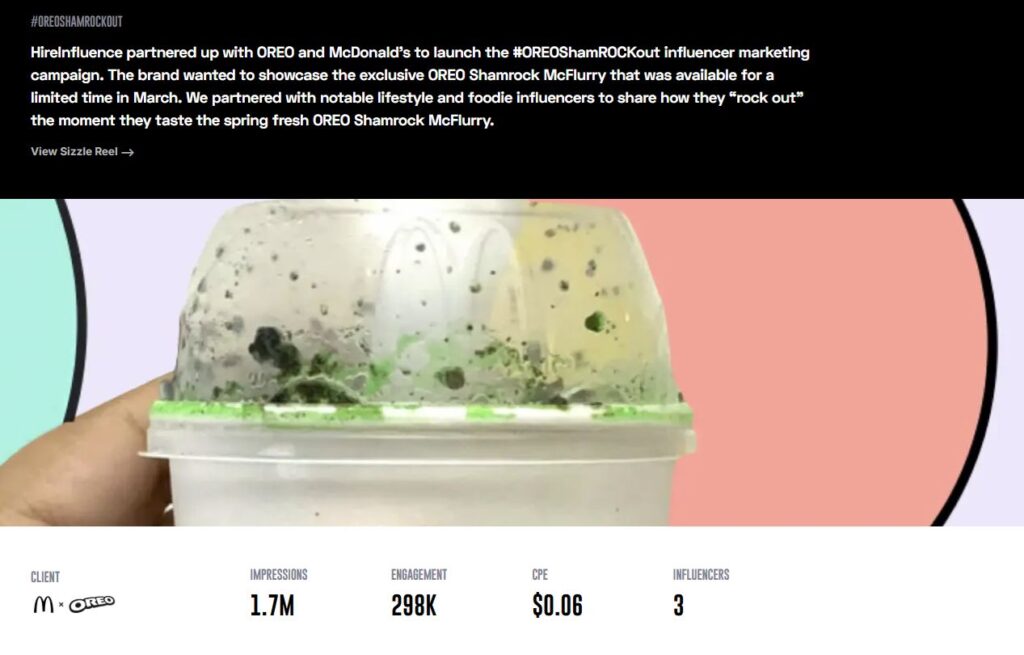
The Oreo and McDonald’s #OREOShamROCKout campaign demonstrates CPG creator program cost efficiency at the level enterprise CPG finance teams use to compare creator spend against alternative paid media investments. The campaign delivered 1.7 million impressions at $0.06 CPE, establishing the efficiency benchmark for enterprise CPG creator programs.
The Grammarly engagement demonstrates multi-platform creator program scale relevant to CPG (Grammarly operates as a digital CPG-adjacent product with similar consumer behavior dynamics). The program activated 133 creators across YouTube, TikTok, and Instagram, producing 214 million impressions, 33.1 million views, and $15 million in earned media value. HireInfluence also documents direct CPG capability through the influencer marketing agency for food and beverage brands resource, which covers food-and-beverage-specific creator program dynamics.
How CPG Brands Should Evaluate a Content Creator Agency
Five evaluation questions separate credible CPG content creator agencies from general influencer marketplaces.
First, ask about CPG category creator sourcing methodology. Circana’s community and wellness trends make this consequential. The agency should describe how creators are evaluated for CPG category credibility, community standing, and wellness positioning beyond surface follower count metrics.
Second, ask about retail commerce integration capability. Circana’s shoppable formats finding makes this differentiating. The agency should describe program infrastructure integrating creator content with TikTok Shop, Amazon Live, Walmart Marketplace, Target affiliate programs, and grocery retailer affiliate programs.
Third, ask about creative direction methodology calibrated to value justification. Circana’s private label growth finding makes this consequential. The agency should describe creative direction methodology with specific examples of CPG creator programs that built emotional brand connection beyond price-based competition.
Fourth, ask about multi-segment audience targeting infrastructure. The agency should describe creator orchestration across consumer segments with personalized creator content and specific examples of segment-specific CPG creator program execution.
Fifth, ask about attribution infrastructure at retail commerce integration. The agency should describe attribution capability for capturing retail conversion attribution, category share impact, and brand lift with specific examples of CPG programs that demonstrated measurable business outcomes.
The CPG Content Creator Agency Model
HireInfluence runs enterprise CPG creator programs across food and beverage, personal care, household, and adjacent CPG categories. The agency was founded in 2011 and maintains offices in Houston and The Woodlands, TX; Austin, TX; Los Angeles, CA; and New York, NY. That national footprint, combined with CPG creator program depth built across more than a decade, positions the agency to deliver programs calibrated to the consumer trends Circana documents. The about section documents how the company operates.
Engagements typically start at approximately $100,000, aligned with the enterprise delivery standard. Confirmed clients include Microsoft, Southwest Airlines, Target, Coca-Cola, Walmart, Meta, McDonald’s, Oreo, Grammarly, Ricola, and MTV. Award recognition across 2024 and 2026 includes the MUSE Creative Awards, Netty Awards, NYX Awards, Global Digital Excellence Awards, U.S. Agency Awards (Digital Marketing Agency of the Year), and Vega Digital Awards. The agency is also an exclusive TikTok Shop Lite Program partner since July 2024, providing direct access to TikTok’s commerce infrastructure for CPG creator programs connecting content to measurable conversion outcomes.
Jason Pampell, Founder and CEO, launched HireInfluence in 2011. Prior to founding the company, he managed content rights and strategic media partnerships for Forbes and Billboard. His 30+ years of leadership experience in sales, marketing, and team building for Fortune 1000 organizations shaped how the agency structures CPG creator engagements today.
For CPG brands ready to evaluate what a creator engagement calibrated to current consumer trends should include, the HireInfluence team handles initial conversations directly through the contact page. Brands benchmarking pricing should reference the cost of influencer marketing guide for context on enterprise engagement costs. Those evaluating TikTok-focused strategies should review the TikTok influencer marketing resource, and brands wanting context on UGC strategy fundamentals should review the UGC overview. The work portfolio documents CPG creator program execution.
Circana’s 2026 consumer trends data makes the operating environment direct. Community engagement, wellness focus, hyper-personalization, private label growth, and shoppable formats are reshaping how CPG creator programs need to deliver impact. The content creator agency for CPG decision is the decision about which partner has built the capability profile current CPG creator program execution requires. The brands winning in 2026 are working with partners calibrated to community-credible creator sourcing, wellness positioning integration, multi-segment audience targeting, retail commerce integration, value justification creative direction, and attribution at retail conversion depth, not those still operating on generic awareness models from an earlier moment in the discipline.