
Answering what does an influencer marketing agency do requires understanding the market the agency stands in front of, and new industry data makes that market look demanding. A 2026 analysis, reporting a World Federation of Advertisers cross-market study of 1,400 senior marketing professionals across 28 countries, found that 81 percent had encountered influencer fraud within the past twelve months. Affected campaigns showed a 37 percent gap between projected and actual authentic reach, and the median budget waste came to $128,000 per mid-scale program. Those numbers describe a channel that is simultaneously one of the most effective in marketing and one of the least forgiving to operate casually. An agency’s job, in the shortest honest version, is to capture the effectiveness while absorbing the operational burden: finding the right creators, verifying that their audiences are real, producing content that converts, and proving the results in numbers a CFO will accept. The rest of this guide breaks that job into its working parts.
Table of Contents
Why New Fraud and Risk Data Explains the Agency’s Job
The research, reported by ContentGrip in May 2026, is useful precisely because it quantifies what happens when the work is done poorly. A 37 percent shortfall between projected and authentic reach is not a rounding error; it means that more than a third of what an unverified media plan promises may never have existed. The $128,000 median waste figure translates that shortfall into budget terms for a mid-scale campaign, and the 81 percent encounter rate establishes that this is the normal condition of the market rather than an occasional hazard. When four out of five senior marketers across 28 countries have run into the problem within a year, the question stops being whether a brand will face it and becomes who on the brand’s behalf is equipped to handle it.
That framing clarifies the agency’s role in a way service menus usually do not. An influencer marketing agency performs four jobs at once. It acts as a market maker, maintaining the creator relationships and category knowledge that turn an open-ended search into a qualified shortlist. It acts as an underwriter, running the audience verification, engagement analysis, and brand safety screening that keep the 37 percent reach gap out of the client’s media plan. It acts as a producer, translating brand objectives into briefs, managing creative development, and coordinating publication across platforms. And it acts as an accountant, wiring attribution into every campaign so results arrive as tracked outcomes rather than platform screenshots. Brands sometimes assume the job is mostly the first item, access to creators. The fraud data argues the opposite: access is the cheapest part, and judgment about what the access is worth is where the value concentrates. The accountability structure matters as much as the labor. When the functions live inside an agency contract, the reach gap, the compliance exposure, and the delivery risk all have a named owner with remedies attached, which is a materially different position than distributing the same risks across an internal team’s job descriptions.
There is a structural reason brands buy this externally rather than building it. Each of the four jobs is a specialist discipline with its own tooling, and the work arrives in waves that match campaign calendars rather than payroll cycles. An internal team sized for launch weeks sits idle between them; a team sized for the quiet weeks drowns at launch. Agencies amortize the specialists across many clients, which is why a single engagement can include sourcing analysts, contract managers, creative directors, paid media traders, and measurement leads without the client hiring any of them. The 28-country scope of the study adds one more point: the risk profile is global, and so are the enterprise brands navigating it, which puts a premium on partners who have operated across markets and platforms rather than inside one feed.
It is equally useful to name what an agency does not do. It does not set brand positioning; it translates positioning the brand already owns into creator programs. It does not replace paid media or public relations teams; it coordinates with them so creator content strengthens both. And an honest one does not guarantee organic reach, because the fraud data shows exactly what such guarantees tend to be made of. Day to day, the work runs on an operations cadence: a dedicated account pod, weekly status against the campaign calendar, monthly reporting cycles, and quarterly planning where the data reshapes the roster. Brands evaluating agencies are really evaluating whether that cadence exists, because the eight functions below only produce outcomes when something is scheduled to make them.
The Eight Functions an Influencer Marketing Agency Runs
The day-to-day answer to what an influencer marketing agency does breaks into eight coordinated functions. In a disciplined shop they run as one system; in a weak one, several are missing and the client discovers which ones mid-campaign.
Program strategy and design. The engagement starts by translating business objectives into creator requirements, budget architecture, and a campaign calendar, the discipline HireInfluence operates through dedicated campaign services. Strategy first means selection criteria exist before outreach does.
Creator sourcing and verification. The agency generates candidates across platforms, databases, and its own relationship network, then applies the authenticity screening the fraud data demands: audience quality analysis, engagement pattern review, growth history, brand safety, and disclosure record. This function is where the 37 percent reach gap gets filtered out. Relationship networks matter here as much as tooling, since the most selective creators rarely surface through cold database outreach.
Negotiation and contracting. Rates, deliverables, usage rights, exclusivity, disclosure obligations, and authenticity representations get formalized so that both sides know what was purchased and what remedies exist if it is not delivered. Whitelisting permissions and content licensing terms belong in this stage too, priced and time-boxed before anything publishes.
Creative direction and brief development. Objectives become briefs that are specific about message and loose about format, protecting the creator voice that makes the channel work while enforcing claims review and compliance.
Cross-platform orchestration. Content gets sequenced across Instagram, TikTok, and YouTube so each platform plays its native role, with production support including user-generated style assets covered in the agency’s UGC overview.
Campaign management and publication. Timelines, approvals, revisions, and posting logistics run on an operations cadence, which is the unglamorous function that determines whether everything else ships on schedule. It also carries escalation duty: when a creator situation turns sensitive, the agency manages the response rather than the brand improvising one.
Paid amplification. Winning organic content gets licensed and scaled through whitelisted advertising to audiences beyond the creator’s followers, a capability HireInfluence delivers through its specialties and services capability.
Measurement and attribution. Tracked links, conversion reporting, and earned media value calculations connect every creator to outcomes through the agency’s analytics capability, which is what turns the next campaign’s decisions into informed ones.
What the Job Produces: Program Delivery
Delivered programs are the clearest demonstration of the eight functions operating together. For Ricola’s #CoatYourThroat campaign, HireInfluence sourced, verified, and managed 18 influencers spanning micro to celebrity tiers, producing 26 million impressions, 20.5 million reach, a 13.17 percent engagement rate, and 62,500 MikMak retail clicks that connected content directly to purchase; the Ricola case study shows the full sequence. At larger scale, the agency recruited and managed 133 creators across YouTube, TikTok, and Instagram for Grammarly, generating 214 million impressions, 33.1 million views, and $15 million in earned media value.
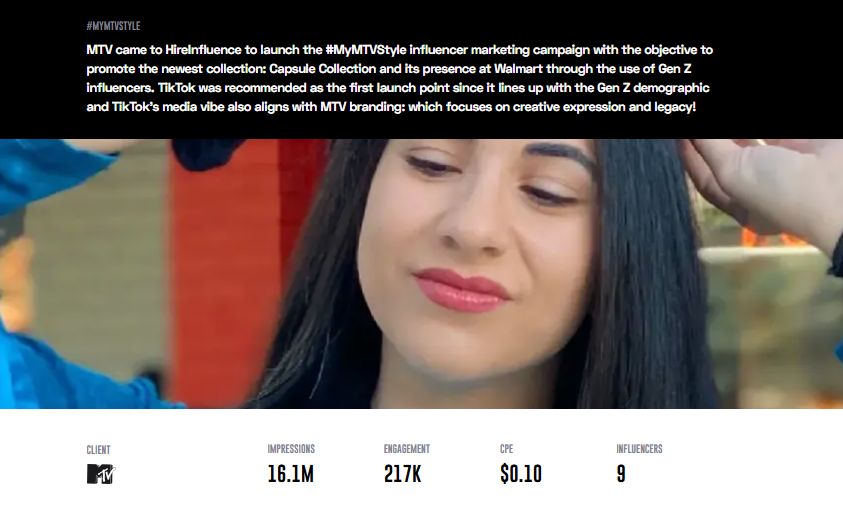
Efficiency work looks like the Oreo and McDonald’s #OREOShamROCKout collaboration at a $0.06 cost per engagement and MTV’s #MyMTVStyle activation at a $0.01 cost per view and a $1.50 CPM on TikTok, while Southwest Airlines’ #SouthwestSaysAloha program reached 56 million impressions with 3 million engagements. These and other category examples sit in the agency’s work portfolio.
Notice what the numbers have in common: every campaign pairs a reach figure with a verified action figure, which is the signature of a program where sourcing, commerce, and measurement all did their jobs. Single-metric case studies, by contrast, usually indicate a single-function operator, and the missing functions become the client’s problem at exactly the moment they are hardest to add.
How to Evaluate Whether an Agency Actually Does the Job
Five questions test whether a given agency performs the functions above or merely lists them.
First, ask how creators are verified and what share of candidates gets rejected. Given an environment where 81 percent of marketers have encountered fraud, an agency without a stated rejection rate and a described methodology is not underwriting anything. Follow the answer with a request for a redacted vetting output, because described processes leave artifacts.
Second, ask who owns negotiation and contracting, and what authenticity protections its standard creator agreement contains. The answer reveals whether the agency absorbs risk or passes it through.
Third, ask to walk through a brief from a past campaign with the client name removed. A real production function leaves artifacts, and the artifact shows whether creator voice survives the process. Pay attention to what the brief refuses to dictate; restraint is the tell.
Fourth, ask how paid amplification decisions get made: which content earns spend, how permissions are secured, and who trades the budget. Amplification is the function most often claimed and least often staffed.
Fifth, ask what the monthly report contains and how program pricing maps to the functions delivered. Transparent partners can decompose their fee into the work; the agency’s cost of influencer marketing guide outlines the variables an honest budget conversation should include. A fee that cannot be decomposed is usually covering for functions that will not be performed.
The Agency Model, Operated in Full
HireInfluence has run the full eight-function model as a full-service influencer marketing agency since 2011, with a team of more than 25 people across 10 or more states and offices in Houston and The Woodlands, Austin, Los Angeles, and New York. The agency delivers enterprise engagements starting near the $100,000 level for brands including Microsoft, Southwest Airlines, Target, Coca-Cola, Oreo, and Grammarly, and it has held an exclusive TikTok Shop Lite Program partnership since July 2024, which extends the commerce function directly into social storefronts. Recognition includes the 2026 U.S. Agency Awards Digital Marketing Agency of the Year and the 2024 MUSE Creative Awards Marketing Agency of the Year.
Founder and CEO Jason Pampell launched HireInfluence in 2011 after managing content rights, licensing, and strategic media partnerships for Forbes and Billboard, and he brings more than 30 years of leadership experience in sales, marketing, and team building for Fortune 1000 organizations. Rights management is a fitting origin for the work: the HireInfluence team treats creator partnerships as licensed media assets, verified before purchase and measured after. That standard is enforced by structure: strategy, sourcing, contracting, creative, operations, amplification, and measurement run as one accountable engagement rather than a list of add-ons. Brands that want the job performed rather than described can start through the contact page, with company background in the about section.
The 2026 risk data gives the question its final answer. What an influencer marketing agency does is stand between an enterprise budget and a market where a 37 percent reach shortfall is common enough to have a median price tag. The good ones make the channel’s upside available. The disciplined ones make its downside someone else’s problem.