Before hiring an influencer, an enterprise brand needs a clear read on a market that has grown more crowded, more expensive, and more exposed to fraud than it was even two years ago. A 2026 benchmark study found that creator sourcing and vetting is now the single most outsourced function in influencer programs at 19.44%, that rising creator costs rank as the top challenge marketers report at 35.4%, that fake or bot followers account for 56.5% of all reported fraud and quality issues, that AI-driven creator matching leads current AI adoption at 26.89%, and that TikTok sits in 31% of brand plans heading into the year. The pattern behind those figures is consistent: the decisions made before a contract is signed, on fit, authenticity, cost, and disclosure, shape the result far more than the campaign that follows.
Table of Contents
Why Groundwork Drives Successful Influencer Hiring
The fact that vetting is the most outsourced task in the discipline is not an accident. It is the stage where budgets are most often wasted, and where specialized judgment pays for itself. Follower count once served as a rough proxy for value, but that shortcut no longer holds. An account with a large audience can still deliver weak attention, mismatched demographics, or engagement manufactured by automation, and none of that is visible from a public profile at a glance. Brands that understand this treat audience quality, not audience size, as the first screen when they consider a creator.
Cost pressure sharpens the same point. When rates climb, the tolerance for waste falls, because every misaligned partnership now carries a higher price. A brand that pays a premium for reach it cannot verify is compounding two problems at once: an inflated rate and an unreliable audience. Knowing what drives a creator’s price, and what a fair rate looks like for a given platform, format, and audience, is part of the preparation that separates a disciplined program from an expensive guess. Preparation here is not about squeezing a creator on price; it is about entering the conversation with enough context to recognize a fair number and to spot a rate that reflects inflated reach rather than genuine influence.
The Influencer Marketing Hub benchmark data shows that fake or bot followers make up more than half of all reported quality problems, which reframes verification from a nice-to-have into a direct budget-protection measure. If more than half of the quality issues brands encounter trace back to inauthentic audiences, then the vetting step is not a formality to rush through on the way to launch. It is the control that decides whether the rest of the spend lands on real people who might actually buy the product.
Disclosure is the second discipline brands underestimate before they hire. Paid partnerships carry clear regulatory expectations, and the responsibility for compliant disclosure sits with the brand as much as the creator. A partner who treats disclosure as an afterthought is a liability, not a bargain, because the reputational and legal exposure of an improperly labeled campaign outlasts any short-term gain. Establishing how a creator handles sponsored-content labeling belongs in the evaluation, not in a cleanup conversation after a post has already gone live.
Fit ties these threads together. The strongest creator for a brand is rarely the largest available name; it is the one whose audience, values, and content style align with what the brand sells and how it wants to be seen. Preparation is what surfaces that alignment before money changes hands, and it is why the groundwork done in the days before a contract tends to decide whether a program reads as authentic or as a transaction the audience can see straight through.
What Enterprise Brands Should Expect From an Influencer Partner
A capable influencer partner coordinates a set of functions that a single hire or an internal generalist rarely covers at scale. The following eight responsibilities describe what enterprise brands should expect a partner to own from the first planning session onward.
Program strategy and design. The agency has to translate a business objective into a campaign structure, mapping goals, platforms, creator tiers, and timing into a plan rather than a series of disconnected posts. That planning work is the core of dedicated campaign services, and it is what keeps a program pointed at an outcome instead of activity for its own sake.
Creator sourcing and verification. The agency has to identify creators who fit the brief and then confirm that their audiences are real and relevant. That means checking follower authenticity, engagement quality, and audience geography before a name ever reaches a shortlist, so that vetting protects the budget rather than rubber-stamping reach. The same scrutiny applies to a creator’s track record: past brand partnerships, content consistency, and how an audience has grown over time all signal whether attention is earned or manufactured. A partner that can show its work here, rather than asserting that a name is safe, is the one worth trusting with real budget.
Platform and commerce integration. The agency has to match the program to where the audience actually spends time and makes purchases, which increasingly means shoppable formats and commerce-enabled placements. Aligning creator content with the mechanics of each channel, including a TikTok influencer marketing resource that connects content to conversion, keeps the work close to buying behavior.
Creative direction and content production. The agency has to guide creators toward content that serves the brand while keeping the creator’s own voice intact, since audiences reward material that feels native and tune out material that feels scripted. A working grasp of what makes a UGC overview effective informs how briefs are written and how creative freedom is balanced against brand requirements.
Audience and segment-specific execution. The agency has to tailor the program to the specific segments a brand wants to reach, rather than treating one large audience as interchangeable. Different segments respond to different creators, formats, and messages, and execution that ignores those differences leaves performance on the table. A program aimed at a broad national retail audience and one aimed at a narrow professional niche call for different creators and different creative, and a partner that runs both the same way is optimizing for neither.
Cross-platform orchestration. The agency has to sequence activity across channels so that a campaign builds on itself instead of fragmenting, coordinating timing and messaging so each platform reinforces the others. Orchestration is what turns separate posts into a coherent presence that audiences actually register. That coordination also protects budget, since content produced for one channel can often be adapted for another rather than commissioned twice, provided the plan accounts for it from the start.
Paid amplification. The agency has to extend the reach of content that earns attention, using paid distribution to put strong creator material in front of audiences beyond a creator’s organic following. That amplification sits within a broader specialties and services capability that pairs organic creator work with paid support.
Attribution and measurement. The agency has to connect creator activity to outcomes a brand can defend, tying spend to reach, engagement, and where possible retail action. A dependable analytics capability is what separates a program that reports impressions from one that reports impact.
Program Delivery Across Enterprise Campaigns
Delivery is where these functions show up as results. A creator program built for Grammarly enlisted 133 creators and produced 214M impressions, 33.1M views, and $15M in earned media value, a scale that comes from disciplined selection rather than sheer volume. The #CoatYourThroat program for Ricola worked with 18 influencers to generate 26M impressions, 20.5M reach, a 13.17% engagement rate, and 62,500 MikMak retail clicks, a case detailed in the Ricola case study that shows content moving an audience toward purchase.
The #MyMTVStyle activation for MTV delivered 16.1M impressions and 216,600 engagements at a $0.01 cost per view and a $1.50 CPM on TikTok, and the #SouthwestSaysAloha campaign for Southwest Airlines reached 56M impressions and 3M engagements.
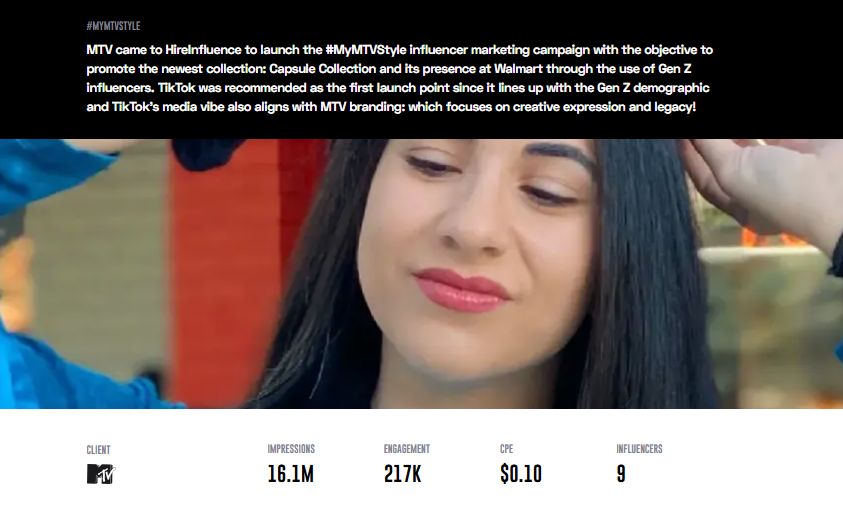
These programs, alongside the broader work portfolio, read together into a consistent pattern: careful creator selection and platform fit produce reach and retail action at costs that hold up at enterprise scale.
How to Evaluate an Influencer Marketing Agency
The right questions surface whether a prospective partner has the discipline the work demands. First, ask how the agency vets creators. The agency should describe a verification process that goes well past follower counts, covering audience authenticity, engagement quality, and demographic fit before any name is recommended, and a vague answer here is the clearest early warning a brand will get.
Second, ask how the agency defines and measures success. The agency should tie its work to outcomes the brand cares about, explaining how it will report reach, engagement, and, where the campaign allows, conversion or retail action, rather than defaulting to vanity metrics that flatter a recap deck but say little about business impact.
Third, ask how the agency handles disclosure and compliance. The agency should treat compliant sponsored-content labeling as standard practice and be able to explain how it keeps creators aligned with regulatory expectations, because a partner that is casual about disclosure exposes the brand to risk it will ultimately own.
Fourth, ask how the agency sources creators for a specific audience. The agency should be able to describe how it finds and confirms creators whose followers match the segment a brand is trying to reach, not simply how it books the biggest names it happens to have access to.
Fifth, ask how the agency prices programs and where the budget goes. The agency should be able to walk through what drives creator rates and how spend is allocated across sourcing, production, amplification, and measurement, and a cost of influencer marketing guide is a useful reference for pressure-testing whether the numbers a brand hears in a pitch are reasonable.
Inside the HireInfluence Approach to Hiring Influencers
HireInfluence has operated as a full-service enterprise influencer marketing agency since 2011, with a team of more than 25 people across 10-plus states and offices in Houston and The Woodlands, Texas; Austin, Texas; Los Angeles, California; and New York, New York. That footprint supports enterprise programs that need coordinated sourcing, production, and measurement rather than a single point of contact stretched thin across every task at once. The spread across Texas, California, and New York also keeps the team close to the markets and creators that national campaigns most often target.
The agency’s client roster includes Microsoft, Target, Coca-Cola, Walmart, Meta, and McDonald’s, and it works to a six-figure engagement floor that reflects the scope of the programs it runs. As a TikTok Shop Lite Program partner since July 2024, it connects creator content directly to commerce, and its recognition includes Marketing Agency of the Year at the 2024 MUSE Creative Awards and Digital Marketing Agency of the Year at the 2026 U.S. Agency Awards.
That approach reflects the background of founder and CEO Jason Pampell, whose experience maps closely to what hiring creators actually demands. Before founding HireInfluence in 2011, Jason Pampell spent years managing content rights, licensing, and strategic media partnerships for Forbes and Billboard, work that shapes how the HireInfluence team structures creator agreements, usage rights, and fit before a partnership begins. Brands weighing a first program can reach the team through its contact page, or learn more about how it works in the about section.
The through-line from the research is worth restating in plain terms: with creator costs climbing and inauthentic audiences making up the majority of reported quality problems, the brands that treat vetting, fit, cost, and disclosure as pre-hire disciplines are the ones that protect their spend and give a campaign a real chance to perform.