
Marketing teams asking how to run a ugc campaign almost always begin by briefing creators toward enthusiasm, and a 2025 study of more than 8,000 shoppers across six markets found that 52% of them distrust creator content that feels overly promotional. The same research found that 43% locate authenticity specifically in creators who acknowledge a product’s pros and cons, while 44% lose trust the moment a creator refuses to mention a product’s flaws and 40% grow skeptical when a creator seems unfamiliar with what they are promoting. Short-form video is the most trusted content format at 46%, ahead of customer reviews at 43%. One in three shoppers has purchased a product on a creator recommendation, and among shoppers aged 18 to 34 that figure reaches 56%, against 11% of shoppers 55 and older. The instruction buried in those numbers is uncomfortable for anyone who has ever written a campaign brief. The audience is not asking for advocacy. It is asking for testimony, and it can tell the difference.
Table of Contents
Why Shopper Distrust Reframes the UGC Campaign
Every other campaign discipline is built to suppress exactly the thing this audience is looking for. A television spot does not mention the drawback. A display ad does not concede the trade-off. Decades of marketing craft have gone into removing hesitation from the message, and the whole apparatus of approvals, legal review, and brand guidelines exists to make sure nothing ambivalent survives contact with the public. A user-generated content campaign asks a brand to run that machinery in reverse. The format’s entire value proposition rests on the audience believing that nobody made the speaker say it.
This is why so many of these programs fail in a way that looks like success on the way out the door. The content gets produced. It is well lit, on message, and it clears review in one pass. It also reads, to more than half the intended audience, as an advertisement wearing a costume. The 52 percent distrust finding is not a complaint about production values. It is a description of what happens when the audience detects intent. Polish is not the trigger. Persuasion is. A rough video that argues a case is more suspect than a well-shot one that simply reports an experience.
The pros-and-cons finding is the operational heart of the matter. When 43 percent of shoppers say authenticity comes from creators who name the downsides, they are describing a specific structural feature of the content, not a mood. The downside has to actually be in the video. It cannot be gestured at, and it cannot be a manufactured flaw chosen because it does not matter. A brand that briefs a creator to mention that the product is so good it sells out is not running a user-generated content campaign. It is running an advertisement with a decorative concession attached, and the 44 percent who disengage when flaws go unmentioned are the same people who notice when the flaw is fake.
The unfamiliarity finding cuts in a different direction and closes off the obvious workaround. If 40 percent of shoppers become skeptical when a creator appears not to know the product, then a brand cannot solve the candor problem by casting people who will say anything. Fluency and honesty have to arrive together in the same person. That combination is not something a brief produces. It is something sourcing produces, and it means the selection criteria for this format have almost nothing to do with the criteria for a paid endorsement.
The generational split settles the question of whether any of this is optional. A format that reaches 56 percent of shoppers aged 18 to 34 and 11 percent of shoppers over 55 is not a general-purpose awareness instrument, and treating it as one wastes it. It is the mechanism by which a specific cohort converts interest into confidence, and that cohort has grown up reading sponsored content for tells. The brand that wants their purchase has to accept the terms on which they grant it. Those terms include the right to hear what is wrong with the product.
What Enterprise Brands Should Expect From a UGC Campaign Partner
Program strategy and design. The agency has to establish what the content is for before it commissions a single asset, because a user-generated content campaign built for product-page conversion and one built for paid social testing require different creators, different volumes, and different rights. This is the function where dedicated campaign services either produce a coherent program or produce a content library nobody has a use for.
Creator sourcing and verification. The agency has to select for product fluency rather than audience size, since the research says an unconvincing speaker costs a brand 40 percent of its skeptics regardless of reach. Verification here means confirming that a creator has actually used the category, has an opinion about it, and is willing to say the unflattering part out loud on the record.
Platform and commerce integration. The agency has to understand where the content will terminate, because a video that will live on a product detail page carries different specification requirements than one destined for a retail media network or an ad account. The integration work happens at the brief stage, not in post-production.
Creative direction and content production. The agency has to direct toward specificity rather than approval, which is the inversion that most in-house review processes are structurally unable to perform. A working knowledge of what separates authentic contribution from staged imitation is the baseline, and the UGC overview covers the distinction that governs everything downstream in this function.
Audience and segment-specific execution. The agency has to build to the cohort that actually responds to the format, since a program engineered for shoppers over 55 and a program engineered for shoppers under 35 are not variations on one campaign. The 56 percent and 11 percent figures are a segmentation instruction, not a headline.
Cross-platform orchestration. The agency has to sequence the same content library across surfaces that reward different behavior, and adjacent-channel reading such as this TikTok influencer marketing resource clarifies how a single asset performs differently depending on where it lands. Orchestration is what prevents a brand from producing the same video five times.
Paid amplification. The agency has to decide which organic assets deserve budget and which should be left alone, because amplifying content that reads as promotional simply buys wider distribution for the tell. A specialist specialties and services capability matters most at the point where earned content becomes paid media and the disclosure changes how it is read.
Attribution and measurement. The agency has to connect content decisions to commercial outcomes rather than to interaction counts, since a video that earns trust and a video that earns views are frequently not the same video. An analytics capability built for this format has to measure whether the content moved purchase confidence, which is the only variable the research says is in play.
Program Delivery Across UGC Campaigns
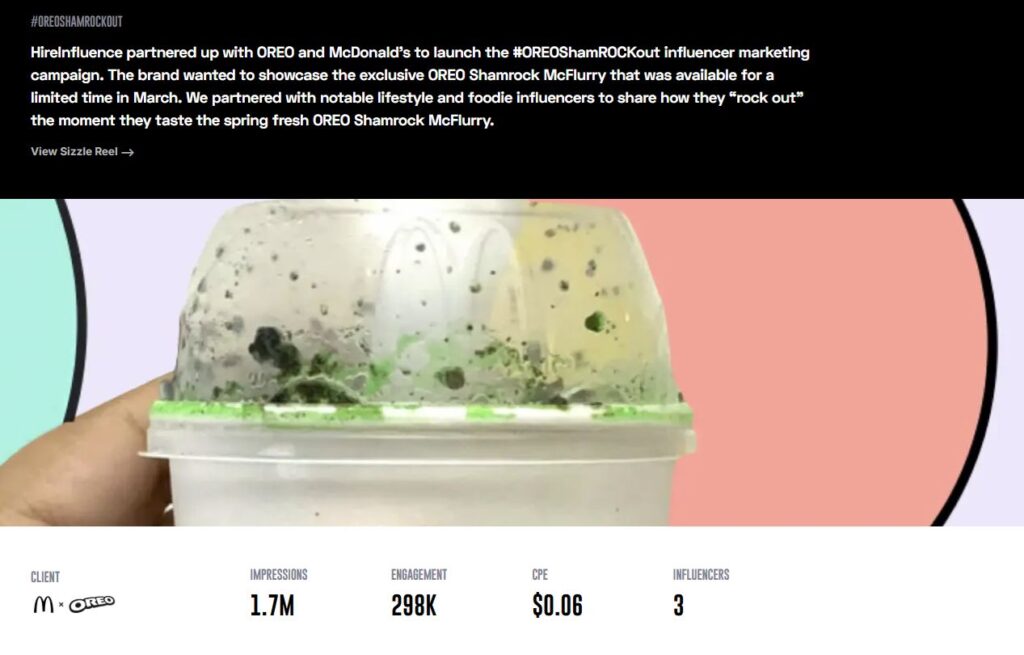
Program delivery is where a candor-first brief either survives contact with scale or does not. The Southwest Airlines #SouthwestSaysAloha program generated 56M impressions and 3M engagements, a ratio that only holds when the content is not fighting the audience’s skepticism on every impression. The Grammarly creator program ran 133 creators to 214M impressions, 33.1M views, and $15M in earned media value, a volume that makes the sourcing standard non-negotiable, because unfamiliar creators do not fail quietly at that scale. The MTV #MyMTVStyle campaign delivered 16.1M impressions and 216,600 engagements at $0.01 CPV and $1.50 CPM. The Oreo and McDonald’s #OREOShamROCKout activation reached 1.7M impressions at $0.06 cost per engagement.
The Ricola case study is the clearest demonstration of the point the research is making: 26M impressions and 20.5M reach at a 13.17% engagement rate across 18 influencers, converting to 62,500 MikMak retail clicks. That last figure is attention turning into an action, which is what a user-generated content campaign is actually for. Further examples across categories and formats sit in the work portfolio.
How to Evaluate a UGC Campaign Agency
First, ask how the agency briefs the downside. The agency should be able to describe the mechanism by which a genuine drawback reaches the final asset, and should be able to name a program where that happened.
Second, ask what disqualifies a creator. The agency should have a standard that removes people for lack of product fluency, and should be able to explain how it verifies fluency rather than assuming it.
Third, ask where the content is going before it is made. The agency should treat destination as a production input, and should be able to show how the same brief changes when the asset is bound for a product page rather than an ad account.
Fourth, ask how the agency measures trust rather than traffic. The agency should distinguish between content that earned attention and content that earned confidence, and should have instrumentation for the second.
Fifth, ask what the program costs and what the money buys. The agency should be able to decompose the number into creator fees, production, rights, and management without hesitation, and the reasoning behind those components is set out in this cost of influencer marketing guide.
The HireInfluence Model for UGC Campaigns
HireInfluence has operated as a full-service enterprise influencer marketing agency since 2011, and its about section records a team of 25 or more across 10 or more states, with offices in Houston, The Woodlands, Austin, Los Angeles, and New York. The firm works at a six-figure engagement floor, which is what funds the verification infrastructure this format requires, since confirming that a creator genuinely knows a product is labor rather than software, and it is the reason a candor standard can be enforced across a roster instead of hoped for. Client programs have run for Walmart, Target, Coca-Cola, Grammarly, MTV, and Microsoft. The firm was named Marketing Agency of the Year at the 2024 MUSE Creative Awards and Digital Marketing Agency of the Year at the 2026 U.S. Agency Awards. It has been a TikTok Shop Lite Program partner since July 2024, which matters for any user-generated content program whose assets are expected to terminate at a point of sale rather than at an impression. Brands scoping a program on these terms can reach the team through the contact page.
Founder and CEO Jason Pampell spent years managing content rights, licensing, and strategic media partnerships at Forbes and Billboard before starting the firm in 2011, and that background explains the model more directly than any methodology statement could. Publishing understood something well before performance marketing did: the audience arrives for the content, not for the entity that paid to put it there, and the moment a reader senses the second thing they stop believing the first. A masthead that sells its credibility one placement at a time has nothing left to sell. That is the same trade a brand makes when it briefs a creator toward enthusiasm and gets a video that 52 percent of the audience reads as an ad.
The survey settles what the category’s own instincts obscure. When the audience has already told a brand that it will grant belief only to a speaker permitted to say what is wrong, the campaign’s job stops being persuasion and becomes permission.