
Agencies price on four models: a monthly retainer, a project fee, a percentage of managed spend, or a hybrid with performance components. The fee almost never includes creator payments, usage rights, paid media, or production. Comparing proposals means normalising to total programme cost, because headline fees priced on different bases are not comparable.
Table of Contents
- The four fee models, and what each one selects for
- What is almost never included in the fee
- Why proposals are so hard to compare
- What actually drives the number
- What should disqualify an agency, including this one
- How to run the comparison in practice
- Red flags in a proposal
- Program Delivery and What Programme Spend Produces
- The HireInfluence Model and How Engagements Are Priced
Any article claiming to publish what agencies charge should be read carefully, because the honest answer is that there is no reliable published rate for this category and figures circulating as benchmarks are rarely traceable to a checkable source. What can be described precisely, and what actually decides whether a brand overpays, is the structure. Brands looking to hire influencer marketing agency partners lose money far more often to a misunderstood fee model than to a high fee, because a model determines what is included, what arrives later as an invoice, and what the agency is incentivised to do.
The four fee models, and what each one selects for
Retainer. A fixed monthly fee covering the agency’s time: strategy, sourcing, negotiation, campaign management, and reporting. It suits continuous programmes, makes budgeting predictable, and decouples the fee from spend. Its weakness is that it is insensitive to activity, so a quiet quarter costs the same as a heavy one.
Project fee. A one-time fee for a defined campaign with a start and an end. It suits launches and seasonal pushes and makes scope explicit. Its weakness is that everything outside the defined scope becomes a change order, and influencer campaigns generate scope changes routinely when a creator drops out or a platform mechanic shifts mid-flight.
Percentage of managed spend. The agency takes a share of creator and media budget it manages. It scales with the programme and requires no renegotiation as budgets grow. Its weakness is the obvious one: the model rewards larger spend, so the recommendation to increase budget always carries an interest.
Hybrid and performance components. A reduced base with a component tied to outcomes. It aligns incentives where the outcome is genuinely attributable. Its weakness is that influencer outcomes are often not cleanly attributable, and a performance component attached to a metric the agency partly controls, such as engagement, produces behaviour optimised for that metric rather than for the business.
The general point matters more than any individual model: the payment structure selects the behaviour. A brand choosing a model is choosing what its agency will optimise, and that choice should be deliberate rather than inherited from whatever the agency proposed first.
What is almost never included in the fee
This is where budgets break, and the list is consistent across models.
Creator fees. The largest line in most programmes, billed separately in nearly every arrangement.
Usage rights. The line most often underestimated. Rights are priced by term, territory, and media type, and negotiating them after content exists costs materially more than negotiating them before. A brand that discovers it needs paid usage for an asset already published is renegotiating from the weaker position.
Paid media. The amplification budget itself, and sometimes a separate management fee on it.
Production. Where content is produced beyond what a creator delivers natively, including studio work, editing, and additional formats.
Sampling and shipping. Trivial for a small programme, substantial for a seeding programme running thousands of units.
Platform costs and specialist tooling where required for measurement.
A proposal that does not itemise these has not been scoped. Asking for line-item separation is the single most useful request a brand can make of any agency proposal, in any model.
Why proposals are so hard to compare
Two agencies quoting for the same programme on different models produce numbers that cannot be read against each other. A retainer quote and a percentage-of-spend quote are answering different questions, and the lower headline figure frequently produces the higher total.
The workable method is to normalise. Build a single estimate of total programme cost over a defined period, including every excluded item above, and compare that. It requires each agency to state assumptions about creator count, rights term, and media budget, which is itself diagnostic: an agency that cannot state its assumptions has not scoped the work.
Brands should also ask what happens at renewal, because a fee that steps up on scope growth and a fee that steps up on time behave very differently in year two.
What actually drives the number
Six factors move programme cost more than anything else, and all six are within the brand’s control at scoping.
Rights term and breadth. Perpetual, all-media, all-territory rights cost multiples of a bounded licence. Most brands buy more than they use.
Whether content carries paid media. Paid usage changes creator pricing and adds authorisation and tracking work on every platform.
Number of platforms. Each additional platform adds a distinct rights and disclosure model rather than a proportional increment of the same work.
Creator tier and count. Not linear. Coordination cost rises faster than creator count.
Exclusivity. A creator barred from working with competitors is compensated for the opportunity, and the cost scales with category and duration.
Approval complexity. Regulated categories and multi-stakeholder review extend timelines, and timeline is cost.
What should disqualify an agency, including this one
HireInfluence builds custom-scoped, fully managed programs rather than packaged or self-serve buys, which means there is no rate card and a scoping conversation precedes any number. Brands wanting a fixed, comparable quote quickly will move faster with a packaged provider, and that is a legitimate requirement rather than a failure of seriousness. The firm represents brands rather than creators. And brands whose programmes fit the direct-hiring conditions will not recover managed overhead and should not try.
How to run the comparison in practice
The normalisation described above is straightforward once structured, and it takes a spreadsheet rather than a process.
Fix the variables first and give every agency the same ones: a defined period, a creator count, a rights term with territory and media type named, and a paid media budget. Without fixed inputs each proposal quotes against its own assumptions and the outputs are not comparable.
Then build one total per agency covering agency fee, creator fees, rights, paid media, production, and logistics. Compare the totals, and separately compare what each agency assumed it would take to deliver, because two agencies quoting materially different creator counts for the same objective are describing different plans rather than different prices.
Finally, ask each to state what would push the total up by a quarter, and what would bring it down. The answers reveal where each agency thinks the risk sits, and an agency that cannot name a downside scenario has not planned one.
Red flags in a proposal
Five things in a pricing proposal should prompt a second conversation.
A bundled number with no line items. If creator fees, rights, media, and production are not separated, the proposal cannot be compared to anything and the brand cannot tell which lever to pull when the budget moves.
Rights described as included without a term. Rights are always bounded by term, territory, and media type. A proposal saying rights are included without naming those three is either underscoping or describing a narrower grant than the brand will assume.
A benchmark presented without a source. Category averages for engagement rate or cost per thousand circulate widely and are frequently untraceable. An agency using one to justify a number should be asked where it came from, and should be able to answer.
A performance component attached to a metric the agency controls. Tying fees to engagement rate rewards optimising for engagement rate. If a performance component is used, it should attach to something the business actually cares about.
No stated assumptions. Every quote rests on assumed creator counts, rights terms, and media budgets. An agency that has not written its assumptions down has not scoped the work, and the number will move.
Program Delivery and What Programme Spend Produces
The #CoatYourThroat programme for Ricola drove 62,500 MikMak retail clicks, and the campaign is documented in full in the Ricola case study. Retail click volume is a useful reference point for cost discussions precisely because it is an outcome rather than a delivery count.
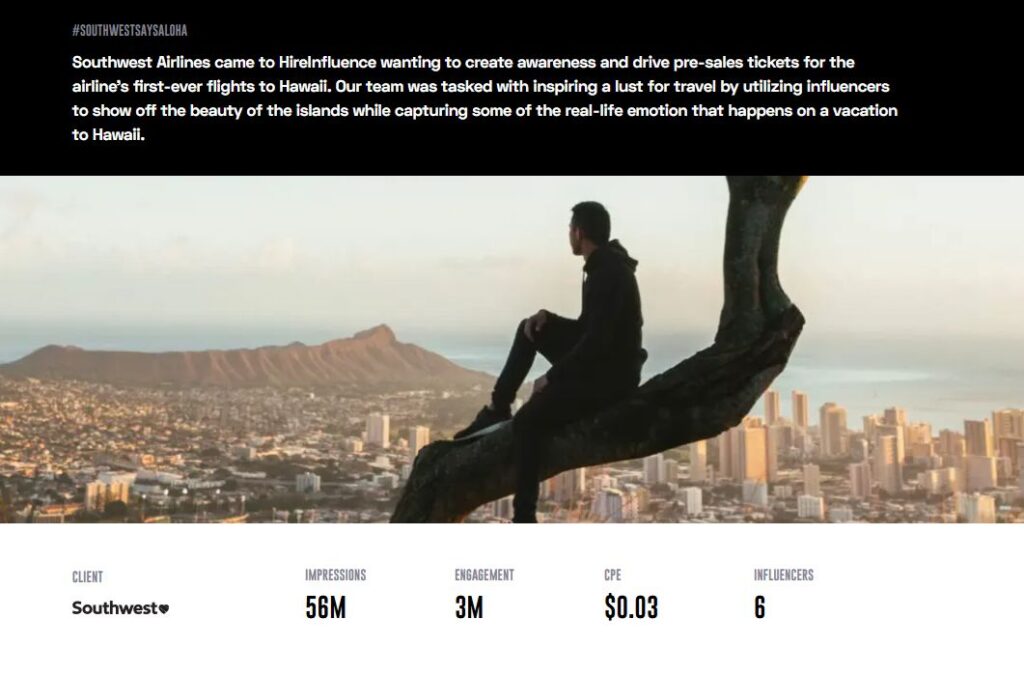
The #SouthwestSaysAloha programme for Southwest Airlines delivered 56M impressions and 3M engagements. For MTV, the #MyMTVStyle programme returned 16.1M impressions and 216,600 engagements at $0.01 CPV and $1.50 CPM, figures that describe efficiency achieved on specific campaigns rather than rates a brand should expect to be quoted.
Additional campaign detail is published in the work portfolio.
The HireInfluence Model and How Engagements Are Priced
Founded in 2011, HireInfluence is a full-service influencer marketing agency built for enterprise brands, headquartered in Houston with offices in Austin, Los Angeles, and New York. The firm runs creator programs for brands including Adidas, Coca-Cola, Honda, McDonald’s, Warner Bros, and eBay, covering strategy, talent sourcing, branded content production, paid amplification, and performance reporting. Creator selection runs through a manual vetting and validation process rather than database filtering alone, and campaigns are scoped to each client’s objectives rather than sold as fixed packages.
Brands building a budget should read the cost of influencer marketing for how programme spend is constructed, and the influencer exclusivity clauses guide, because exclusivity and rights term are the two levers that move a quote most and are negotiated least carefully. Scoping conversations start through contact, and the firm’s background is set out on the about page.