
Decide which owned surfaces will carry creator content before contracting, because integration fails on rights rather than on planning. A creator paid to publish a post has granted that post existing on their channel. Putting it on a product page, in email, or into paid media is a separate grant with a separate price.
Table of Contents
- The sequence that actually works
- What each surface requires
- What creator content is genuinely good for in a content strategy
- Measuring the integration rather than the campaign
- What to specify in the licence, surface by surface
- Who should own the integration decision
- What should disqualify an agency, including this one
- Program Delivery Across Campaigns With Long Asset Lives
- The HireInfluence Model for Integrated Content Programs
Most guidance treats this as a calendar exercise: map creator activity against content pillars, sequence it against campaigns, repurpose the output. That planning is fine and it is not where integration breaks. A content marketing strategy that assumes creator assets will flow onto owned channels is making a rights assumption, and the assumption is usually made by the team building the calendar rather than the team negotiating the contracts. The two conversations happen months apart, and the plan is built after the terms are already fixed. This article is about closing that gap.
The sequence that actually works
The correct order inverts how most brands do it.
First, specify the surfaces. Which owned properties will carry creator content: the site, product pages, email, organic social on brand channels, paid media, retail and trade materials, out-of-home. This is a list, and it should be written before anyone talks to a creator.
Second, convert the list into a licence specification. Each surface implies a media type, and the durations differ. A social post has a short useful life. A product page asset may need years. Uniform terms across all surfaces are administratively simple and commercially wrong in both directions: too short for the durable surfaces, unnecessarily expensive for the ephemeral ones.
Third, contract against the specification. Not against a template inherited from the last campaign.
Fourth, build the calendar. By this point the calendar can only contain things the brand is actually permitted to do, which is the whole objective.
Brands that run this sequence in the usual order discover the constraint at step four and either pay to fix it or quietly drop the integration that justified the programme.
What each surface requires
Owned social channels. Reposting creator content to the brand’s own feed is a distinct grant from the creator publishing it on theirs. Platform mechanics apply too: on Instagram the brand’s approval is required before a paid partnership label displays the brand name, and permission is revocable by either side.
Paid media. The most valuable integration and the most tightly gated. Each platform handles it differently, and the differences are structural rather than procedural. TikTok requires an authorisation with a fixed term where expiry is terminal and a new code must be generated. YouTube grants no advertising rights through linking at all, with Google stating the advertiser must secure sufficient rights separately, and enforces no expiry. Instagram uses a two-way permission at content or account level.
Site and product pages. Usually the longest-lived surface and therefore the one where an under-specified term costs the most. An asset still converting in year two is only useful if it is still licensed in year two.
Email and lifecycle. Frequently forgotten in rights specifications because it does not feel like advertising. It is a media type and it needs naming.
Retail, trade, and physical. Almost never covered by a default social licence, and the grant that most often has to be bought separately after the fact.
What creator content is genuinely good for in a content strategy
Two uses justify the integration overhead, and a third does not.
Demonstration and use-in-context. Creator content shows a product being used by someone with a reason to be using it. That is difficult and expensive to manufacture in a studio and it is the strongest argument for putting creator work on owned surfaces.
Volume across variants. Brands with many product variants, formats, or use cases need more content than a studio production model economically supplies. Creator programmes scale on a different curve.
What does not justify it: filling a calendar. Creator content used as generic inventory to hit a posting cadence carries all of the rights overhead and none of the credibility benefit, because credibility comes from the creator’s own audience relationship and does not travel to a brand channel automatically.
Measuring the integration rather than the campaign
A creator programme feeding owned channels should be measured on both, and brands typically measure only the first.
Campaign-level measurement covers the creator’s own publication. Integration-level measurement covers what the repurposed asset did on the owned surface, compared to what would otherwise have been there. The second question is answerable with normal owned-channel testing and is rarely asked, which means brands frequently cannot say whether the integration was worth the licence they paid for.
Brands should decide at scoping which owned surfaces will be tested and against what baseline, because retrofitting that comparison after the fact is usually impossible.
What to specify in the licence, surface by surface
Turning the surface list into a licence specification is the step brands most often skip, and it takes one table rather than a negotiation.
For each surface, three things need naming. The media type, because a licence covering organic social does not cover paid, and neither covers a printed shelf-talker. The territory, which matters wherever a brand operates in more than one market or where a retailer’s footprint differs from the brand’s. The duration, set against how long the asset will realistically be useful on that surface rather than against a single default.
Two practical rules save more money than any negotiation tactic. Do not buy perpetual all-media rights by default, because the price reflects everything a brand might do and most brands use a fraction of it. And do not buy the shortest term available for durable surfaces, because renegotiating in year two costs more than the difference and is agreed from a weaker position once the asset has proven itself.
The specification should be written once and reused across creators, which turns each negotiation into a variation on a known position rather than a fresh argument.
Who should own the integration decision
Integration sits between two teams and consequently belongs to neither by default, which is why it drifts.
The content team owns the calendar and knows which surfaces need filling. The influencer team owns the contracts and knows what is permitted. Neither has the full picture, and the gap between them is where a plan gets built against assets that cannot legally support it.
The workable answer is that the surface specification belongs to the content team and the licence negotiation belongs to the influencer team, with the specification handed over before contracting opens. That sequencing gives each team the thing it is best placed to decide and removes the guessing from both.
Where a single agency covers both, the same discipline applies internally and should be visible in the scope of work rather than assumed.
What should disqualify an agency, including this one
HireInfluence builds custom-scoped, fully managed programs rather than packaged or self-serve buys, so a brand whose content strategy needs an editorial calendar, a search plan, and owned-channel production should engage a content marketing agency for that work. The firm represents brands rather than creators. And a brand that has not decided which owned surfaces will carry creator content is not ready to contract creators, whichever agency it uses.
Program Delivery Across Campaigns With Long Asset Lives
The #CoatYourThroat programme for Ricola ran with 18 influencers, and the campaign is documented in full in the Ricola case study.
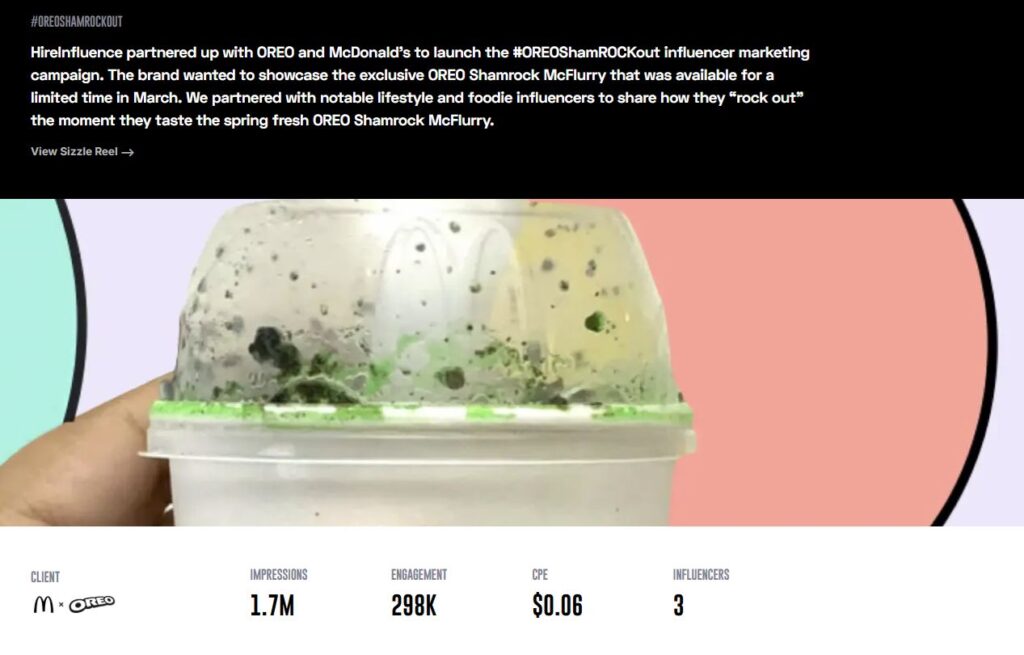
The #OREOShamROCKout programme for Oreo and McDonald’s returned 1.7M impressions at $0.06 cost per engagement. The #SouthwestSaysAloha programme for Southwest Airlines delivered 56M impressions and 3M engagements. Programmes of that scale produce asset libraries rather than individual posts, and an asset library is only usable to the extent the licences behind it were specified against real surfaces.
Additional campaign detail is published in the work portfolio.
The HireInfluence Model for Integrated Content Programs
Founded in 2011, HireInfluence is a full-service influencer marketing agency built for enterprise brands, headquartered in Houston with offices in Austin, Los Angeles, and New York. The firm runs creator programs for brands including Adidas, Coca-Cola, MTV, Target, Warner Bros, and eBay, covering strategy, talent sourcing, branded content production, paid amplification, and performance reporting. Creator selection runs through a manual vetting and validation process rather than database filtering alone, and campaigns are scoped to each client’s objectives rather than sold as fixed packages.
Brands planning integration should agree the term and media-type provisions in their creator contracts early, and should read creator content and studio ads in paid media, which addresses the most valuable and most tightly gated surface. Scoping conversations start through contact, and the firm’s background is set out on the about page.