It depends on whether the content needs to carry someone’s credibility. Creator-produced content does, but it is licensed rather than owned and runs through a revocable permission chain. Studio and in-house content is owned outright and carries no third-party trust signal. Most brands need a mix and should decide the split deliberately.
Table of Contents
- Creator-produced content
- Studio-produced content
- In-house production
- How to decide the split
- What an agency in this space should be able to do
- The mistake that costs most, and it is not the production choice
- What should disqualify an agency, including this one
- Program Delivery Across Creator-Led Instagram Work
- The HireInfluence Model for Instagram Content
Brands searching for the best Instagram content agency are usually solving for volume, and volume is the easiest of the three variables to satisfy. The harder questions are what each production source actually produces as a legal object, and what the content is being asked to do. A studio and a creator can shoot the same product in the same room and produce two things that differ completely in ownership, in permission requirements, and in why anyone would believe them. This article sets out those differences and the situations each source suits.
Creator-produced content
What it is legally. Licensed material, bounded by term, territory, and media type. The brand does not own it, and using it beyond what was agreed requires a further grant.
What the permission chain requires. On Instagram the creator toggles the paid partnership label and tags the brand, and the first tag sends a request the brand must approve. Until approval the label displays without the brand name, and if the brand denies it the label is removed from the content entirely. Permission exists at content level for a single post or account level for organic content where the brand is tagged, and either party can withdraw at any time. Account-level access is the version that scales and it is a negotiated position inside the creator agreement rather than something requested afterwards.
What it is genuinely good for. Anything where the credibility of the person matters: demonstration, recommendation, use in a real context, and reaching an audience that already trusts the speaker.
Where it fails. Precise brand control, guaranteed consistency across a set, and anything requiring exact product representation for regulatory reasons. Creators are also not a reliable source for evergreen assets a brand needs to control indefinitely, because indefinite control is exactly what the licensing model does not provide cheaply.
Studio-produced content
What it is legally. Normally work-for-hire the brand owns outright, with no expiry, no territory, and no third party whose consent is needed.
What it is good for. Product accuracy, brand consistency, complex demonstration, anything with regulatory constraint, and any asset the brand needs to control for years. Cost per asset is higher; cost per year of use is often much lower.
Where it fails. It reads as advertising, because it is. On a feed built around personal posting, studio pacing and studio lighting are recognisable, and audiences discount them accordingly. No amount of casual framing fully disguises production values.
In-house production
What it is legally. Owned outright, same as studio.
What it is good for. Volume at low marginal cost, speed on reactive work, and the sustained cadence an always-on Instagram presence needs. Brand knowledge is already resident and nothing has to be briefed.
Where it fails. Range and freshness. In-house output converges on a house style, which is an asset for recognisability and a liability for a feed audiences scroll past. It also competes with everything else the social team owns, so creator programme administration and content production draw on the same people.
How to decide the split
Four questions settle it faster than a capability comparison.
Does this asset need to be believed by someone who does not trust the brand? If yes, creator. Credibility does not transfer from a studio.
How long does the brand need to control it? Longer than about a year points to owned production, because licensing that duration is expensive and renegotiating it later is worse.
Is the constraint regulatory or claims-based? Point to studio or in-house, where the script is controlled and the review path is short.
Is the constraint volume? Point to in-house for cadence and creators for variety. A studio is rarely the volume answer.
A fifth question is worth asking where budgets are tight: what happens to this asset when the campaign ends? Anything with a life beyond the flight should be produced or licensed accordingly at the outset, and anything genuinely disposable can be commissioned on the cheapest terms available without regret.
Most enterprise Instagram programmes end up roughly three-way, and the useful discipline is deciding the proportions deliberately at planning rather than letting them fall out of whichever budget line had room.
What an agency in this space should be able to do
A partner covering Instagram content production should be able to answer all of the following, and many can answer only the first.
Which source is right for each asset in the plan, and why. A recommendation that everything be creator-produced is a supplier position rather than an answer.
How account-level permission is secured and maintained. Content-level permission does not scale and cannot be retrofitted without reopening terms.
How creator eligibility is verified. Instagram documents the causes of the paid partnership label being unavailable as a personal or private account, loss of standing from policy strikes or repeated violations, and the brand partner lacking a professional account. Meta states there is no official minimum follower count, so screening on size is screening on the wrong variable.
How the content will be tested. Instagram’s trial mechanic publishes a Reel initially to non-followers, which makes it a testing surface. It changes often enough that an agency should describe its current behaviour rather than a remembered one. A partner that cannot say when it last checked is describing a feature from memory, on a surface that rewards being current.
How perception is measured, if that is the objective. A Meta brand-lift study is a controlled experiment splitting the audience into exposed and holdout groups, measuring ad recall as the primary metric alongside awareness, message association, favourability, and purchase intent, with Meta recommending one or two questions per study. It produces an estimate rather than a count.
The mistake that costs most, and it is not the production choice
Across all three sources, the expensive error is the same and it happens before anything is shot: the brand does not decide what the asset is for beyond its first appearance.
Creator content commissioned for a single post, licensed accordingly, then wanted six months later for a product page is the most common version. Studio content produced for a campaign, then reused indefinitely because it is owned, is the opposite failure: the brand keeps running material that has aged because there is no licence expiry to force the question.
The discipline that prevents both is deciding, at commissioning, where the asset will live and for how long. That decision sets the production source, the licence term, and the budget line, in that order. Brands that make it in that order rarely have a rights problem. Brands that pick a supplier first almost always do.
What should disqualify an agency, including this one
HireInfluence builds custom-scoped, fully managed programs rather than packaged or self-serve buys, and the firm’s production capability is creator-led rather than studio. A brand whose Instagram need is a controlled studio library or a daily in-house cadence should resource that separately. The firm represents brands rather than creators. And a brand unwilling to commit a response time on incoming tag requests will lose creator assets to its own queue whoever produces them.
Program Delivery Across Creator-Led Instagram Work
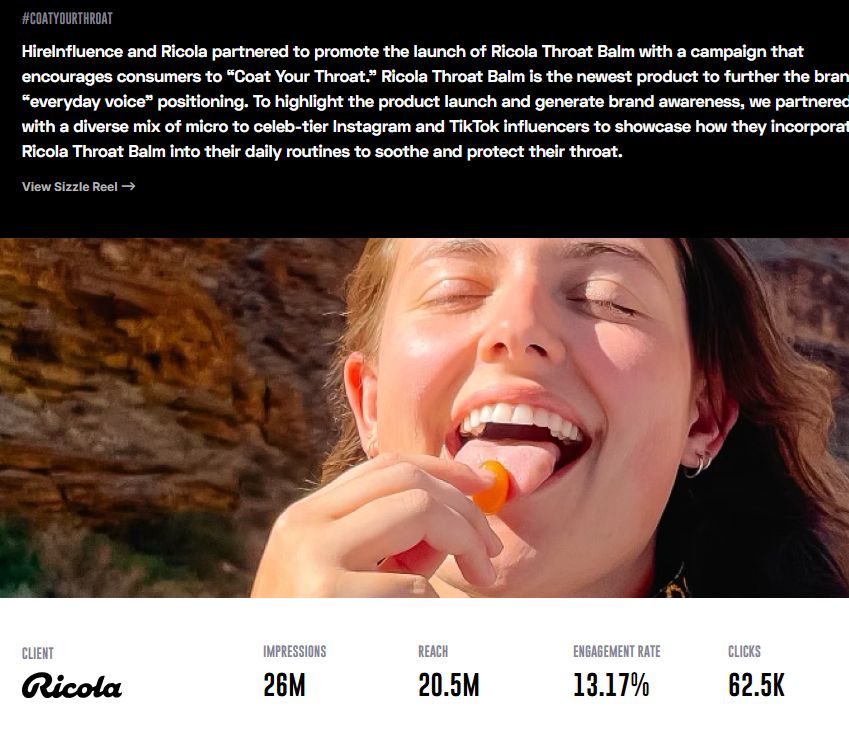
The #CoatYourThroat programme for Ricola drove 62,500 MikMak retail clicks, and the campaign is documented in full in the Ricola case study.
The #OREOShamROCKout programme for Oreo and McDonald’s returned 1.7M impressions at $0.06 cost per engagement. For MTV, the #MyMTVStyle programme returned 16.1M impressions and 216,600 engagements at $0.01 CPV and $1.50 CPM. Both produced creator-led asset sets rather than single posts, which is the production model this article describes.
Additional campaign detail is published in the work portfolio.
The HireInfluence Model for Instagram Content
Founded in 2011, HireInfluence is a full-service influencer marketing agency built for enterprise brands, headquartered in Houston with offices in Austin, Los Angeles, and New York. The firm runs creator programs for brands including Coca-Cola, Microsoft, NFL, Southwest Airlines, Target, and eBay, covering strategy, talent sourcing, branded content production, paid amplification, and performance reporting. Creator selection runs through a manual vetting and validation process rather than database filtering alone, and campaigns are scoped to each client’s objectives rather than sold as fixed packages.
Brands planning Instagram production should read the influencer content approval process, which covers the permission chain in operational detail, and what user generated content is, which sets out the category boundaries this decision runs across. Scoping conversations start through contact, and the firm’s background is set out on the about page.