
An agency that understands the account is usually the animal while the contracting party is the owner. That gap changes vetting, creates welfare obligations no other consumer category carries, and puts ingestion and health claims into content produced by someone with no professional training in either.
Table of Contents
- The contracting gap, and what it changes
- Welfare is a creative constraint, not a compliance footnote
- The claims problem is sharper than it looks
- What to ask an agency
- What does not differ
- Where the category performs unusually well
- What to settle before briefing
- Program Delivery Across Consumer Categories
- The HireInfluence Model for Consumer Product Categories
Pet is one of the most creator-native consumer categories and one of the least well served by generic influencer practice, because the standard model assumes the person on screen is the person signing. A pet influencer marketing company working properly in the category handles a set of specifics that simply do not arise elsewhere: an animal whose participation cannot be consented to, a product that is frequently eaten, and an audience that reacts to perceived mistreatment faster and more severely than to almost anything else. This article covers what those specifics demand of an agency.
The contracting gap, and what it changes
The audience follows an animal. The agreement is with a human. Everything downstream inherits that split.
Vetting has to cover both. The animal account’s audience and engagement, and the owner’s own history and conduct. Brands are frequently surprised to discover that the owner has a separate personal presence with content the brand would never have approved.
Continuity is fragile in a specific way. An animal ages, becomes unwell, or dies. This is a real and frequent program event in pet, and it has no equivalent in other categories. Contracts should say what happens to licensed content in that circumstance, and brands should hold that conversation with unusual sensitivity when it arrives.
Likeness rights are unsettled ground. The animal’s image is the asset and the legal position on animal likeness differs from human likeness. Agreements should secure rights from the owner explicitly rather than assuming standard creator terms cover it.
Welfare is a creative constraint, not a compliance footnote
Pet audiences enforce standards that no regulator has written down, and they enforce them immediately.
Content that appears to distress the animal ends campaigns. Costumes, restraint, unnatural settings, food withheld for a shot. What reads as harmless to a marketer frequently reads differently to an audience of people who have strong views about animals.
Briefs should specify what will not be asked for. A brief that says nothing about welfare invites a creator to interpret ambition as license, and the resulting content is the brand’s problem regardless of who filmed it.
Vetting should include prior conduct. An owner with a history of content the pet community reacted badly to carries that history into the brand’s campaign.
The practical position: welfare guidance belongs in the brief and in the contract, and an agency that has run this category will raise it before being asked.
The claims problem is sharper than it looks
Pet products divide into categories with very different claim exposure, and the division does not track what marketers expect.
Food and treats carry the same substantiation logic as human food, with an added complication: the person describing the benefit is describing an effect on an animal that cannot report it. Claims about digestion, coat condition, energy, or joint comfort are the ones creators reach for naturally and the ones most likely to be unsupportable.
Supplements and health products sit closer to a veterinary claim than most brands acknowledge, and content implying treatment of a condition is a different risk category entirely.
Hardware, toys, and accessories are comparatively straightforward, with safety and durability the main exposure.
The control is the same one that works in regulated CPG: specify what must be said with exact permitted phrasing, name the prohibited territory by concept rather than by word list, and give the creator a one-page claims sheet they can keep. Creators comply readily when told precisely what is permitted and improvise when handed a prohibition list.
What to ask an agency
How is the owner vetted separately from the account? An agency that has only looked at the animal account has done half the work.
What welfare guidance goes into the brief, and who wrote it?
How are ingestion and health claims controlled, and at what point does review happen? On TikTok the caption locks permanently at authorization and the disclosure label cannot be changed once applied, so sign-off has to precede authorization rather than publication.
What happens if the animal becomes unwell mid-campaign? A credible answer covers content already produced, content not yet delivered, and how the situation is handled publicly.
How is gifted product handled? Pet brands seed heavily, and compensation includes in-kind. Platform policies list gifted product alongside paid posts, affiliate commissions, and ambassador relationships as triggering disclosure.
What does not differ
Worth stating so brands do not over-engineer. Rights work the same way, bounded by term, territory, and media type. Platform mechanics are identical: TikTok authorization expires terminally, Instagram permission is a revocable two-way approval, and on YouTube linking conveys no advertising rights at all. Disclosure carries no performance penalty, with TikTok’s own study across nearly two million videos finding no difference between properly disclosed and undisclosed branded content.
Where the category performs unusually well
The constraints above are real and the upside is genuine, which is worth stating because pet is one of the highest-performing consumer categories for creator content.
Audience trust is unusually high. Pet owners take product recommendations from other pet owners at a rate few categories match, because the decision is emotional and the recommender has visible skin in the game.
Content is inherently watchable. The format problem that other categories solve with production budget solves itself here.
Repeat purchase is the norm, which means an acquired customer has a long value tail and justifies more investment per acquisition than the first order suggests.
Micro and nano accounts perform strongly, because the community is dense and highly engaged rather than broad. A roster weighted toward smaller accounts frequently outperforms one built on reach.
The practical implication for agency selection: an agency proposing a small number of large accounts has applied a generic playbook. One proposing a wider roster of smaller, community-embedded accounts has understood the category.
What to settle before briefing
Four decisions belong in the scope rather than in a creative conversation later.
Whether the animal may be dressed, restrained, or placed in a constructed setting, and to what degree. This single decision prevents most welfare complaints.
Whether the product may be shown being consumed on camera, and under what supervision.
What happens to licensed content if the animal dies. Uncomfortable to raise and considerably more uncomfortable to improvise.
Who in the brand approves welfare-sensitive content, since a marketing reviewer may not spot what a pet audience will.
Program Delivery Across Consumer Categories
The #CoatYourThroat program for Ricola drove 62,500 MikMak retail clicks, and the campaign is documented in full in the Ricola case study, an example of retail-conversion measurement in a category where the purchase happens off-platform.
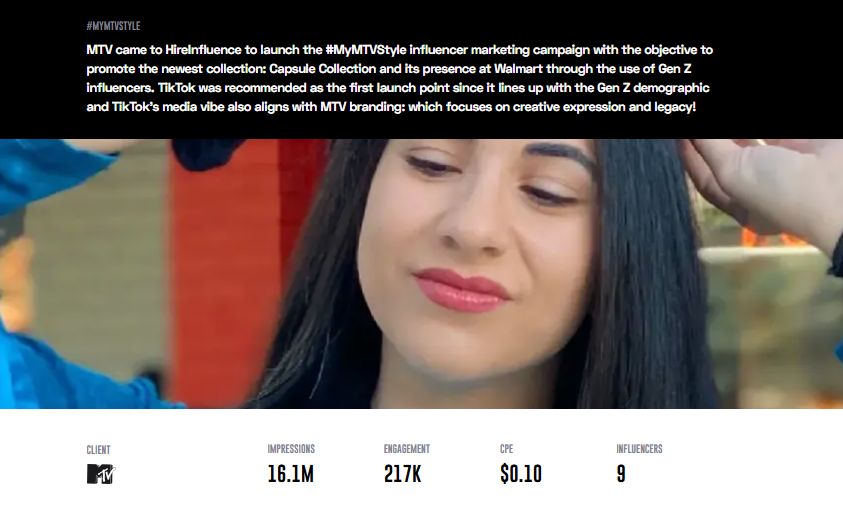
The #OREOShamROCKout program for Oreo and McDonald’s returned 1.7M impressions at $0.06 cost per engagement. For MTV, the #MyMTVStyle program returned 16.1M impressions and 216,600 engagements at $0.01 CPV and $1.50 CPM.
Additional campaign detail is published in the work portfolio.
The HireInfluence Model for Consumer Product Categories
Founded in 2011, HireInfluence is a full-service influencer marketing agency built for enterprise brands, headquartered in Houston with offices in Austin, Los Angeles, and New York. The firm runs creator programs for brands including Coca-Cola, Honda, Microsoft, Southwest Airlines, Warner Bros, and eBay, covering strategy, talent sourcing, branded content production, paid amplification, and performance reporting. Creator selection runs through a manual vetting and validation process rather than database filtering alone, and campaigns are scoped to each client’s objectives rather than sold as fixed packages.
Pet brands scoping a program should read the influencer content approval process and the FTC influencer disclosure guidelines for enterprise brands. Neither is legal advice. Scoping conversations start through contact.