
Hiring a B2B SaaS influencer marketing agency is usually framed as a reach problem, a search for whichever creator commands the biggest audience in enterprise technology. That framing gets the mechanics backward. The seventh annual study of how thought leadership shapes business buying, built on responses from nearly 2,000 global professionals, found that more than 40% of B2B deals stall because of internal misalignment inside the buying group, not because a brand failed to reach enough people. The same research reported that 63% of the hidden buyers who quietly steer those decisions spend more than an hour every week consuming thought leadership, and that 53% of decision makers say brand recognition matters less once a company’s thought leadership is strong. Across the study, thought leadership proved more persuasive with these hidden stakeholders than traditional product marketing did. For enterprise software, that inverts the reach assumption completely. The task is not to be seen by the largest possible crowd. It is to be trusted by the small group of finance, security, and operations stakeholders who can quietly advance or end a six-figure purchase.
Table of Contents
Why a B2B SaaS Influencer Agency Belongs on LinkedIn
Enterprise software is almost never bought by one person. A modern SaaS purchase runs through a buying committee that can include a technical evaluator, a security reviewer, a procurement lead, a finance approver, and the economic buyer who signs, each weighing the decision against a different fear. That structure is exactly why reach alone fails. A message can travel widely and still never earn the trust of the one reviewer whose objection stalls the contract. The buying group does not need to be impressed at scale. It needs to be reassured in specific, credible, role-relevant ways.
LinkedIn is where that reassurance happens, because it is where the committee already spends its professional attention. Practitioners follow other practitioners, read post-mortems, and form opinions about vendors long before a sales conversation begins. A software brand that shows up in those feeds through credible voices is shaping the shortlist while competitors are still buying ad impressions. The platform rewards specificity, and specificity is what moves technical buyers.
This is where a hard distinction matters. Follower count and authority are unrelated properties. A lifestyle creator can carry a million followers and hold no standing whatsoever with a chief information security officer, while a data engineer with eight thousand followers can reframe how an entire category is evaluated because the audience trusts that the person has actually done the work. An agency that shops for reach will deliver the former. An agency built for enterprise software hunts for the latter, because credibility with the buying committee is the only currency that changes a purchase decision.
Thought leadership, done seriously, is trust engineering rather than publishing. It anticipates the objection a security reviewer will raise and answers it in a creator’s own voice. It gives an internal champion the third-party validation needed to defend a shortlist choice in a room full of skeptics. When the research shows that a company’s thought leadership can lower a buyer’s dependence on brand recognition, it is describing this mechanism: strong ideas from trusted people reduce the perceived risk of choosing a vendor that is not already a household name.
A generalist agency tends to miss this because it optimizes for the metrics of consumer campaigns, where volume and virality carry the day. Enterprise software runs on the opposite physics. Sales cycles are long, audiences are narrow, and a single misfired claim can cost credibility with an entire committee. A specialist partner plans for that reality, briefing creators on positioning, keeping technical accuracy intact, and treating a small number of high-trust placements as more valuable than a flood of low-context mentions.
The hidden buyer deserves particular attention, because the research found that these stakeholders consume nearly as much thought leadership as the target buyer yet are routinely ignored by marketing built only for the obvious decision maker. In practice, that means content strategy for a software brand cannot speak solely to the practitioner who will use the product. It has to reach the finance and operations reviewers who never touch the software but can quietly block the deal, and it has to give them a reason to say yes rather than a reason to wait.
What Enterprise Brands Should Expect From a B2B SaaS Influencer Partner
Campaign architecture. The agency has to design the whole program around the buying committee rather than a single persona, mapping which creators reach which stakeholder and sequencing content so that awareness, proof, and validation arrive in the right order, which is why the firm’s dedicated campaign services start with objectives before names.
Creator identification and vetting. The agency has to separate genuine practitioner authority from surface popularity, verifying that a creator’s audience actually contains the technical and executive buyers a software brand needs, and confirming that their track record survives scrutiny from a skeptical review.
Message alignment. The agency has to translate product positioning into arguments a creator can make honestly in their own voice, so the content reads as an informed point of view rather than a scripted advertisement that a technical audience will reject on sight.
Practitioner and user-generated content. The agency has to build a supply of credible, experience-based content from real users and operators, and a clear UGC overview helps a brand understand why practitioner proof outperforms polished brand messaging with technical buyers.
Governance and disclosure. The agency has to keep every partnership compliant with disclosure rules and any industry-specific requirements a software category carries, protecting the brand from the reputational and legal exposure that undisclosed or overstated claims create.
Platform mix beyond a single feed. The agency has to know when a program should extend past LinkedIn into video and short-form channels where evaluators also research, and this TikTok influencer marketing resource shows how a secondary platform can support an enterprise narrative without diluting it.
Paid amplification. The agency has to put media behind the content that earns the strongest organic response, and the firm’s specialties and services capability covers the amplification and targeting work that turns a high-performing post into repeatable committee reach.
Attribution and measurement. The agency has to connect creator activity to pipeline rather than vanity metrics, and a serious analytics capability is what lets a software brand see which placements influenced real opportunities instead of guessing.
Program Delivery Across B2B SaaS Campaigns
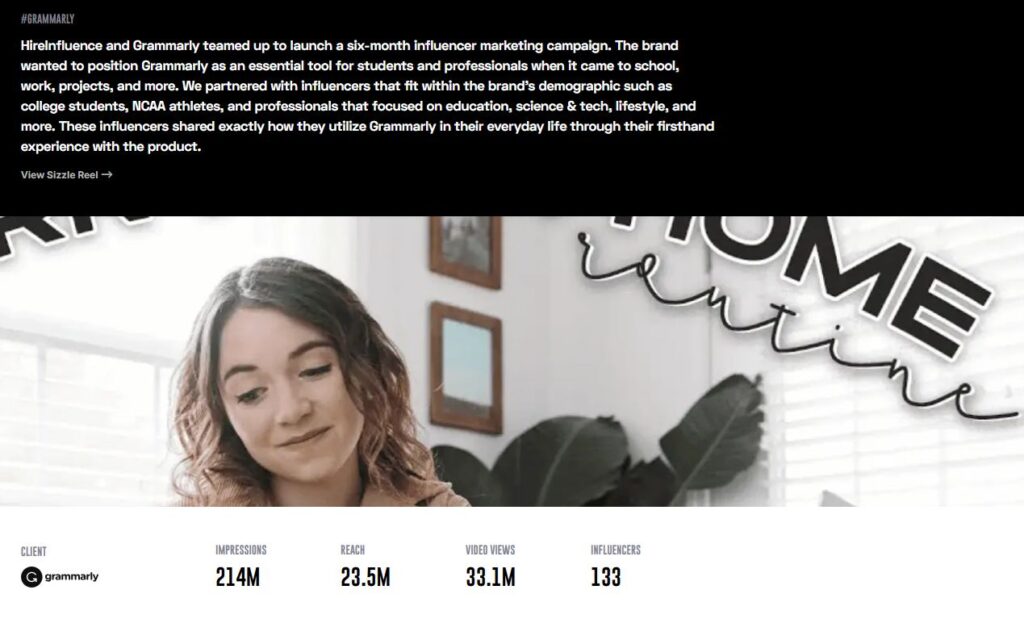
Program delivery is where an enterprise thesis meets real numbers, and the firm’s record shows the scale a disciplined program can reach. A creator activation for the writing-assistant brand Grammarly mobilized 133 creators and generated 214 million impressions, evidence that a technology narrative can travel at consumer scale when the roster is built around credibility rather than raw follower counts. That breadth matters for software, because a single champion rarely reaches every stakeholder in a buying committee, and a coordinated set of trusted voices does.
Depth matters as much as breadth. The Ricola case study reached 26 million impressions through a tightly managed creator roster, a reminder that reach and control are not opposites when a program is engineered rather than improvised. For a B2B software brand, the lesson translates directly: the goal is not the largest number of posts, it is the right posts reaching the right reviewers with a message that survives technical scrutiny. Brands can review the broader body of work in the firm’s work portfolio to see how program structure changes outcomes across very different categories, from consumer packaged goods to enterprise technology, where roughly 50% of the value comes from getting the roster right before a single brief goes out.
How to Evaluate a B2B SaaS Influencer Agency
First, ask how the agency identifies creators who hold real authority with technical and executive buyers rather than large but irrelevant audiences. The agency should be able to walk through its vetting method, showing how it confirms that a creator’s followers include the security, engineering, and finance stakeholders a software purchase depends on.
Second, ask how the agency keeps technical accuracy intact when a creator translates a product into their own point of view. The agency should describe a briefing and review process that protects credibility with expert audiences without flattening a creator’s voice into a script.
Third, ask how the agency reaches the hidden buyers who influence a deal without ever using the product. The agency should show content strategy that speaks to finance and operations reviewers, not only to the practitioner who will log in every day.
Fourth, ask how the agency measures contribution to pipeline rather than impressions alone. The agency should connect creator activity to opportunities and influenced revenue, and explain the attribution model it uses to do so.
Fifth, ask how the agency prices a program and where the money actually goes, using a resource like this cost of influencer marketing guide as a reference point. The agency should be transparent about the split between creator fees, production, media, and management, so a brand understands what it is buying at every line.
The HireInfluence Model for B2B SaaS Influencer Marketing
HireInfluence was founded in 2011 and operates as a team of more than 25 specialists across over 10 states, with offices in Houston, The Woodlands, Austin, Los Angeles, and New York. The firm works to a six-figure engagement floor, a threshold that reflects the depth of strategy, vetting, and measurement an enterprise program requires rather than a transactional posting service. That model was recognized as Marketing Agency of the Year at the 2024 MUSE Creative Awards and as Digital Marketing Agency of the Year at the 2026 U.S. Agency Awards, and the firm is a partner in the TikTok Shop Lite Program, giving it a foothold in social commerce alongside its enterprise work.
The client roster spans categories that demand exactly the kind of credibility a software buyer looks for, including Microsoft, Meta, Grammarly, Walmart, Target, and Coca-Cola. Working with technology and consumer brands at that level means the firm has built programs for audiences that scrutinize claims closely, which is the same discipline a B2B SaaS narrative demands on LinkedIn.
Before founding the firm in 2011, Jason Pampell spent his career pricing content rights, licensing, and media partnerships for Forbes and Billboard, work that treated editorial credibility as a measurable asset rather than a soft benefit. That lens carries directly into enterprise software, where a founder’s argument or a practitioner’s walkthrough is the asset that moves a buying committee, and where the firm’s job is to price, place, and protect that credibility the way a media company would. It is why the HireInfluence model starts with who is trusted, not who is loud.
Brands weighing a program can read more in the firm’s about section or start a conversation through its contact page. The research behind this discipline is blunt about the stakes: strong thought leadership can lower a buyer’s reliance on brand recognition, while thin content actively erodes trust with the exact stakeholders a software deal depends on. For an enterprise software brand, that is the whole argument for treating LinkedIn influence as a governed discipline rather than a campaign afterthought, and for choosing a partner that measures credibility the way the study measures it.