
Enterprise brands building creator affiliate marketing programs generally assume affiliate is where creator content naturally ends up, and a survey of 204 marketing leaders at organizations above $10M in revenue found it is where creator content ends up least. Creator content now flows into display advertising at 46%, content marketing at 44%, and user-generated content at 41%, while affiliate marketing trails at 38% and connected TV sits at 35%. On social, 92% of brands run creator content in ads and allocate 20% of budgets to boosting it. Within retail media networks, creator marketing has climbed to the second highest investment priority, up from third in 2024. Read together, those figures describe an odd preference. Brands deploy creator content most readily into the channels that count exposure, and least readily into the one channel where a recommendation and a purchase share a single record.
Table of Contents
Why Affiliate Is the Deployment Brands Reach For Last
The ranking is the finding. If creator content were being allocated on the basis of what it demonstrably does, the deployment that closes a transaction would not sit below display advertising by eight points. Display is a placement. Content marketing is a publishing exercise. Both are perfectly reasonable uses of creator material and neither produces a record of a sale caused by a specific creator. Affiliate does, which makes its position near the bottom of that list a statement about organizational preference rather than about performance. The channels that grew fastest are the ones where the creator’s contribution can be described. The channel that grew least is the one where it can be settled.
The explanation is not that affiliate underperforms. It is that affiliate is the only creator deployment that produces a number nobody can argue with, and a number nobody can argue with is a liability inside an organization that has not decided what creator content is for. An impression total can be presented to a finance committee as progress. A creator-attributed revenue figure can be presented only as itself, and if it is small, it is small in a way that no reframing survives. Every other deployment on that list permits the campaign to be described as successful. Affiliate permits the campaign to be measured, which is a materially less comfortable arrangement.
That discomfort is worth taking seriously rather than mocking, because affiliate genuinely does not measure the whole of what creator content does. A creator’s post that produces no tracked sale may still have moved a purchase that happened three weeks later in a physical store. Affiliate attribution captures the portion of the effect that runs through a link, and that portion is not the effect. A brand that migrates entirely to affiliate accounting will systematically underrate creator work, and the migration will feel like rigor while it is happening. Rigor and completeness are unrelated properties.
The correct reading sits between the two errors, and it is structural rather than tactical. Affiliate should not be the deployment a brand reaches for last, and it should not be the only deployment a brand trusts. It is the instrument that anchors the rest. When a brand runs creator content into display, content marketing, and connected TV, it accumulates a large volume of exposure it can describe and cannot verify. Running the same creators through an affiliate structure alongside those deployments produces a tethered point: a known set of creators, a known set of content, and a recorded set of transactions attributable to them. The anchored point does not measure the whole program. It calibrates the claims made about the rest of it.
The reason enterprise brands struggle to reach that arrangement is that affiliate carries commercial terms the other deployments do not. Display placement requires a media buy. Affiliate requires a commission structure, which requires deciding in advance what a creator’s recommendation is worth as a share of the revenue it produces, and that is a negotiation the brand cannot postpone or paper over. It has to be settled before the creator posts, at a rate the creator will accept, on attribution rules both parties can inspect. That work sits in contracting and finance rather than in marketing, and it is genuinely harder than buying a placement. The trailing position of affiliate in the deployment ranking is, in large part, an artifact of that difficulty rather than a judgment about the channel.
What Enterprise Brands Should Expect From a Creator Affiliate Partner
Program strategy and design. The agency has to decide where the affiliate structure sits relative to the rest of the creator program, because affiliate run as a separate initiative competes with the brand’s other creator work instead of anchoring it. The design question is which creators carry commission alongside their fee and which do not, and it is answered at the planning stage inside dedicated campaign services rather than after a roster is booked.
Creator sourcing and verification. The agency has to source for conversion behavior rather than for reach, because a creator whose audience buys and a creator whose audience watches are different assets and follower counts do not distinguish them. Verification carries specific weight in a commission structure, since a fabricated audience produces no transactions and therefore costs a brand nothing in commission while consuming the fee, which makes affiliate the deployment where audience fraud is most visible and least expensive.
Platform and commerce integration. The agency has to build the tracking path before the content exists, because a commission structure with no reliable attribution is a dispute waiting to be scheduled. Link infrastructure, code assignment, and the handoff into the brand’s commerce stack determine whether a creator’s contribution can be recorded at all, and those decisions are made at setup or not made.
Creative direction and content production. The agency has to direct creative toward the specific act the commission pays for, since content optimized for watch time and content optimized for a click are structurally different and a brief that requests both delivers neither reliably. The UGC overview covers how creative supply gets structured; the affiliate layer adds the requirement that the content contain a reason to act now.
Audience and segment-specific execution. The agency has to accept that affiliate performance varies by segment in ways that reflect purchase behavior rather than content quality, and to plan for it. A segment that researches for weeks before buying will show weak affiliate numbers behind strong creator content, and a program that reads that as creative failure will optimize away the work that was doing the most.
Cross-platform orchestration. The agency has to know which surfaces support a commission structure and which do not, because affiliate viability is a property of the platform rather than of the campaign. That constraint shapes channel selection before creative is briefed, and the TikTok influencer marketing resource is useful background on how one commerce-capable surface behaves in that role.
Paid amplification. The agency has to resolve who earns commission when a creator’s content is amplified with brand money, because the answer is not obvious and an unresolved answer becomes a conflict once the content performs. Amplified creator content converts against a paid audience the creator did not build, and the commercial treatment of that case runs through the specialties and services capability.
Attribution and measurement. The agency has to report affiliate revenue as a floor rather than as a total, and to say plainly that the tracked figure is the portion of the effect that traveled through a link. That candor is what an analytics capability exists to supply, and its absence is how affiliate accounting quietly convinces a brand its creator program is smaller than it is.
Program Delivery Across Creator Affiliate Programs
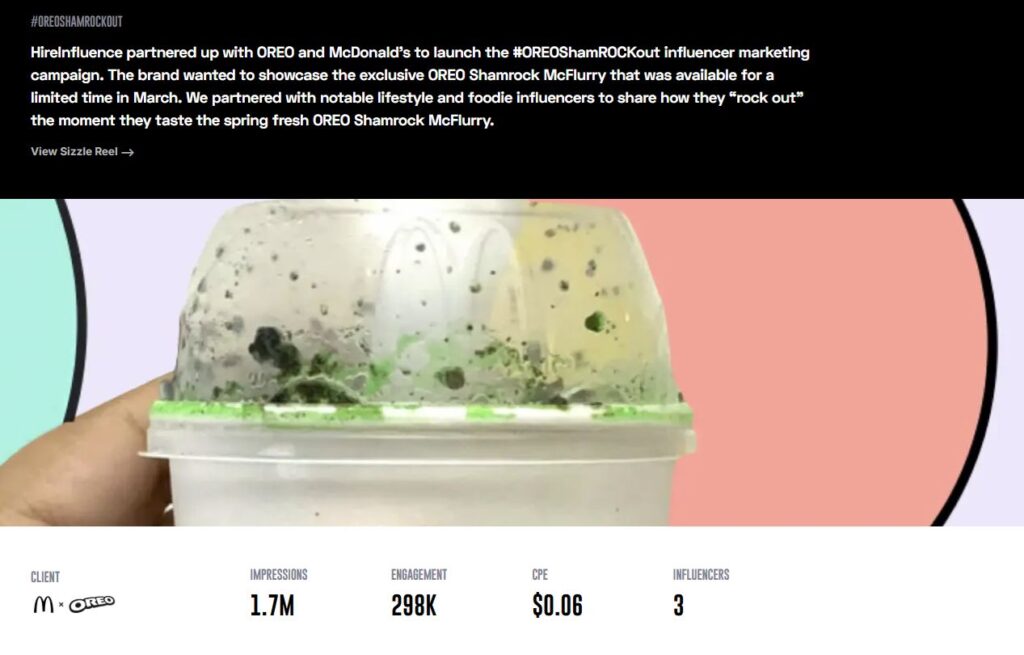
Southwest Airlines #SouthwestSaysAloha produced 56M impressions and 3M engagements, a scale that demonstrates what exposure looks like when a program is built for reach rather than for settlement. The Grammarly creator program ran 133 creators to 214M impressions and 33.1M views. The MTV #MyMTVStyle activation delivered 16.1M impressions and 216,600 engagements at $0.01 CPV and a $1.50 CPM. The Oreo and McDonald’s #OREOShamROCKout campaign returned 1.7M impressions at a $0.06 cost per engagement.
Set against those, the Ricola #CoatYourThroat program is the instructive case: 18 influencers, 26M impressions, 20.5M reach, a 13.17% engagement rate, and then 62,500 MikMak retail clicks. The first four numbers describe how many people encountered the work. The last one describes how many did something a system recorded, which is the entire difference an affiliate structure is built to produce. The Ricola case study and the work portfolio set out how that instrumentation was built.
How to Evaluate a Creator Affiliate Agency
First, ask how the commission rate was arrived at. The agency should be able to explain the rate as a function of margin, expected conversion, and what the creator would otherwise charge, rather than presenting a category default.
Second, ask what the attribution window is and who chose it. The agency should be candid that window length is a commercial decision that moves money between the brand and the creator, and that a short window is not a neutral technical setting.
Third, ask what happens to a creator who drives no tracked sales. The agency should have a position on whether that creator is dropped, which requires having decided in advance whether affiliate is the program’s measurement or its whole rationale.
Fourth, ask how amplified content is treated in the commission structure. The agency should have resolved the case before it arises, because the alternative is renegotiating with a creator whose content is already outperforming.
Fifth, ask what the structure costs to run relative to a fee-only program. The agency should account for the contracting, tracking, and reconciliation overhead honestly rather than presenting commission as a way to pay less; the cost of influencer marketing guide frames that comparison.
The HireInfluence Model for Creator Affiliate Marketing
HireInfluence has run enterprise influencer programs since 2011, with 25 or more people across 10 or more states and offices in Houston and The Woodlands, Austin, Los Angeles, and New York. Engagements begin at six figures, which reflects the contracting and attribution infrastructure a commission structure requires rather than the volume of content produced. The firm won Marketing Agency of the Year at the 2024 MUSE Creative Awards and Digital Marketing Agency of the Year at the 2026 U.S. Agency Awards, and has been a TikTok Shop Lite Program partner since July 2024, which matters directly on a surface built to close transactions inside the content. Programs for Walmart, Target, Coca-Cola, McDonald’s, Oreo, and Ricola have been built with that commerce path instrumented from the start. The contact page and the about section describe how engagements are structured.
Before founding the firm, Jason Pampell spent years managing content rights, licensing, and strategic media partnerships for Forbes and Billboard. A licensing desk keeps a ledger, and the ledger records not who saw a property but who paid to use it. Attention was always the story a publisher told; settlement was the entry that made the story an asset. A commission structure asks a creator program for exactly that entry, and the reason so few brands run one is the reason so few stories become assets.
The benchmark research makes the final case on its own terms. When creator content is deployed into display, content marketing, and connected TV more readily than into the one channel that records a sale, the ordering has stopped reflecting performance and started reflecting what an organization is prepared to find out. When a brand is willing to be told the number, affiliate is not the deployment it reaches for last. It is the one that makes the others legible.