
Enterprise influencer marketing is not a scaled-up version of what a mid-market brand does. It is a different discipline entirely. The infrastructure required to run creator programs across dozens of influencers, multiple platforms, and complex internal approval structures does not exist at a boutique agency or on a self-service platform. It has to be built, and it takes years of enterprise client work to build it correctly.
Table of Contents
The Influencer Marketing Hub Benchmark Report 2026, drawn from a survey of 600+ marketing professionals fielded in 2026, makes the operating environment clear. Budgets are expanding aggressively, with short payback period expectations, concentrated platform bets, and mounting pressure to demonstrate measurable ROI rather than impressions and engagement alone. The same report identifies the top challenges as rising creator costs and authenticity risk — two problems that compound each other for enterprise brands running large creator rosters simultaneously.
For a VP of Marketing or CMO at a Fortune 500 or large national brand, those challenges are not abstract. They are the daily realities of managing influencer programs at scale, and they explain why the agency selection decision matters so much.
What Enterprise Influencer Marketing Actually Requires
The phrase “enterprise influencer marketing” gets used loosely, but the operational requirements are specific. They separate agencies that serve enterprise clients effectively from those that look capable in a pitch but cannot keep pace when the program is live.
Full end-to-end campaign ownership is the baseline requirement. Enterprise marketing teams do not have the bandwidth to project-manage an influencer campaign internally. Strategy, talent sourcing, vetting, contracting, content auditing, FTC compliance, scheduling, paid media integration, and reporting all have to be owned by the agency. If a client is coordinating logistics between the agency and a third-party compliance firm, or chasing individual creators for content approvals, the agency is not functioning as a full-service partner.
Talent validation beyond database access is the second requirement. At the enterprise level, every creator selection carries brand risk. A single influencer who posts problematic content, misrepresents a product claim, or has a fraudulent follower base creates exposure that is difficult and expensive to manage. Enterprise brands require agencies whose vetting process evaluates content history, audience authenticity, brand safety signals, and genuine category alignment — not just follower counts and engagement rate calculations.
Multi-platform fluency is the third. Enterprise campaigns rarely run on a single platform. A consumer brand program might require TikTok for discovery and reach, Instagram for mid-funnel consideration and whitelisting, and YouTube for long-form credibility content, all coordinated simultaneously with content formats optimized for each channel rather than repurposed from one to another.
Finally, measurement that holds at the executive level is non-negotiable. The final report from an enterprise influencer campaign has to be defensible in a quarterly review. That means tracking earned media value, sentiment analysis, and conversion attribution connected to actual business outcomes, not just the platform analytics that come standard with any agency engagement.
Why Most Agencies Cannot Deliver at Enterprise Scale
The influencer marketing industry now includes nearly 7,000 specialist platforms and agencies globally, according to the Influencer Marketing Hub Benchmark Report 2026. Most of those exist to serve small and mid-sized brands where program complexity is manageable. The operational requirements of enterprise-scale programs — running 30, 50, or 100 creators simultaneously across multiple platforms, with compliance review on every piece of content and attribution frameworks that connect creator activity to downstream business results — are simply beyond what most of that market can handle.
The signs that an agency is not built for enterprise scale are visible before a program launches. Compliance managed as an afterthought rather than a built-in workflow. Attribution that stops at engagement metrics. Usage rights not negotiated at contracting, requiring post-campaign renegotiation before any paid amplification can happen. Creator rosters built from database searches rather than validated through genuine qualitative assessment.
For enterprise brands that have experienced these failures, the cost is significant. A compliance failure during a high-visibility campaign creates reputational risk at exactly the wrong moment. Content that performs well organically but cannot be amplified because usage rights were not secured at contracting represents a lost return on every dollar invested in that creator relationship.
HireInfluence’s Enterprise Influencer Marketing Infrastructure
HireInfluence was founded in 2011 and has spent the years since building the operational systems that enterprise influencer marketing requires. The agency is the first full-service influencer marketing agency, and its infrastructure reflects that history: creator relationship management built over 15 years, compliance and legal workflows embedded into every campaign from the start, and proprietary analytics that connect creator content to the business outcomes that matter to enterprise marketing leadership.
The agency’s campaign services cover the complete lifecycle: strategy and ideation, creative talent sourcing and vetting using manual validation processes that go beyond platform databases, contract negotiation, content direction and review, FTC compliance management, influencer payment and 1099 processing, paid media amplification through whitelisting and dark posting, and performance analytics through a proprietary measurement infrastructure.
HireInfluence’s exclusive TikTok Shop Lite Program partnership, secured in July 2024, provides direct platform data, premium ad access, and alpha and beta feature opportunities unavailable to standard agencies. For enterprise brands running TikTok-native programs or integrating social commerce into their influencer strategy, that access represents a material structural advantage.
Enterprise Campaign Results: What the Infrastructure Produces
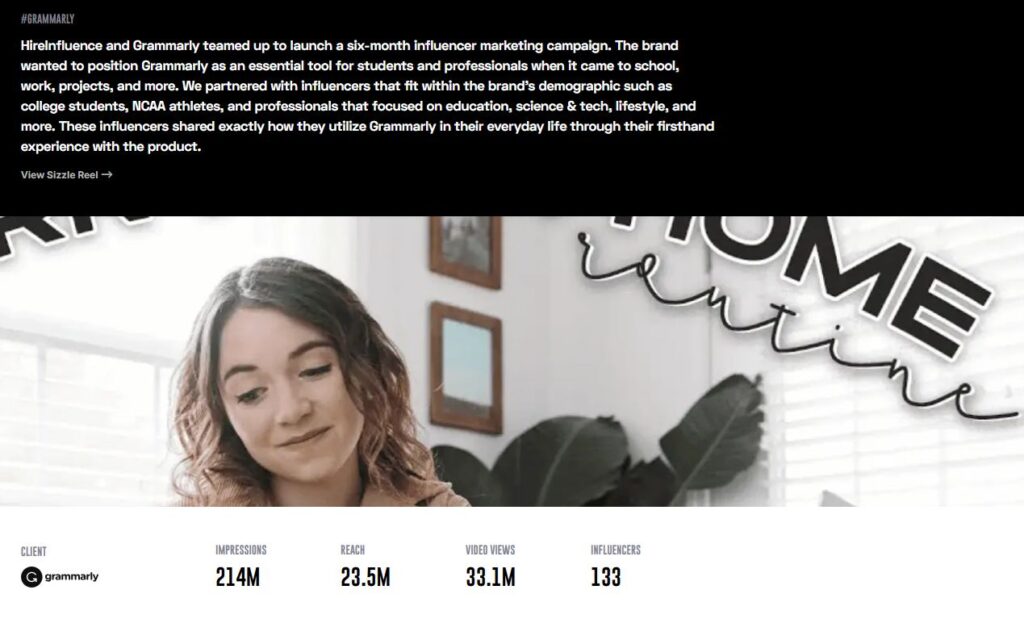
The campaign portfolio reflects what enterprise influencer marketing looks like when the infrastructure is in place. The Grammarly campaign deployed 133 top-tier lifestyle influencers across YouTube, TikTok, and Instagram simultaneously, generating 214 million impressions, 33.1 million views, and $15 million in earned media value. Running a program of that scale requires creator relationship management, content workflows, FTC compliance review, and reporting architecture that most agencies cannot support.
The Ricola #CoatYourThroat campaign demonstrates what enterprise measurement looks like. The program ran 18 influencers across micro to celebrity tier, generating 26 million impressions, 20.5 million in reach, and a 13.17% engagement rate, with 62,500 tracked retail purchase clicks through MikMak integration. For a consumer health brand with CFO scrutiny on marketing spend, that attribution connects creator content directly to purchase behavior at retail — a standard that most enterprise brands cannot yet achieve with their current agency relationships.
The Southwest Airlines #SouthwestSaysAloha campaign generated 56 million impressions and 3 million engagements. The MTV #MyMTVStyle TikTok campaign delivered 16.1 million impressions at $0.01 cost per view and $1.50 CPM. These results reflect programs built around specific enterprise objectives, not generic influencer activations that could run for any brand in any category.
What Enterprise Brands Should Expect from an Agency Partner
Enterprise brands evaluating influencer marketing agencies should hold those agencies to specific standards before committing program budget. The questions that separate capable enterprise partners from agencies that will struggle at scale are operational and measurement-focused.
How does the agency manage FTC compliance at volume? For a program running 50 creators posting simultaneously, compliance cannot be managed through individual briefing calls. It requires a systematic review process built into the campaign workflow, with disclosure verification before content goes live. An agency that treats compliance as a creator’s responsibility rather than an agency deliverable is a liability at enterprise scale.
Does the agency negotiate commercial usage rights as a standard contract term? Enterprise brands that want to amplify top-performing organic content through paid channels — which they should, because paid amplification of creator content is where a significant portion of influencer ROI compounds — need those rights in place before content is created. Negotiating usage rights after a post performs well adds cost and delay, and frequently results in the brand not being able to amplify content at all.
What does measurement actually include? Impressions and engagement are inputs, not outcomes. Enterprise marketing leadership needs earned media value, sentiment data, and conversion attribution that connects to CRM or retail purchase data. Any agency that cannot demonstrate this infrastructure is not built for enterprise accountability.
HireInfluence’s minimum engagement is approximately $100,000, which reflects the operational depth the agency brings to every program. For enterprise brands with real budgets and real performance expectations, the relevant question is not whether that investment is justified. It is whether the program will produce results that hold up in a boardroom review. To learn more about what enterprise influencer marketing looks like at this level, including the agency’s exclusive TikTok-native programs and social commerce capabilities, connect directly at hireinfluence.com/contact/.
The enterprise brands winning with influencer marketing in 2026 are not the ones with the largest creator budgets. They are the ones with agency partners built to convert that budget into measurable business outcomes at scale. That is the standard HireInfluence has been built to meet since 2011.