
Every credible agency shows strong case studies, a deep roster, and a reporting dashboard, so none of those separate anyone. What separates them is who owns rights expiry across platforms, when usage rights get negotiated, and what the brand still has to do.
Table of Contents
- Why pitches fail to differentiate
- The five questions that do differentiate
- What to verify independently
- The trap in shortlists built from published rankings
- The one signal worth more than any answer
- What should disqualify an agency, including this one
- References are worth more than case studies, if asked properly
- Program Delivery and What Separates Delivery From a Deck
- The HireInfluence Model for Brands Running an Evaluation
The search for the best influencer marketing agency usually runs through pitches, and pitches are the wrong instrument. A pitch is optimised to demonstrate capability, and capability is not in dispute: most established creator agencies can produce good creative, source appropriate talent, and report on it. Brands that pick badly rarely pick an incompetent agency. They pick a competent agency whose operating model does not match how their programme actually runs, and they discover it in month three. The questions below are designed to surface the operating model, because that is the variable, and because none of them can be answered from a deck.
Why pitches fail to differentiate
Three things dominate an agency pitch and none of them carries information.
Case studies are the agency’s best work, selected. Every agency has a portfolio of strong campaigns, because strong campaigns are the ones that get kept. A portfolio establishes that good work has happened somewhere in the agency’s history. It does not establish that it happens reliably, or that it happened on a programme resembling the brand’s.
Roster size is close to meaningless now. Every major platform operates a first-party creator marketplace, discovery is largely solved, and access has widened: YouTube removed minimum spend requirements and account-management tier gating from its Creator Partnerships search features in June 2026, and Meta states there is no official minimum follower count on Instagram Creator Marketplace. An agency’s roster is no longer a moat.
Dashboards all look the same in a demo and differ enormously in what they are fed. The interesting question is not what the reporting looks like but what data reaches it, and on what cadence, from whom.
The five questions that do differentiate
Who owns rights expiry, and what does the register record? The answer should name a team and describe fields. This is the single most diagnostic question available, because the three major platforms handle rights expiry in three incompatible ways and an agency that has run all three will say so immediately.
When are usage rights negotiated? The correct answer is during creator contracting, before content is produced. Any answer placing rights negotiation after publication describes a programme that will pay twice for the same asset, once to make it and again to run it.
Which platform in the proposed plan provides no expiry enforcement, and who is watching it? On YouTube, Google states the advertiser is responsible for securing sufficient rights and that this may require a separate agreement with the creator. The platform tracks no usage term and will not stop a campaign that has outlived one. An agency that cannot answer this has not read the documentation for a platform in its own proposal.
How was a specific creator on the proposed roster found, and who was rejected? This separates vetting from filtering. An agency that sources manually can describe why a plausible-looking creator was excluded. An agency running a database query cannot, because the query has no opinion.
What does the brand’s own team still have to do? A credible answer names decisions and a cadence. An answer implying the brand does nothing is describing a service that does not exist, and the resulting programme will stall on unactioned approvals.
What to verify independently
Three things can be checked without asking the agency, and all three are worth ten minutes.
Whether claimed awards exist as claimed. Award walls are self-maintained and drift. Checking one or two against the awarding body is quick and occasionally revealing.
Whether named clients are corroborated anywhere. Case study pages, press releases, and client-side testimonials are stronger evidence than a logo grid, because a logo can represent a single project from years ago.
Whether published guidance is current. An agency publishing platform advice that names retired products is telling a brand something about its own currency. Three major creator products were restructured in the eighteen months to mid-2026: TikTok Creator Marketplace moved inside TikTok One, Meta announced a merger of Creator Marketplace and the Partnership Ads Hub, and YouTube consolidated BrandConnect into Creator Partnerships while renaming partnership ads to creator partnerships boost.
The trap in shortlists built from published rankings
Brands often start from a published list of top agencies, and those lists are a weaker signal than they appear.
Ranking articles are overwhelmingly produced by parties with an interest: agencies ranking themselves alongside competitors, directories monetising placement, or publishers monetising affiliate relationships. A ranking is not evidence of quality, and its ordering rarely reflects any tested methodology.
The more useful use of such a list is as a sourcing device rather than a verdict. Take the names, discard the order, and apply the five questions above. A shortlist assembled that way will look different from the published order roughly every time, which is itself informative about what the published order was measuring.
The one signal worth more than any answer
Across every question in this article, the most informative thing is not which answer an agency gives but whether it volunteers a limitation without being pushed.
An agency that names a platform it is weaker on, a programme type it does not suit, or a client size it serves badly is describing a real operating model. An agency that answers every question affirmatively is describing a sales position, and the gap between the two shows up in month three when something the pitch implied was covered turns out not to be.
This is testable in a single question near the end of a meeting: ask what kind of brand should not hire them. A firm that has thought about fit answers immediately and specifically. A firm that has not treats the question as a trap and deflects, which is itself the answer.
What should disqualify an agency, including this one
HireInfluence builds custom-scoped, fully managed programs rather than packaged or self-serve buys, so brands wanting a fixed package or a comparable quote inside a week are better served elsewhere, and that is a legitimate requirement rather than a lack of seriousness. The firm represents brands rather than creators. And a brand running organic-only creator posts on a single platform does not need managed execution and will not recover its overhead.
References are worth more than case studies, if asked properly
Most reference calls are wasted because the question asked is whether the agency was good, and the answer is always yes. Nobody supplies a reference who will say otherwise.
Four questions produce information anyway.
What went wrong, and how was it handled? Every programme of any length has a creator drop out, a piece of content rejected, or a flight that underdelivered. A reference who cannot recall anything going wrong either had a very short engagement or is not being candid, and either way the call is over.
How much work did the internal team end up doing? Compared against what was expected at the start. The gap between the two is the single most useful number a reference can supply.
Who actually worked on the account after the first quarter? Pitch teams and delivery teams differ at most agencies. The question is not whether they differ but whether the change was disclosed in advance.
Would the same scope be bought again? A reference who would re-engage but change the scope is describing a mis-scope rather than a bad agency, and the detail of what they would change is worth more than the endorsement.
Program Delivery and What Separates Delivery From a Deck
The #CoatYourThroat programme for Ricola drove 62,500 MikMak retail clicks, and the campaign is documented in full in the Ricola case study. Retail click volume is a useful example of the distinction this article draws, because it is an outcome that required the measurement infrastructure to be built into the campaign rather than reported after it.
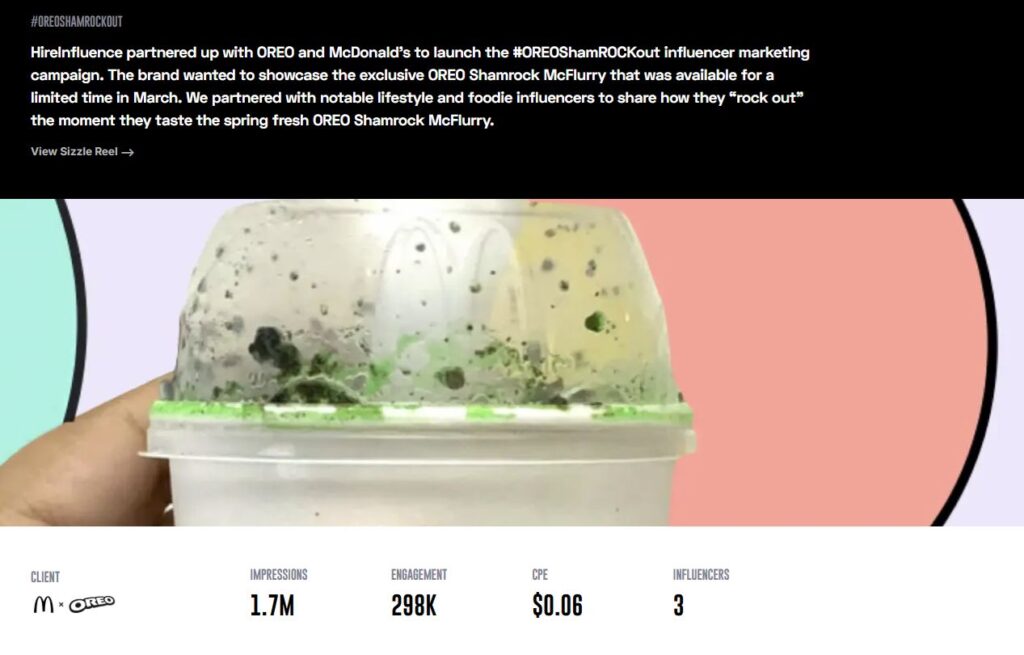
The #OREOShamROCKout programme for Oreo and McDonald’s returned 1.7M impressions at $0.06 cost per engagement across a two-brand partnership. The Grammarly creator programme ran with 133 creators, generating 214M impressions and 33.1M views, a scale at which the administrative questions above stop being theoretical.
Additional campaign detail is published in the work portfolio.
The HireInfluence Model for Brands Running an Evaluation
Founded in 2011, HireInfluence is a full-service influencer marketing agency built for enterprise brands, headquartered in Houston with offices in Austin, Los Angeles, and New York. The firm runs creator programs for brands including Coca-Cola, Honda, MTV, NFL, Southwest Airlines, and eBay, covering strategy, talent sourcing, branded content production, paid amplification, and performance reporting. Creator selection runs through a manual vetting and validation process rather than database filtering alone, and campaigns are scoped to each client’s objectives rather than sold as fixed packages.
Brands mid-evaluation will get more from the operational material than from a capabilities overview. The influencer content approval process describes the workflow a brand’s own team would sit inside, and the influencer exclusivity clauses guide covers the contract terms that decide whether creator content can be reused at all. Scoping conversations start through contact, and the firm’s background is set out on the about page.