Boston brands operate in one of the most diverse enterprise markets in the country. Life sciences, consumer goods, financial services, technology, and retail all have significant footholds here, and the marketing teams running those brands need an influencer marketing agency that can match their sophistication. HireInfluence has been doing exactly that since 2011.
Table of Contents
- Boston’s Enterprise Market Is More Than Big Tech
- What Full-Service Influencer Marketing Actually Means
- The Compliance Dimension Boston Brands Cannot Ignore
- Attribution That Answers the Questions Boston Marketers Actually Ask
- Multi-Platform Execution for Boston’s Diverse Brand Mix
- Paid Amplification and Whitelisting Built Into Strategy
- UGC as a Structured Asset Channel
- Why National Reach Matters for Boston Brands
- What Boston Brands Should Ask Before Choosing an Agency
Boston’s Enterprise Market Is More Than Big Tech
A lot of cities get reduced to a single industry narrative when it comes to marketing. Boston resists that. According to the City of Boston’s official business development resource, the city is home to seven Fortune 500 headquarters including State Street, Vertex, Liberty Mutual, and Wayfair. Massachusetts-headquartered companies received $7.89 billion in venture capital funding in 2024, and Boston has ranked second in the country for AI company VC funding every year since 2020.
That breadth creates a genuinely complex influencer marketing environment. A financial services brand running a creator program has different compliance requirements than a consumer goods brand. A life sciences company working with health-adjacent influencers faces disclosure and accuracy standards that most agencies are not equipped to manage. A consumer footwear brand, and Boston is home to New Balance, Converse, Puma, Reebok, and Clarks, needs creators who can drive product demand with audiences that convert.
One agency handling all of those categories well is a short list. HireInfluence is on it.
What Full-Service Influencer Marketing Actually Means
Most agencies describe themselves as full-service. What that usually means in practice is creator sourcing, content posting, and a report of impression counts at the end. That is not full-service. That is the minimum viable version of influencer marketing.
Full-service, for a Boston enterprise brand, means the agency manages creative talent sourcing, rigorous creator vetting, FTC compliance across every piece of content, influencer contracting and payment, paid media amplification, multi-platform coordination, and performance measurement with attribution models that connect creator activity to business outcomes. It means the brand’s internal team is not spending hours managing compliance checklists, creator invoices, or post-campaign reporting that does not answer the questions senior leadership actually asks.
HireInfluence handles every layer of that work. The agency’s minimum engagement is approximately $100,000, which reflects the infrastructure it brings to every campaign. That threshold exists because HireInfluence is built for brands with real budget commitments and real performance expectations, not pilot programs.
The Compliance Dimension Boston Brands Cannot Ignore
Boston’s market concentration in life sciences, financial services, and healthcare-adjacent industries makes FTC compliance a more pressing concern here than in almost any other city. Influencer content that makes implied health claims, references financial products, or promotes pharmaceutical-adjacent brands without proper disclosures is a liability issue, not just a marketing problem.
HireInfluence manages FTC compliance as a core operational discipline. Every creator in a campaign is subject to content review before posting, documented disclosure requirements enforced across every platform, and a compliance process that protects the brand if regulatory questions arise after the campaign. For brands with legal teams that review marketing activity, that infrastructure is not a differentiator. It is a prerequisite.
This operational depth extends to creator contracting and payment. HireInfluence handles influencer agreements, 1099 and payment services, and all back-office work that brands underestimate when they try to run campaigns internally or through agencies that are not properly structured for enterprise-scale programs.
Attribution That Answers the Questions Boston Marketers Actually Ask
The measurement gap in influencer marketing frustrates enterprise marketers everywhere, and Boston is no exception. Impression counts and engagement rates are easy to deliver. Connecting creator activity to sales volume, brand lift, or cost-per-acquisition benchmarks that hold up in a quarterly business review is harder, and most agencies either cannot do it or deliver attribution models that fall apart under scrutiny.
HireInfluence’s analytics team builds attribution frameworks tailored to each campaign’s specific objectives. That means different approaches depending on whether the goal is retail purchase volume, app downloads, lead generation, or awareness lift in a specific demographic segment.
The Ricola #CoatYourThroat campaign is a clear example of what rigorous attribution looks like in practice.
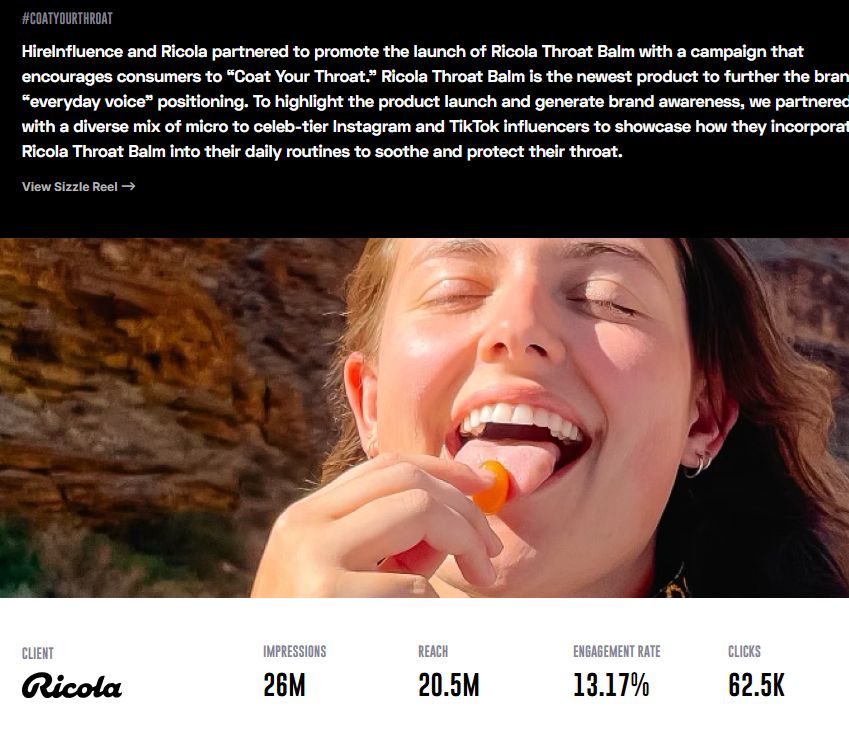
HireInfluence delivered 26 million impressions and a 13.17% engagement rate across 18 influencers spanning micro to celebrity tier, with 62,500 tracked clicks using MikMak retail purchase link integration.
That kind of attribution turns influencer marketing from a brand awareness exercise into a defensible budget line for a CMO presenting results to a board.
Multi-Platform Execution for Boston’s Diverse Brand Mix
Boston brands are not running single-platform campaigns. A consumer footwear brand needs TikTok and Instagram. A financial services company may need LinkedIn alongside YouTube. A life sciences brand with a consumer product line may need a completely different platform mix than its clinical or institutional counterpart.
HireInfluence runs campaigns across TikTok, Instagram, YouTube, Facebook, Pinterest, and LinkedIn as core competencies. The agency coordinates talent sourcing, content review, schedule optimization, and paid amplification across all active platforms within a single campaign, without the coordination gaps that come from managing channels in separate silos.
As an official TikTok Shop Lite Program partner with exclusive data and ad access secured in July 2024, HireInfluence also brings TikTok capabilities that most agencies cannot match. For Boston consumer brands with retail objectives, that partnership provides attribution infrastructure and campaign performance tools that generic agencies cannot replicate.
Paid Amplification and Whitelisting Built Into Strategy
Organic influencer reach has a ceiling, and Boston’s enterprise brands are sophisticated enough to know it. HireInfluence integrates paid media amplification into campaign strategy from the start rather than treating it as something to bolt on once organic results are in.
That includes influencer whitelisting, where paid ads run through the creator’s account rather than the brand’s handle. Whitelisted content consistently outperforms standard brand advertising because it carries the creator’s credibility with an audience that already trusts them. HireInfluence manages the full whitelisting setup, including dark posting configurations for brands that need paid creative running without it appearing publicly on the creator’s profile.
For Boston brands with paid media budgets to activate alongside influencer programs, that integrated approach extends reach and drives performance improvements across both channels simultaneously.
UGC as a Structured Asset Channel
One capability Boston brands frequently underutilize is UGC as a formal content production channel rather than just an organic byproduct of creator campaigns. HireInfluence offers White Glove UGC Services for enterprise clients, producing creator content that functions as a licensed library of brand assets available for deployment across paid media, website creative, email, and retail environments.
For Boston’s consumer brands with high ongoing content demands, UGC production at scale materially reduces cost per asset compared to traditional production. A campaign that delivers influencer reach and a reusable content library simultaneously does more work per dollar than one generating only social impressions.
This is a particularly useful lever for Boston’s footwear and consumer goods brands, which need a constant volume of fresh creative across channels and audiences throughout the year.
Why National Reach Matters for Boston Brands
HireInfluence does not have a Boston office. The agency is headquartered in Houston and The Woodlands, with additional offices in Austin, Los Angeles, and New York. For Boston brands evaluating enterprise influencer partners, that national footprint is an asset, not a limitation.
The agency’s client roster includes Microsoft, Oreo, McDonald’s, Southwest Airlines, Target, Meta, and Grammarly. The Grammarly campaign delivered 214 million impressions, 33.1 million views, and $15 million in earned media value across 133 top-tier influencers on YouTube, TikTok, and Instagram. That is the scale of execution Boston enterprise brands should benchmark when choosing a partner.
In 2026, HireInfluence won Digital Marketing Agency of the Year at the U.S. Agency Awards and Best Influencer Marketing Campaign at the Vega Digital Awards. Both are national-level recognitions reflecting performance at the scale Boston’s market demands.
What Boston Brands Should Ask Before Choosing an Agency
The right evaluation for a Boston enterprise brand goes beyond creator rosters and platform coverage. The more important questions are: Can the agency build attribution models that hold up in a quarterly review? Does it manage FTC compliance without pushing that work back to the client? Can it coordinate campaigns across multiple platforms without operational failures? Does it integrate paid amplification from day one?
Most agencies can answer yes to one or two of those. HireInfluence answers yes to all of them, backed by campaign history across industries that mirror the complexity of Boston’s market.
For Boston brands that are ready to run influencer marketing at the level their market requires, the conversation worth having is about what enterprise-grade execution actually looks like and what outcomes it produces.