
Most marketers already know intuitively that creator content drives purchases. The data confirms it. According to Sprout Social’s 2025 State of Influencer Marketing Report, based on a survey of 650 marketers across the US, UK, and Australia, 83% of marketers find that sponsored influencer content generates more conversions than organic content. Separately, 86% of consumers make at least one influencer-inspired purchase per year. These numbers reflect a channel that has crossed well past awareness into measurable commercial performance.
Table of Contents
The gap between knowing this and executing on it is where most enterprise brands lose ground. Running influencer campaigns that generate conversions requires more than finding creators with engaged audiences. It requires building attribution infrastructure before the campaign launches, structuring content specifically for conversion rather than engagement, pairing organic creator content with paid amplification to extend reach into high-intent audience segments, and reporting on outcomes that connect to the revenue metrics that leadership actually cares about. That is what separates a direct response influencer program from a brand awareness campaign with a purchase link tacked on at the end.
For enterprise brands running direct response programs at scale, the agency question is not whether influencer marketing services can drive conversions. It is whether your agency is built to execute campaigns that are designed from the start to produce them.
What Direct Response Influencer Marketing Actually Requires
The term “direct response” in influencer marketing means something specific: the campaign has a measurable conversion objective, a trackable path to that conversion for every creator and every piece of content, and reporting that shows whether the objective was met. It is the opposite of an awareness campaign measured on impressions and reach.
Building that infrastructure requires decisions made before the first creator is briefed. What is the conversion event? A purchase, a signup, a demo request, a trial activation? How will it be tracked? Unique UTM parameters per creator, branded promo codes, pixel-based conversion tracking, or a combination? What is the attribution window? What creative formats have demonstrated the highest conversion rates for this product category? What audience segments should paid amplification target to extend high-performing organic content beyond its initial reach?
Agencies that build direct response programs start with those questions. Agencies that retrofit performance tracking onto a campaign designed for awareness get engagement data and inconsistent conversion attribution. The distinction shows up in the reporting: one program tells the CMO which creators drove revenue and what it cost; the other delivers an impression count and a hope.
Creator selection also differs for direct response programs. Conversion-optimized campaigns favor mid-tier and micro creators with high-engagement audiences in the specific niche that matches the product, rather than large accounts with broad but less targeted reach. A 200,000-follower fitness creator whose audience actively purchases supplements, gear, and wellness products will consistently outperform a 2 million-follower general lifestyle creator for a direct response objective. Vetting creators with genuine conversion history in the relevant category is more important than follower count.
The Three Levers of Direct Response Conversion
Effective direct response influencer campaigns operate across three levers simultaneously: content, amplification, and offers.
Content for conversion is different from content for engagement. Engagement-optimized content invites comments, reactions, and shares. Conversion-optimized content moves a viewer from passive awareness to active intent. The most reliable formats for driving direct response from creator content are product demonstrations that show the item solving a real problem, honest reviews that address common objections before the viewer raises them, and time-limited offers that create purchase urgency. Creators who can communicate product benefits authentically in their own voice, rather than reading from a brand script, consistently produce higher-converting content because audiences trust the recommendation.
Paid amplification of high-performing organic content through whitelisting and dark posting is the force multiplier that takes a direct response program from niche reach to scalable performance. When a creator post is already converting at a strong rate organically, running that content as a paid ad through whitelisting, where the ad appears to come from the creator’s account rather than the brand’s, extends its reach to audiences who have never seen the creator’s organic content. Those ads consistently outperform brand-produced creative because they carry the authenticity of creator content while benefiting from the targeting precision of paid media.
Offers and incentives are often underused in direct response influencer programs. Unique promo codes per creator, time-limited discounts tied to specific content windows, exclusive bundles, or free trial activations all lower the friction between a viewer’s intent and a completed conversion. They also provide clean attribution data: a conversion tracked to a specific creator’s promo code is unambiguous evidence of that creator’s direct commercial contribution.
Measuring Direct Response Outcomes
The measurement framework for a direct response influencer program needs to connect creator activity to the business metrics that matter downstream. Impressions and engagement rates are input metrics. Direct response programs measure outputs: conversions, cost per acquisition, attributed revenue, and return on ad spend.
HireInfluence’s analytics infrastructure is built to deliver exactly this kind of reporting. The Ricola #CoatYourThroat campaign is the clearest example in the portfolio: 26 million impressions, a 13.17% engagement rate across 18 creators, and 62,500 tracked retail purchase clicks through MikMak retail link integration. The MikMak integration connected creator content directly to in-store purchase behavior, giving the brand unambiguous attribution data that tied influencer spend to product sales. That is what direct response measurement looks like when it is built into the campaign infrastructure from the start.
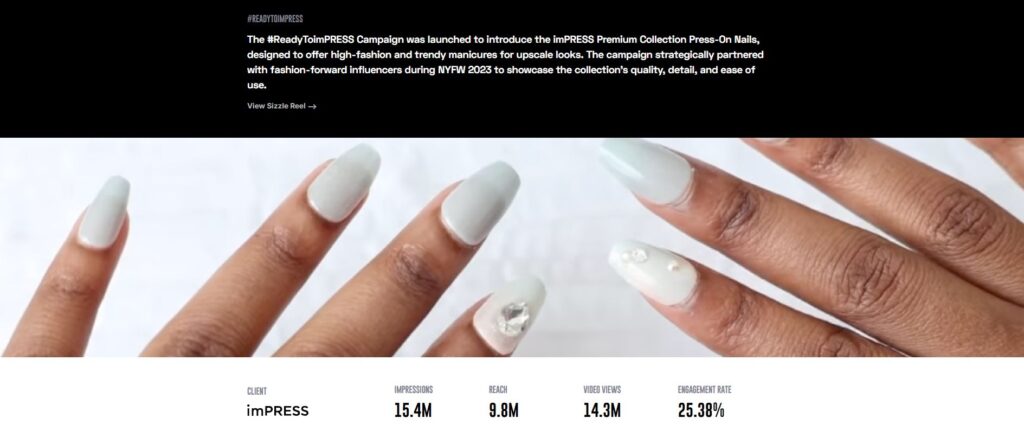
The imPress Nails campaign during New York Fashion Week demonstrates a different dimension of direct response: partnering with luxury fashion influencers whose audiences aligned precisely with the imPress brand, launching during a high-interest moment, and driving content with direct-to-website CTAs. The campaign was structured to convert fashion week attention into direct purchase activity, not just brand visibility.
Why HireInfluence for Direct Response
HireInfluence has been building full-service influencer campaigns since 2011, with an enterprise client roster that includes Oreo, McDonald’s, Grammarly, Ricola, Meta, and Southwest Airlines. The campaign work across those clients reflects programs built to drive measurable commercial outcomes, not just recognition. The agency is also an official TikTok Shop Lite Program partner with exclusive TikTok data and ad access, giving enterprise brands a direct connection to the platform’s highest-volume social commerce infrastructure for direct response programs.
Understanding the full cost of a direct response influencer program at enterprise scale, including creator fees, UGC production rights, paid amplification, tracking infrastructure, and reporting overhead, starts at approximately $100,000. For brands that need to demonstrate that influencer spend drives revenue rather than impressions, that investment buys not just creator relationships but the measurement architecture required to prove it.
Direct response influencer marketing is not a different kind of influencer marketing. It is influencer marketing executed with commercial discipline from brief to reporting. The brands that build it correctly turn creator content into a predictable revenue channel. The ones that do not continue running awareness programs and wondering why the purchase numbers do not move.