
When a CMO or VP of Marketing searches for an influencer marketing consultant, they are usually looking for one of two things. Either they want strategic guidance to build or improve their influencer program, or they want someone who can take over execution and run campaigns end-to-end. In practice, most enterprise brands need both, and the distinction between a consultant and a full-service agency matters significantly for which one they choose.
Table of Contents
- What an Influencer Marketing Consultant Does (And What They Often Cannot)
- What Enterprise-Level Influencer Marketing Strategy Actually Covers
- HireInfluence as Enterprise Influencer Marketing Consultant and Execution Partner
- When You Need a Full-Service Partner, Not Just a Consultant
- Platform and Content Strategy as Part of Consulting Services
- The Measurement Gap That Consultants Often Miss
- The Cost and Brand Safety Case for a Full-Service Partner
According to eMarketer, 79% of marketers cite measuring ROI as their biggest challenge in influencer marketing, and social media creator revenue is projected to reach $20.6 billion in 2026. The brands investing at that scale cannot afford to treat influencer strategy as a question of general principles. They need a partner who can translate strategic direction into campaign architecture, creator selection, paid amplification, compliance management, and performance measurement, all operating simultaneously.
What an Influencer Marketing Consultant Does (And What They Often Cannot)
A dedicated influencer marketing consultant brings specialized expertise in creator strategy, platform dynamics, and campaign structure. The best consultants do for influencer programs what a CMO does for a marketing department: they establish the framework, define success, and ensure that execution is aligned with business objectives. For brands that have never run a serious influencer program, a consultant’s strategic input can prevent expensive mistakes in creator selection, briefing, and measurement design.
The limitation of the pure consulting model is execution. A consultant advises. They typically do not source creators, manage contracts, brief talent, review content, handle FTC compliance, run paid amplification, or report results. For brands that need influencer programs to actually produce campaigns, not just strategy documents, the consulting model leaves a significant gap that the brand’s internal team has to fill, often without the capability to do so effectively.
Full-service influencer marketing agencies that also provide strategic consulting eliminate this gap. They bring the same strategic expertise as a dedicated consultant while also owning end-to-end execution. For enterprise brands with minimum campaign investments around $100,000, this integrated model consistently produces better results than outsourcing strategy to a consultant while trying to manage execution internally.
What Enterprise-Level Influencer Marketing Strategy Actually Covers
Effective influencer marketing strategy for an enterprise brand is not a single document. It is an ongoing operational framework that addresses several interconnected questions.
Which platforms, and in what priority order? TikTok is the dominant investment platform in 2026 for most enterprise brands, but the right mix depends on category, audience demographics, and campaign objectives. A strategic partner with deep platform experience builds this architecture from data rather than convention.
Which creator tiers, and what does the mix look like? The right tier strategy depends entirely on campaign objectives. Brand awareness at launch scale calls for macro and celebrity placements. Sustained consideration and conversion calls for micro and nano programs. Most enterprise campaigns require a coordinated multi-tier approach, which requires deliberate design.
How does paid amplification integrate with organic creator content? Creator content that performs organically almost always performs better when amplified through paid channels. Building this amplification layer into campaign architecture from the brief stage, rather than treating it as an afterthought, is a strategic decision that separates sophisticated programs from basic ones.
How is performance measured, and against what business outcomes? Impressions are not a business outcome. The measurement framework should connect campaign activity to retail attribution, sales lift, EMV, and cost per acquisition. Designing this framework requires both strategic expertise and technical measurement capability.
HireInfluence as Enterprise Influencer Marketing Consultant and Execution Partner
HireInfluence provides the strategic and executional depth that enterprise brands need from an influencer marketing partner. Founded in 2011, they have been executing enterprise influencer programs since before the modern creator economy took shape, which means their strategic frameworks are built from real campaign experience rather than theoretical best practice.
Their full-service campaign management covers every stage from strategy and creator identification through content review, paid amplification, compliance, and proprietary analytics. For enterprise brands that need a single partner to own both strategic direction and campaign execution, this is the model that delivers.
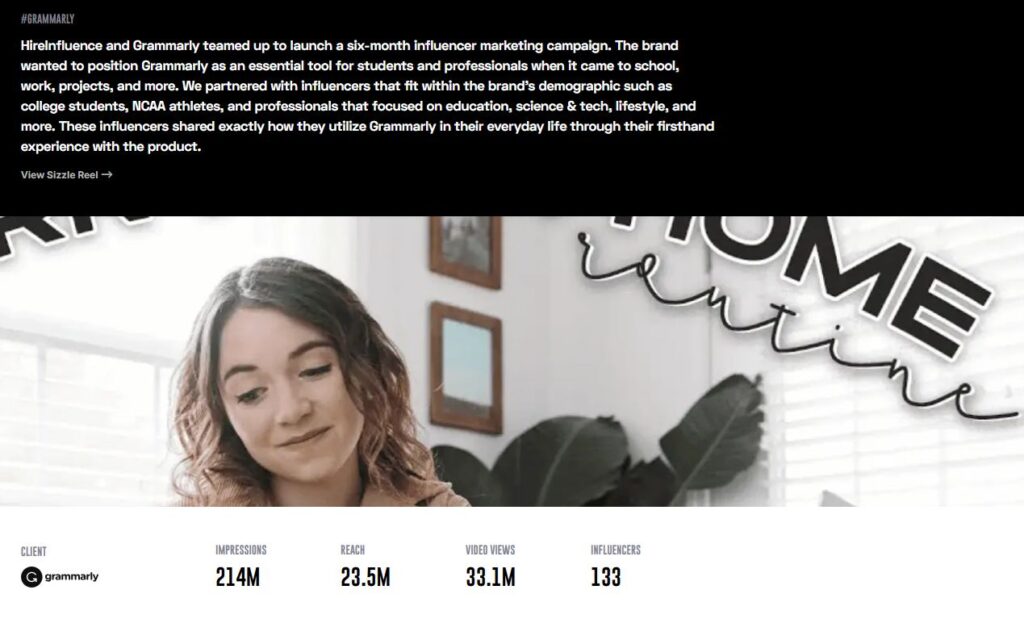
The Grammarly campaign illustrates what this integration produces at scale: 133 influencers across YouTube, TikTok, and Instagram, 214 million impressions, 33.1 million views, and $15 million in earned media value. The Ricola #CoatYourThroat campaign demonstrates measurement precision: 26 million impressions, 13.17% engagement rate, and 62,500 tracked retail clicks, all documented on the Ricola project page. These results reflect a partner who operates as both strategic consultant and execution agency.
When You Need a Full-Service Partner, Not Just a Consultant
The clearest signal that a brand needs a full-service partner rather than a standalone consultant is when execution is the constraint. If the brand has internal strategic capability but no operational infrastructure to source creators, manage contracts, handle compliance, and run paid amplification, a pure consultant will produce strategy that cannot be executed effectively.
For enterprise brands launching or scaling influencer programs, the most efficient path is a partner who covers both functions. HireInfluence’s work across enterprise brands including Microsoft, Target, Southwest Airlines, McDonald’s, and Grammarly reflects exactly this model: strategy and execution in one partnership.
Platform and Content Strategy as Part of Consulting Services
A capable influencer marketing consultant brings current, data-driven platform intelligence to every engagement. TikTok is the primary investment platform in 2026, with engagement rates and commerce conversion that no other platform matches. HireInfluence is an official TikTok Shop Lite Program partner, giving their strategic recommendations the backing of direct TikTok data and ad infrastructure access. More detail on TikTok influencer marketing strategy is available on the HireInfluence blog.
Understanding how user-generated content from creator programs functions as a paid and owned media asset is a foundational element of influencer marketing strategy. Brands that build this into their program architecture from the brief stage produce significantly more durable value from their creator investments.
For enterprise brands seeking influencer marketing consulting and full-service execution from a partner with a decade-plus track record at enterprise scale, contact HireInfluence. Minimum engagement is approximately $100,000.
The Measurement Gap That Consultants Often Miss
One of the most significant practical differences between a standalone influencer marketing consultant and a full-service agency is measurement infrastructure. Measurement in influencer marketing requires technical capability, not just analytical frameworks: tracked link management, retail integration setup (tools like MikMak), paid amplification platforms, whitelisting workflows, and analytics systems that aggregate performance across dozens of creators into campaign-level reporting.
A consultant can advise on what metrics to track and how to interpret results. They typically cannot build and operate the technical measurement stack. For enterprise brands where leadership requires the same ROI accountability from influencer programs as from any other media investment, this gap is material.
HireInfluence’s proprietary measurement capability, part of their analytics and performance services, covers the full technical stack. Tracked retail clicks, EMV calculation, paid amplification reporting, and creator-level performance attribution are standard components of every enterprise program. This is what turns influencer marketing from a channel that is hard to justify to a channel that competes on equal footing with paid search and display for budget allocation.
The Cost and Brand Safety Case for a Full-Service Partner
Beyond execution quality, there are risk management arguments for choosing a full-service agency over a consulting arrangement. Brand safety in influencer marketing requires ongoing monitoring: checking that creators maintain brand-compatible conduct, that disclosures remain compliant as FTC guidance evolves, and that content approvals happen before publication rather than after.
A consultant monitors and advises. A full-service agency monitors, advises, and acts, building brand safety protocols directly into campaign operations. For enterprise brands where a single non-compliant or brand-damaging creator post represents significant reputational and regulatory exposure, having an agency with operational ownership of brand safety is not a luxury.
HireInfluence’s FTC compliance management and content approval workflows are standard components of every enterprise program, providing the operational brand safety layer that the consulting model alone cannot deliver.