
Influencer marketing for big brands operates at a level of complexity, accountability, and risk that is categorically different from running creator programs for smaller organizations. The budget is larger, the internal stakeholder requirements are more demanding, the compliance exposure is greater, and the performance expectations are set against marketing teams that can compare creator outcomes against paid search, programmatic, and broadcast channels all producing their own attribution data.
Table of Contents
Big brands that run influencer marketing well do not just have bigger creator budgets. They have agency partners with the operational infrastructure to manage programs at enterprise volume, the compliance discipline their legal and regulatory teams require, and the measurement architecture to produce the kind of attribution that survives executive scrutiny. The difference between a big brand that generates consistent ROI from creator programs and one that treats influencer marketing as an expensive experiment is almost always the agency partner, not the brand.
According to Sprout Social’s 2026 social media marketing statistics research, 94% of organizations say influencer marketing outperforms traditional digital advertising, often delivering two to three times the returns. That performance advantage is real — but it is not guaranteed. It is earned by brands that run their programs with the same operational rigor and measurement discipline they apply to their highest-performing paid channels.
What Big Brands Require That Smaller Organizations Do Not
The requirements that distinguish enterprise influencer marketing from the programs smaller brands run are operational, legal, and strategic.
Approval chain complexity is the first. A big brand’s marketing campaign does not get approved by one person. It moves through creative, legal, compliance, brand, and executive review — sometimes sequentially, sometimes in parallel. An agency that builds campaign timelines without accounting for that approval structure will miss windows, create creator relationship friction, and produce rushed content that does not meet the brand’s standards. HireInfluence’s campaign management workflow builds internal approval cycles into the program timeline from the outset, so compliance and legal review is not a bottleneck but an integrated step.
Brand safety requirements are elevated. A compliance or creator behavior issue that creates a minor inconvenience for a small brand becomes a news story for a major one. Vetting that is adequate for a $50,000 program is not adequate for a $500,000 program with Fortune 500 brand equity at stake. HireInfluence’s creator evaluation process assesses full content history, ongoing posting behavior, audience composition, and brand alignment signals — not just followers and engagement rate.
Performance accountability is higher. Big brand marketing teams answer to boards, CFOs, and CEOs who evaluate marketing spend against business outcomes. The final report from an influencer campaign has to be defensible at that level: earned media value, conversion attribution connected to retail or digital purchase data, and sentiment tracking that shows movement in brand perception metrics.
HireInfluence’s Track Record with Major Brands
HireInfluence has built and managed influencer programs for some of the most recognized brands in the world. The confirmed client roster includes Microsoft, Target, Walmart, Coca-Cola, Southwest Airlines, McDonald’s, Oreo, Grammarly, MTV, Meta, and Ricola. These are not experimental clients. They are major organizations with serious marketing operations, demanding internal stakeholders, and high expectations for measurable outcomes. The agency relationships that have persisted across those brands reflect what happens when the operational infrastructure, compliance discipline, and measurement capabilities are all functioning at the level major brands require.
The agency’s campaign services are built specifically for this operating environment. Talent sourcing and vetting uses a manual evaluation process that goes beyond standard database access to assess audience authenticity, engagement quality, content history, and brand safety signals. Contract management includes commercial usage rights and exclusivity terms as standard — not negotiated separately for each creator after a brand discovers it needs them. FTC compliance is managed in-house, with documented review and sign-off before any creator’s content goes live.
The analytics platform is built to produce reporting that holds up in executive review. Earned media value, sentiment analysis, and conversion attribution are tracked through proprietary measurement infrastructure, with tracking setup completed before the first creator posts rather than assembled from available data after campaigns conclude.
HireInfluence’s exclusive TikTok platform access through the TikTok Shop Lite Program, secured in July 2024, gives major brands running TikTok creator programs direct platform data and premium ad capabilities that standard agencies cannot access. For big brands where TikTok is a primary or growing investment platform, that access is a structural advantage.
Verified Results for Major Brand Clients
The programs in HireInfluence’s work portfolio reflect what influencer marketing for big brands produces when the operational infrastructure matches the program’s scale.
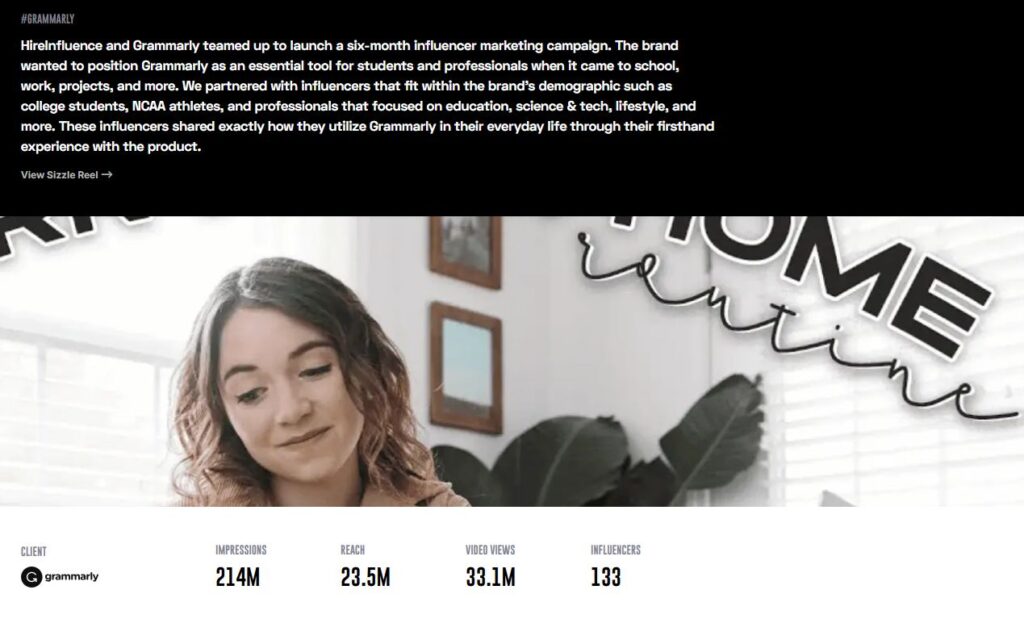
The Grammarly campaign — 133 top-tier creators across YouTube, TikTok, and Instagram — generated 214 million impressions, 33.1 million views, and $15 million in earned media value. Grammarly is a major software brand with a broad consumer and professional audience, and the program was built around a multi-tier creator mix that delivered reach and authentic product integration simultaneously.
The Ricola #CoatYourThroat campaign produced 26 million impressions, 20.5 million reach, and a 13.17% engagement rate across 18 creators, with 62,500 tracked retail purchase clicks through MikMak integration. For a consumer health brand with retail distribution at scale, that attribution — connecting creator content directly to in-store and online purchase behavior — is exactly what a major brand’s measurement team needs to justify continued investment.
The Southwest Airlines #SouthwestSaysAloha campaign generated 56 million impressions and 3 million engagements. The Oreo/McDonald’s #OREOShamROCKout campaign delivered 1.7 million impressions at $0.06 cost per engagement. The MTV #MyMTVStyle TikTok campaign reached 16.1 million impressions at $0.01 cost per view. Each of these is a documented outcome from a managed campaign for a recognized major brand.
Choosing an Agency for Big Brand Influencer Programs
Major brands evaluating influencer marketing agency partners should apply the same rigor to that evaluation that they apply to any significant vendor relationship. The questions that reveal whether an agency is genuinely built for big brand programs are operational and evidentiary.
Can the agency show specific campaign results — with creator counts, platform breakdown, and measurement methodology — for brands comparable in scale and category to yours? Not logos on a website, but documented outcomes from named programs. Any agency worth evaluating for a major brand engagement can produce this.
Does the agency manage FTC compliance in-house as part of the standard workflow, or does it delegate disclosure responsibility to creators? For a major brand where a compliance failure becomes public, this distinction is consequential.
Does the agency negotiate commercial usage rights as a standard contract term, or as a separate negotiation after content is created? Major brands running paid amplification programs need rights in place before content goes live.
HireInfluence’s minimum engagement is approximately $100,000. That threshold reflects the operational depth every engagement receives, and it positions the agency clearly in the enterprise segment where big brands operate. For major brands ready to build creator programs with the infrastructure and accountability those programs require, connect at hireinfluence.com/contact/. Learn more about the agency’s founding and approach at hireinfluence.com/about/, and review creator content program results across the confirmed portfolio.