The gap between “we ran some influencer posts” and “we built an influencer program” has become the defining line in New York enterprise marketing. Brands that still treat creator partnerships as one-off media buys are losing ground to competitors running fully serviced programs with strategy, creator vetting, content production, paid amplification, and attribution all coordinated under one roof. According to Linqia’s 2026 State of Influencer Marketing Report, 49% of marketers now work with specialist influencer agencies, up from 28% in 2025, while in-house management has dropped to 23%. That shift is especially pronounced among New York-based enterprise marketers, whose campaigns have to perform in the most competitive media market in the country.
Table of Contents
Influencer marketing services in New York are not interchangeable with “hiring a few creators.” The brands winning in this environment are buying a service stack, not a single deliverable. Strategy. Sourcing. Vetting. Creative direction. Contracting. Content approvals. Paid amplification. Attribution. Reporting. Optimization. When one of those pieces is missing, the program does not scale, and the data on performance variance shows it clearly. This guide breaks down what full-service influencer marketing services in New York actually include, what separates credible partners from bolt-on offerings, and which service components matter most for enterprise brands operating at NYC scale.
Why New York Enterprise Brands Need Full-Service, Not Piecemeal
New York is the most crowded attention market in the United States. Every major consumer brand runs influencer content here, competing against native New York voices, legacy media brands, and creators who live, post, and shoot in the five boroughs. For an enterprise marketer, that means a NY-targeted influencer campaign has a higher baseline for quality, a shorter tolerance for missteps, and a tighter window for audience impact than the same campaign activated in a smaller market.
The Linqia findings are instructive. Creative strategy emerged as the top agency differentiator in the 2026 report, followed by creator selection and measurement capabilities. Those three capabilities are the hardest to build in-house, which is exactly why 49% of marketers are now paying specialist partners to provide them. A brand marketing team can run a single campaign with a freelancer or a platform-only tool. What they cannot do with that setup is run an ongoing, always-on influencer program across multiple platforms, multiple creator tiers, and multiple quarters of performance optimization.
Full-service influencer marketing services in New York are designed specifically for that always-on scenario. The service stack is built around recurring program delivery rather than one-time execution. That architecture matters because 81% of marketers in the Linqia report say creator content outperforms brand-created assets, and 100% are repurposing creator content beyond the creator’s original post, which means a program run well produces content that flows through paid social, owned channels, retail media, CTV, and email. The intersection of creator content and user-generated content is where the most efficient NY enterprise programs are concentrating spend, because the same production session can produce assets used across channels for months. A partial-service agency cannot deliver that outcome because the program infrastructure does not exist.
The Core Service Components Every Full-Service Partner Should Offer
A credible full-service offering in the New York market covers eight distinct capabilities. The differences between strong agencies show up in the depth of each capability, not whether they appear on the services menu.
Strategy and program design. This is where the partnership either works or stalls. Program design covers campaign objectives, KPI definition, creator tier mix, platform strategy, budget allocation, cadence, and measurement methodology. For enterprise brands, strategy also has to account for regulatory compliance (FTC disclosure, category-specific rules for financial services, healthcare, and alcohol), brand safety frameworks, and integration with broader marketing calendars. HireInfluence builds this layer into every engagement through its influencer marketing campaign services, which cover end-to-end strategy from brief to reporting.
Creator sourcing and vetting. Database-only discovery is insufficient for NY enterprise work. Serious vetting includes audience authenticity analysis (fake follower detection, engagement quality review), brand safety screening (past posts, political history, category conflicts), audience demographic verification against the campaign target, and content quality assessment. An NY-based luxury fashion brand running creators during New York Fashion Week needs vetting calibrated to aesthetic fit and audience income bracket, not just follower count.
Creative direction and content production. Full-service partners go beyond brief delivery. They shape concept, visual direction, and messaging to match brand guidelines while preserving the creator’s authentic voice. For brands running content-heavy programs, that extends into on-set production support, content editing, and format adaptation for cross-channel use.
Contracting and rights management. Enterprise legal teams need partners who handle creator contracts with the protections that matter: usage rights (organic, paid, retail media, OOH), exclusivity windows, approval workflows, and indemnification clauses. Contract errors at the creator level create expensive downstream problems.
Paid amplification. Organic creator reach is the starting point, not the endpoint. Top-performing programs pair creator content with paid social amplification across Meta, TikTok, YouTube, and emerging platforms. Dedicated paid media services integrated with influencer campaigns extend reach into high-intent audiences and make performance measurable against acquisition goals.
Attribution and analytics. Measurement is the single biggest gap Linqia identified, with 79% of marketers citing ROI as their top challenge and 48% pointing to attribution as the largest measurement issue. Full-service partners provide attribution frameworks including UTM infrastructure, branded promo codes, pixel tracking, and in some cases direct commerce integration. HireInfluence’s influencer marketing analytics capability is built to address exactly that ROI gap for enterprise clients.
Ongoing optimization. One-off campaigns are a subset of what NY brands now run. Always-on programs, ambassador programs, and quarterly creator rotations require ongoing optimization based on performance data. That means real-time campaign monitoring, budget reallocation across creators and platforms, and iterative creative testing.
Executive reporting and stakeholder communication. Enterprise clients need reporting that translates campaign data into business outcomes for C-suite, board, and cross-functional stakeholders. That is a skill, not just a deck template.
New York Campaign Execution: What It Looks Like in Practice
Executing influencer marketing services at New York enterprise scale requires a track record of campaigns that match the demands of the market. HireInfluence’s imPress Nails campaign during New York Fashion Week is a clean example of what that looks like in practice. The campaign partnered with luxury fashion influencers whose audiences and personal brand positioning matched the imPress brand identity, launched in direct alignment with one of the most aesthetically rigorous moments in the fashion calendar, and structured content with direct-to-website CTAs that converted NYFW attention into measurable purchase activity. That is not a generic influencer activation. It is a services engagement built for NY-specific conditions.
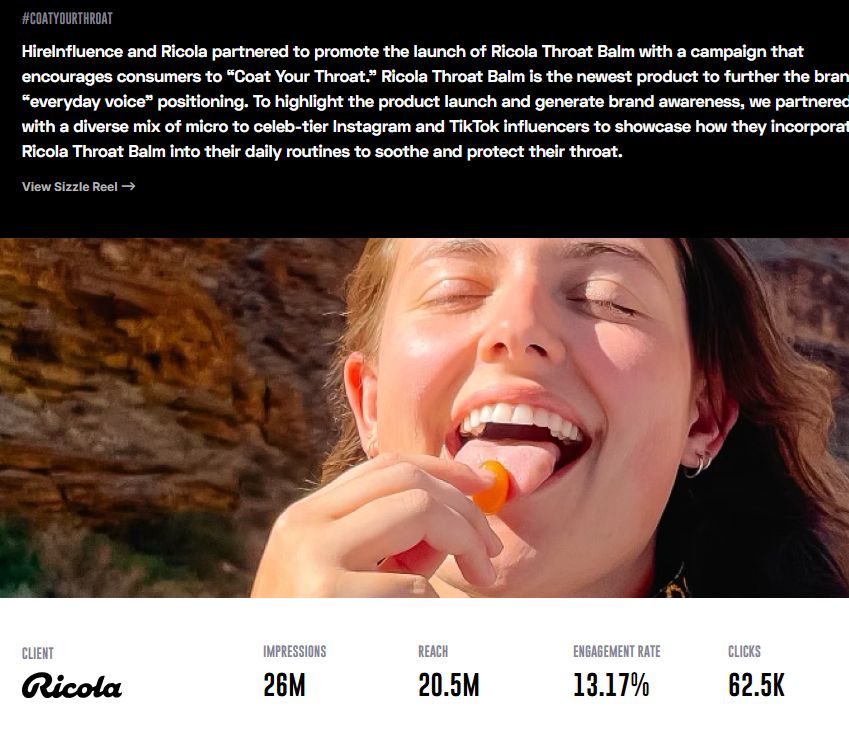
The Ricola #CoatYourThroat campaign demonstrates a different dimension of full-service delivery. The program drove 26 million impressions, a 13.17% engagement rate across 18 influencers spanning micro to celebrity tier, and 62,500 MikMak retail purchase clicks. The Ricola work illustrates what happens when the service stack integrates creator sourcing (18 creators tiered from micro to celebrity), content strategy (a coordinated campaign concept rather than 18 separate posts), and attribution infrastructure (retail purchase tracking via MikMak). A look at HireInfluence’s Ricola case study shows how the operational layers come together in a single program.
The Grammarly program moves the scale up again: 133 creators activated across YouTube, TikTok, and Instagram, producing 214 million impressions, 33.1 million views, and $15 million in EMV. A program of that size cannot be run without the full service stack operating in coordination. Creator contracting, content approvals, FTC compliance, reporting, and performance optimization across 133 distinct partnerships at once is where piecemeal service models visibly fail. HireInfluence’s work portfolio documents how the agency scales across campaign complexity levels.
How to Evaluate Influencer Marketing Services in New York
For brands in the evaluation phase, five questions separate serious partners from surface-level offerings.
First, ask for the service delivery model. A credible full-service partner will describe a staffed program team, not a handoff to a platform dashboard. Who is the account lead? Who runs creator sourcing? Who owns content approvals? Who handles paid amplification? Who reports?
Second, ask for attribution methodology in detail. The answer should specify how UTMs are structured, how promo codes are issued and tracked, how pixel-based conversion data is captured, and how the partner connects creator activity to business outcomes. Vague answers about “full-funnel measurement” are not answers.
Third, ask about creator tier strategy. A full-service partner can articulate when to use nano, micro, mid-tier, macro, and celebrity creators, and why a given mix is optimized for the brand’s specific campaign objective. Single-tier specialists are specialists, not full-service partners.
Fourth, ask for enterprise references. NY-based brand marketers talk to each other. A partner that has delivered for recognizable enterprise clients will have those references available. HireInfluence’s client roster includes Microsoft, Southwest Airlines, Target, Coca-Cola, Walmart, Meta, McDonald’s, Oreo, Grammarly, Ricola, and MTV.
Fifth, ask about category expertise. An agency that has run influencer programs for CPG, retail, technology, entertainment, and healthcare has seen the regulatory, platform, and audience variations across categories. HireInfluence’s dedicated page on TikTok influencer marketing and cost of influencer marketing breakdown are examples of the depth a mature partner brings to category and platform specifics.
The Agency Model Built for New York Enterprise Brands
HireInfluence was founded in 2011 and maintains offices in Houston and The Woodlands, TX; Austin, TX; Los Angeles, CA; and New York, NY. That national footprint, combined with a New York office that provides direct access to the NYC creator ecosystem, positions the agency as a full-service partner for brands running at the scale New York requires. The agency has delivered campaigns recognized by the MUSE Creative Awards, Netty Awards, NYX Awards, Global Digital Excellence Awards, U.S. Agency Awards, and Vega Digital Awards in 2024 and 2026. That award portfolio reflects the kind of creative strategy and measurement capability Linqia identifies as the top differentiators for specialist influencer agencies.
Jason Pampell, Founder and CEO of HireInfluence, launched the company in 2011 and has led its growth into an award-winning partner for enterprise brands. Prior to HireInfluence, he managed content rights and strategic media partnerships for Forbes and Billboard, with 30+ years of leadership experience in sales, marketing, and team building for Fortune 1000 organizations. His background in establishing influencer marketing as a scalable channel is a significant part of why the agency’s service model works at enterprise scale.
Enterprise engagements start at approximately $100,000, which reflects the full-service delivery standard. That pricing tier screens out brands seeking one-off creator buys and aligns the engagement with organizations running influencer marketing as an ongoing business function rather than a campaign experiment. Brands ready to evaluate what a full-service program could look like can reach the team through the HireInfluence contact page.
The New York enterprise market has moved past the phase where influencer marketing was an experimental line item. Linqia’s data makes that clear: budgets are growing for 62% of marketers, creator content is outperforming brand content at an average of 2.7x in controlled tests, and specialist agencies are now the dominant delivery model. For brands operating at the scale New York requires, the question is not whether to use influencer marketing services. The question is whether the service partner has the operational depth to deliver a program built for the market’s standards.