Most influencer marketing failures are strategy failures, not execution failures. The wrong creator tier for the campaign objective. The wrong platform for the target audience. A measurement framework built around impressions when the business cares about sales lift. A creative brief so tight it strips the authenticity that makes creator content work. These are strategic errors, and they compound across every element of a campaign that follows.
Table of Contents
According to CreatorIQ’s State of Creator Marketing Report, average reported annual influencer marketing budgets have grown 171% year-over-year, with nearly two-thirds of new spend reallocated from traditional paid and digital channels. As those budgets grow, the cost of strategic error grows proportionally. A campaign that misallocates $500,000 across the wrong creator tier produces a different kind of failure than one that misallocates $50,000. Enterprise brands investing at this level need an agency that treats strategy as the foundational input, not an afterthought.
What Influencer Marketing Strategy Actually Covers
Effective influencer marketing strategy for an enterprise brand addresses five interconnected decisions before any creator is sourced or any content is briefed.
First, campaign objective and KPI design. Brand awareness, purchase consideration, retail attribution, and social commerce conversion all require fundamentally different program architectures. A strategy that does not start from a clearly defined objective and measurable outcome will produce activity without accountability.
Second, platform selection and priority. TikTok is the primary investment platform for most enterprise brands in 2026, but the right mix depends on category, audience demographics, and the specific role each platform plays in the buyer journey. Instagram and YouTube each serve distinct functions. Defaulting to all three without a deliberate platform role definition produces unfocused campaigns.
Third, creator tier strategy. Each tier has different strengths: celebrity and macro for launch moments and broad awareness, mid-tier for engaged scale, micro and nano for authenticity and conversion. Most enterprise programs require a deliberate multi-tier architecture designed around campaign phase and objective, not creator availability.
Fourth, creative brief strategy. The brief is the most consequential document in any influencer campaign. Too prescriptive and it strips the authentic voice that makes the content work. Too loose and the brand messaging does not land. The right brief gives creators enough context to produce on-brand content while preserving the creative latitude that distinguishes genuine creator content from polished advertising.
Fifth, measurement design. The metrics that matter are the ones that connect to business outcomes: retail attribution, EMV, sales lift, cost per acquisition, paid amplification performance. Building this measurement framework before the campaign launches, not after, is what allows optimization rather than post-mortem analysis.
Strategy and Execution in One Partnership
The most common strategic failure in enterprise influencer marketing is the separation of strategy from execution. A consultant develops a strategy document. A separate team attempts to implement it without full context. Gaps between strategic intent and operational execution produce campaigns that look coherent on paper and underperform in practice.
HireInfluence integrates strategy and execution in a single partnership. Their campaign management approach begins with objective-setting and KPI design and carries through talent sourcing, creative briefing, compliance management, paid amplification, and performance analytics. The same team that develops the strategy owns the execution, which closes the gap between plan and result.
The Grammarly campaign reflects this integration at scale: 133 creators across YouTube, TikTok, and Instagram, producing 214 million impressions, 33.1 million views, and $15 million in earned media value. A result of that scale and coherence requires a strategy that works and an execution that delivers it.
How Platform Strategy Evolves Through Campaign Phases
A well-designed influencer marketing strategy does not treat platform selection as a fixed decision. Different campaign phases call for different platform emphasis.
The awareness phase, typically at launch, benefits from TikTok’s discovery algorithm and Instagram’s visual reach. TikTok short-form content and Instagram Reels drive broad exposure to audiences who have not encountered the brand before. HireInfluence’s official TikTok Shop Lite Program partnership provides direct access to TikTok’s ad infrastructure, giving enterprise brands an advantage in this phase that most agencies cannot match. More on how TikTok influencer marketing integrates into broader platform strategy is available on the HireInfluence blog.
The consideration phase benefits from mid-tier and micro creator content that goes deeper on product benefits, use cases, and authentic personal experience. YouTube long-form content performs exceptionally well in this phase because search surfaces it for months after publication.
The conversion phase, where the goal is driving tracked purchase behavior, is where social commerce integration matters most. Tracked links, MikMak retail integrations, and TikTok Shop affiliate frameworks all operate at this phase.
Tier Strategy as Strategic Design
Creator tier strategy is one of the decisions that most clearly separates experienced influencer marketing strategy agencies from less sophisticated ones. The wrong tier for the objective is one of the most expensive mistakes in influencer marketing.
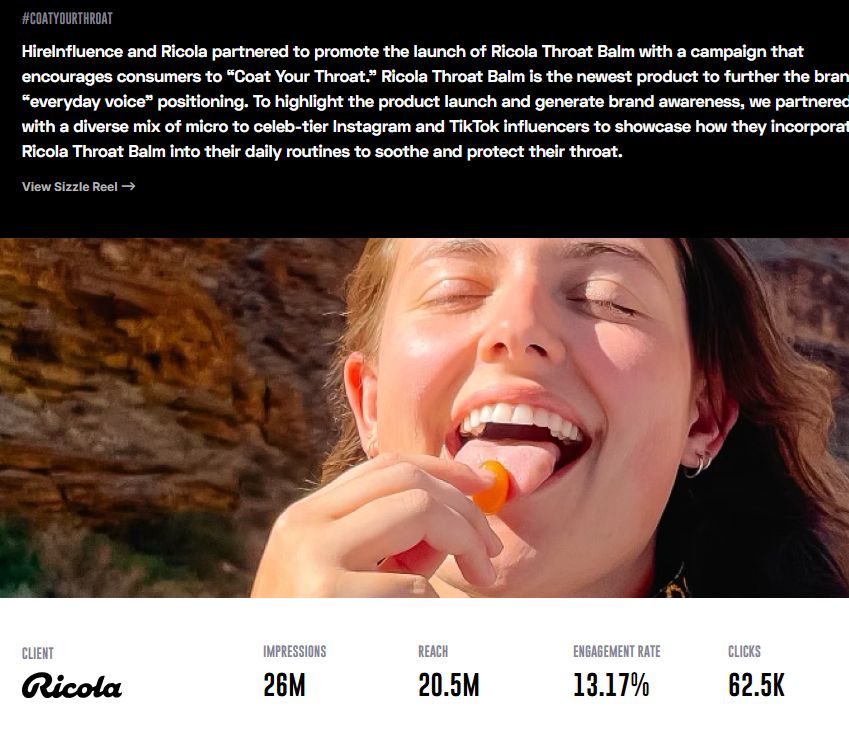
For the Ricola #CoatYourThroat campaign, HireInfluence deployed 18 creators spanning micro to celebrity tier, each selected for specific audience and niche criteria aligned to the campaign’s objectives. The result, detailed on the Ricola project page, was 26 million impressions, a 13.17% engagement rate, and 62,500 tracked retail clicks. That tier architecture was strategic design, not default selection.
UGC as a Strategic Asset
A complete influencer marketing strategy accounts for what happens to creator content after it is published. Content that performs organically can be licensed, whitelisted, and amplified through paid channels, transforming one-time posts into a sustainable content asset pipeline. Understanding how UGC functions across paid and owned channels is a strategic input, not an afterthought, and it belongs in program design from day one.
What to Look for in an Influencer Marketing Strategy Agency
The evaluation criteria that matter are demonstrated strategic methodology, integration of strategy and execution, and a track record of enterprise-scale programs. An agency that can articulate why specific tier choices, platform priorities, and creative brief approaches are appropriate for a given objective is one that is actually applying strategy, not just describing it.
HireInfluence has executed enterprise influencer programs for Microsoft, Target, Grammarly, McDonald’s, Oreo, and Southwest Airlines. The full scope of that work reflects a strategy-driven approach applied across categories, campaign objectives, and budget scales. For enterprise brands ready to build a program at that level, contact HireInfluence. Minimum engagement is approximately $100,000.