Public relations and influencer marketing have been converging for years, and in 2026 the lines between them are largely gone. According to PRLab’s 2026 PR statistics report, 76% of PR agencies now offer content creation and strategy as a core service, and influencer PR has become a standard component of how enterprise brands manage reputation, build awareness, and earn credibility with audiences that have stopped paying attention to press releases.
Table of Contents
- What an Influencer PR Agency Actually Does
- Creator Selection as a Reputation Decision
- Product Launches and Cultural Moment Activations
- Long-Term Ambassador Programs and Brand Narrative
- FTC Compliance and the Credibility Foundation
- Measurement: Connecting Credibility to Commerce
- What to Look for in an Influencer PR Agency
The question most brand marketing and communications teams are wrestling with is not whether to combine influencer marketing and PR. It is how to find an agency capable of executing both with the operational rigor that enterprise-level programs require.
What an Influencer PR Agency Actually Does
Traditional PR is built around earned media: securing coverage in publications, broadcast outlets, and digital platforms that audiences trust. The mechanism is third-party credibility. A journalist or publication says the brand is noteworthy, and that third-party signal carries more weight than the brand saying it about itself.
Influencer marketing operates on a parallel logic. A creator with a genuine relationship with their audience says the brand is worth attention. That creator’s credibility transfers to the brand in a way that a paid ad from the brand cannot replicate. The trust mechanics are structurally similar to earned media. The distribution mechanism is different, and the scale potential is significantly higher.
An influencer PR agency combines both disciplines. It manages creator programs with the performance rigor of influencer marketing while treating creator relationships and brand narrative with the strategic care of a public relations function. For enterprise brands that need both audience reach and brand credibility, this combination is increasingly where the ROI lives.
HireInfluence operates at this intersection. Founded in 2011, the agency has spent 15 years managing full-service influencer campaigns for Fortune 500 brands where brand credibility is as important as campaign metrics. The firm’s work spans earned awareness, ambassador programs, product launches, and cultural moment activations, all of which require both the precision of influencer campaign management and the narrative discipline of PR.
Creator Selection as a Reputation Decision
In a traditional PR context, the journalist or publication you pitch is a reputation signal. A placement in a trusted outlet confers credibility. A placement in a low-quality outlet can actually damage brand perception.
The same logic applies to influencer selection, but most brands do not apply it with the same rigor. Choosing a creator who has misaligned values, a history of brand safety incidents, or an audience that does not match the brand’s positioning can generate impressions while simultaneously creating reputational risk.
HireInfluence’s talent vetting process approaches creator selection as both a performance decision and a brand reputation decision. The analytics team evaluates creators for audience quality, content history, competitive conflicts, and brand alignment before any recommendation is made. For enterprise clients with established brand equity to protect, this vetting standard is non-negotiable.
The Grammarly campaign illustrates the stakes. Deploying 133 top-tier lifestyle influencers across YouTube, TikTok, and Instagram to generate 214 million impressions and $15 million in earned media value required not just a large creator roster, but a carefully curated one. Every creator on that list represented Grammarly’s brand to a real audience. The selection process determined whether those impressions built brand credibility or created noise.
Product Launches and Cultural Moment Activations
Two of the highest-value applications for an influencer PR agency are product launches and cultural moment campaigns. Both require the same core competency: coordinating creator activity so it generates concentrated, synchronized attention rather than scattered individual posts.
A product launch with influencer PR support means creators across relevant tiers receiving the product and publishing content within a coordinated window, creating the perception of cultural momentum. That momentum is not accidental. It requires talent coordination, strict embargo management, briefing discipline, and timing precision that only agencies with full campaign management infrastructure can execute reliably.
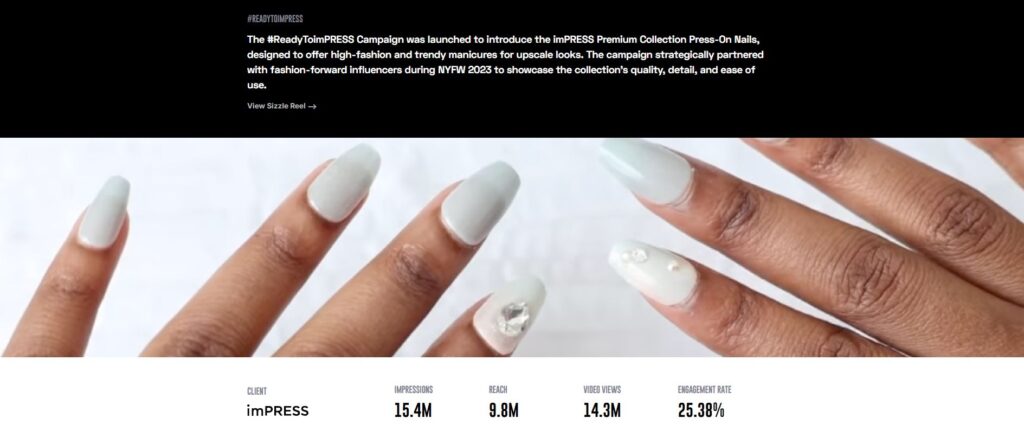
HireInfluence’s imPress Nails campaign during New York Fashion Week is a direct example. Deploying luxury fashion influencers during one of the fashion calendar’s highest-visibility moments, with content structured to drive direct sales, required both the right creators and the right timing infrastructure. The result was a campaign that felt culturally native to the moment rather than a brand insert.
Long-Term Ambassador Programs and Brand Narrative
One of the most powerful tools in an influencer PR playbook is the long-term ambassador program. Rather than treating influencer relationships as campaign-by-campaign transactions, ambassador programs build sustained creator-brand partnerships that generate compounding credibility over time.
When an audience sees the same creator returning to a brand repeatedly, not because a new campaign launched but because the partnership is ongoing, the trust signal is qualitatively different from a one-off sponsored post. This is the PR logic applied to creator relationships: earned credibility accumulates with repetition and consistency.
HireInfluence builds and manages influencer ambassador programs as a core service, handling the operational complexity of recurring activations while maintaining the creative freshness that keeps audiences engaged across multiple content cycles. For brands where long-term credibility is as important as short-term reach, this program structure is where influencer PR delivers its greatest return.
FTC Compliance and the Credibility Foundation
One of the places where influencer marketing most directly intersects with PR is FTC compliance. Sponsored content that is not properly disclosed damages the exact credibility that influencer partnerships are designed to generate. When audiences feel deceived by undisclosed brand relationships, the trust transfer reverses. The creator loses credibility with their audience, and the brand takes reputational damage by association.
HireInfluence manages FTC compliance as a standard part of its campaign workflow, building disclosure requirements into creator briefs and reviewing content before publication. For enterprise brands with legal and communications teams that scrutinize campaign practices, this built-in compliance infrastructure is not optional.
Measurement: Connecting Credibility to Commerce
The historic challenge with PR measurement has been attribution. Earned media generates credibility, but connecting that credibility to revenue has always been difficult. Influencer PR has a structural advantage here: digital attribution tools can track the path from creator content to website visit, product page view, and purchase event.
HireInfluence’s campaign analytics infrastructure closes this loop. The Ricola #CoatYourThroat campaign tracked 62,500 retail purchase clicks through MikMak integration, directly connecting creator content to retail purchase events. For brands investing in influencer PR programs, that level of attribution transforms what was once a qualitative credibility investment into a quantifiable performance channel.
The MTV #MyMTVStyle TikTok campaign delivered 16.1 million impressions at $0.01 cost per view and $1.50 CPM, with 216,600 engagements. These numbers reflect what happens when PR-caliber creator selection is combined with performance-caliber execution and measurement.
What to Look for in an Influencer PR Agency
The capabilities that separate a serious influencer PR agency from a generalist operation come down to three things. First, creator vetting that treats brand reputation as a first-order concern, not an afterthought. Second, campaign infrastructure capable of coordinating complex multi-creator activations with timing and messaging precision. Third, measurement systems that connect creator activity to the business outcomes that matter to both the marketing and communications functions.
HireInfluence meets all three criteria and has the verified campaign results to demonstrate it. With named clients including Microsoft, Southwest Airlines, Target, Grammarly, Oreo, and McDonald’s, and recognized as Digital Marketing Agency of the Year at the U.S. Agency Awards in 2025, the agency operates at the enterprise standard that serious influencer PR programs require.
The agency’s minimum engagement starts at approximately $100,000. For enterprise brands building programs where creator credibility and brand reputation are both on the line, contact HireInfluence to discuss how an influencer PR approach applies to your objectives.