Beauty marketing teams evaluating a social media influencer agency in 2026 are operating in a category where the structural dynamics have shifted significantly. The State of Fashion: Beauty, Volume 2, published in June 2025 by The Business of Fashion and McKinsey & Company based on surveys of more than 15,000 consumers in 13 markets and interviews with nearly 100 beauty executives, documents the reality beauty brands now face. At $441 billion in 2024, the global beauty industry is projected to grow 5% annually through 2030, still resilient but expanding at a steadier pace than the immediate post-pandemic years. Category dynamics are diverging: fragrance is poised for an 8% CAGR through 2030 lifted by younger consumers and niche high-end scents, haircare at 6% CAGR driven by advanced routines and targeted treatments, skincare remaining solid but increasingly price-sensitive, and color cosmetics showing potential at slower rates after past surges. Critically for beauty social media influencer marketing, McKinsey found that consumers looking to influencers for beauty ideas declined from 33% in 2023 to 25% in 2025 in the U.S., China, and Europe, an eight percentage point drop over two years. Only 13% of customers cite brand founder as a key reason for buying their most frequently purchased brand (performance at 39% and price at 24% rank higher). Just 10% of beauty executives use AI regularly with 60% still in exploratory phases, and 58% of consumers say they do not trust beauty content created by generative AI.
Table of Contents
- Why BoF-McKinsey’s State of Beauty Data Reshapes the Social Media Influencer Agency Decision
- What Enterprise Beauty Brands Should Expect From a Social Media Influencer Agency
- Beauty Social Media Influencer Program Delivery
- How Enterprise Beauty Brands Should Evaluate a Social Media Influencer Agency
- The Social Media Influencer Agency Model for Beauty Brands
For beauty marketing teams, those BoF-McKinsey findings establish a specific shift in what a social media influencer agency has to deliver. The decline in influencer relevance from 33% to 25% over two years does not mean creator marketing has stopped working in beauty. It means the bar for what makes creator content work has risen substantially. Content originality, creator authenticity, product performance emphasis, and platform-native craft are now what separates beauty creator programs that produce outcomes from beauty creator programs that underperform against the category’s diminishing tolerance for generic influencer content. The social media influencer agency that serves beauty enterprise clients has to demonstrate the creative direction sophistication, creator sourcing rigor, and content production capability to deliver against the higher bar. This guide breaks down what enterprise beauty brands should expect from a social media influencer agency in 2026 using the “social media influencer agency” framing that differentiates from full-service beauty marketing, how the BoF-McKinsey data reshapes the capability requirements, and what separates a credible beauty partner from a generalist offering.
Why BoF-McKinsey’s State of Beauty Data Reshapes the Social Media Influencer Agency Decision
BoF-McKinsey’s documentation of influencer relevance declining eight percentage points over two years changes what beauty social media influencer marketing has to deliver operationally. Paid reach costs have increased as platform algorithms have favored content originality over follower-count-driven distribution. AI-generated bots now make up more than half of all web traffic, adding to marketing inefficiency and further amplifying the premium on authentic creator content that reads as genuinely human. The agencies that retrofit standard influencer program templates for beauty are operating against those dynamics. The agency that serves beauty enterprise clients now has to structure creator programs around originality, performance emphasis, and in-store or DTC conversion rather than awareness impressions alone.
For beauty brands specifically, the 58% consumer distrust of AI-generated beauty content creates a specific capability requirement. Creator programs that integrate AI sloppy or invisibly trigger audience distrust that damages the brand. The agency has to demonstrate AI integration discipline: using AI where it supports creator craft without replacing authentic creator voice, and rejecting AI integration where consumer trust dynamics make it counterproductive. Beauty is particularly AI-sensitive because consumers evaluate product efficacy through visual signals that AI content can undermine.
BoF-McKinsey’s finding on the “selective splurge” mindset (brands delivering proven efficacy, cultural fluency, and originality winning in a market where growth is more selective) applies directly to how creator programs have to be structured. Beauty creator content that demonstrates product performance authentically, speaks to specific audience cultural contexts, and produces original creative that stands out in the category commands the audience attention that is becoming increasingly scarce. Creator content that follows generic beauty category templates loses the attention battle to creator content that achieves those three differentiation markers.
The recommendation to link social media pages and influencers to in-store calls to action reinforces what beauty creator programs have to deliver at the conversion layer. Beauty is a category where physical retail remains the largest discovery channel (according to McKinsey, more popular than social media or brand marketing for beauty inspiration). The agency has to structure creator content that drives in-store consideration and purchase in addition to DTC conversion. Retail partner coordination, in-store sampling tie-ins, Sephora and Ulta creator programs, and retail-calendar-aligned content are all operational capabilities the current beauty environment requires.
The finding on founder-led brand dynamics (only 13% of customers cite brand founder as key reason for buying) does not mean founder content has no role but it does mean founder-only creator strategy underperforms. The agency has to produce creator programs that build broader brand equity through authentic creators whose audiences align with the beauty brand’s positioning, not programs that concentrate on founder personality as the primary brand differentiator.
What Enterprise Beauty Brands Should Expect From a Social Media Influencer Agency
A credible social media influencer agency for beauty brands operates across eight coordinated service functions calibrated to beauty category dynamics and the BoF-McKinsey data profile.
Beauty social media influencer strategy and in-store attribution design. The engagement begins with business objectives tied to beauty outcomes (shelf velocity at Sephora, Ulta, Target, department store, specialty retail, DTC conversion, product trial generation, category-specific positioning) and a measurement framework that connects creator activity to those outcomes. HireInfluence structures beauty social media influencer strategy through dedicated campaign services built for enterprise beauty engagements.
Creator sourcing calibrated to originality and authenticity signals. BoF-McKinsey’s data on influencer relevance decline makes sourcing rigor central. The agency has to source creators based on content originality, audience authenticity, category expertise, and community context beyond follower count or generic beauty category affiliation.
Creative direction that produces original, culturally fluent beauty content. The category’s rising bar for originality makes this differentiating. The agency should describe how creative direction produces content that stands out against the category’s generic beauty content baseline, with specific examples of beauty programs that achieved originality the data identifies as rewarded.
Contracting and rights management calibrated to beauty multi-channel distribution. Rights structure has to cover retail partner distribution (Sephora in-store screens, Ulta digital channels, department store retail media), paid social amplification, DTC channel distribution, retail media network integration, and emerging platform deployment.
Long-term creator partnership management for beauty categories. Beauty programs benefit disproportionately from sustained creator relationships because repeat authentic product integration builds trust that drives category-specific purchase decisions. Ambassador programs, long-term partnerships, and always-on content programs require operational infrastructure calibrated to beauty product launch cycles and seasonal beauty calendars.
Paid social amplification with beauty commerce integration. Creator content performs best when organic distribution pairs with paid amplification including retail media network integration, TikTok Shop, Instagram Shopping, and DTC commerce platforms. HireInfluence delivers paid amplification through its specialties and services capability.
Beauty attribution infrastructure. UTM frameworks, promo code systems, retail partner tracking (Sephora, Ulta, department store attribution), platform commerce measurement, brand lift studies, and DTC conversion attribution. HireInfluence’s analytics capability is designed to deliver beauty-specific attribution depth.
Disciplined AI integration calibrated to beauty trust dynamics. BoF-McKinsey’s 58% consumer distrust of AI-generated beauty content makes this a specific capability requirement. The agency should describe where AI integration helps (creator discovery, performance analysis, content optimization behind the scenes) and where it does not (consumer-facing content where visual authenticity drives trust). Disciplined AI integration is now a beauty capability differentiator.
Beauty Social Media Influencer Program Delivery
Beauty brands evaluating a social media influencer agency should look at programs that demonstrate enterprise-scale beauty creator marketing delivery.
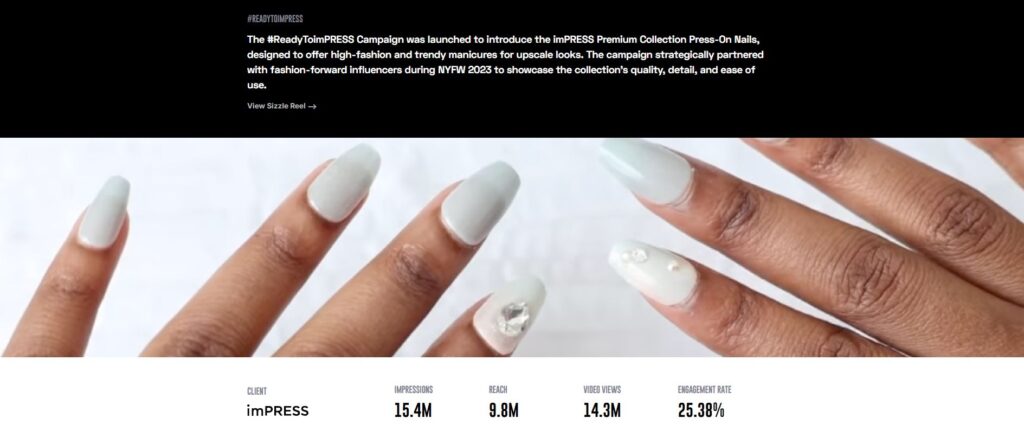
The imPress Nails New York Fashion Week campaign is a direct beauty-category reference. The program partnered with luxury fashion and beauty creators whose audiences and personal brand positioning matched the imPress brand, activated during one of the most aesthetically rigorous moments in the fashion and beauty calendar, and structured content with direct-to-website CTAs that converted NYFW attention into measurable purchase activity. For beauty brands evaluating how creator programs execute at enterprise scale in brand-sensitive moments, the imPress execution establishes what beauty creator marketing produces when creator selection, creative direction, and conversion infrastructure align.
The Grammarly engagement demonstrates multi-platform scale relevant to beauty brands running cross-platform campaigns around product launches. The program activated 133 creators across YouTube, TikTok, and Instagram, producing 214 million impressions, 33.1 million views, and $15 million in earned media value. Running a program at that scale across three video-native platforms simultaneously requires the operational infrastructure beauty marketing programs now demand. The work portfolio documents how the agency scales across program complexity.
The Ricola #CoatYourThroat program demonstrates how creator programs integrate with commerce attribution, which applies directly to beauty brands running creator programs with retail partner integration. The campaign drove 26 million impressions, 20.5 million reach, a 13.17% engagement rate across 18 creators spanning micro to celebrity tier, and 62,500 MikMak retail purchase clicks. The MikMak integration capability translates directly to beauty retail partner attribution at Sephora, Ulta, and mass retail. The Ricola case study documents the full program architecture.
How Enterprise Beauty Brands Should Evaluate a Social Media Influencer Agency
Five evaluation questions separate credible beauty-category partners from generalist agency offerings.
First, ask about originality methodology in creative direction. BoF-McKinsey’s data on influencer relevance decline makes this consequential. The agency should describe how creative direction produces content that stands out against the category’s generic beauty content baseline, with specific examples of beauty programs that achieved the originality the current environment rewards.
Second, ask about retail partner attribution capability specifically. Beauty is a category where physical retail remains the primary discovery channel. The agency should describe Sephora, Ulta, department store, and mass retail attribution infrastructure with specific examples of beauty programs that demonstrated measurable retail impact.
Third, ask about disciplined AI integration in beauty contexts. The 58% consumer AI distrust makes this differentiating. The agency should describe where AI integration supports creator craft versus where it creates consumer trust risk, with specific examples of beauty programs that executed AI integration discipline.
Fourth, ask about beauty sub-category depth. Skincare, cosmetics, haircare, fragrance, wellness-adjacent beauty, and specialty beauty each have distinct audience dynamics, regulatory considerations, and creator ecosystems. The agency should demonstrate direct experience in the specific beauty sub-category where the brand competes.
Fifth, ask about long-term creator partnership infrastructure for beauty. Beauty programs benefit disproportionately from sustained creator relationships that build product trust over time. The agency should describe ambassador programs, launch-window partnerships, and always-on content programs with specific examples of beauty brand creator engagements that demonstrated multi-year retention value.
The Social Media Influencer Agency Model for Beauty Brands
HireInfluence runs enterprise social media influencer programs for beauty and beauty-adjacent brands. The agency was founded in 2011 and maintains offices in Houston and The Woodlands, TX; Austin, TX; Los Angeles, CA; and New York, NY. That national footprint, combined with beauty category depth built across more than a decade including the imPress Nails NYFW execution, positions the agency to deliver creator programs calibrated to beauty business requirements and the industry profile BoF-McKinsey documented. The about section documents how the company operates.
Engagements typically start at approximately $100,000, aligned with the enterprise delivery standard. Confirmed clients include Microsoft, Southwest Airlines, Target, Coca-Cola, Walmart, Meta, McDonald’s, Oreo, Grammarly, Ricola, and MTV. Award recognition across 2024 and 2026 includes the MUSE Creative Awards, Netty Awards, NYX Awards, Global Digital Excellence Awards, U.S. Agency Awards, and Vega Digital Awards. The agency is also an exclusive TikTok Shop Lite Program partner since July 2024, providing direct access to TikTok’s commerce infrastructure for beauty programs connecting creator content to measurable commerce outcomes.
Jason Pampell, Founder and CEO, launched HireInfluence in 2011. Prior to founding the company, he managed content rights and strategic media partnerships for Forbes and Billboard. His 30+ years of leadership experience in sales, marketing, and team building for Fortune 1000 organizations shaped how the agency structures beauty creator engagements today.
For beauty brands ready to evaluate what a social media influencer engagement calibrated to current beauty category dynamics should include, the HireInfluence team handles initial conversations directly through the contact page. Brands benchmarking pricing should reference the cost of influencer marketing guide for context on enterprise engagement costs. Those evaluating TikTok-focused strategies should review the TikTok influencer marketing resource, and brands integrating creator content with broader UGC strategy should review the UGC overview.
BoF-McKinsey’s beauty industry data makes the operating environment direct. Influencer relevance has declined eight percentage points over two years, AI-generated content creates consumer trust risk at 58% skepticism, proven product efficacy and originality now drive brand choice, and the category rewards creator programs that connect to in-store and DTC conversion rather than awareness alone. The social media influencer agency decision for beauty enterprise brands is the decision about which partner has built the capability profile the current environment now requires. The beauty brands winning in the current market are working with partners calibrated to originality, authenticity, disciplined AI integration, and retail-connected conversion, not those still operating on generic influencer marketing templates from an earlier moment in the category.