
Chicago is home to one of the densest concentrations of Fortune 500 headquarters in the United States, with enterprise marketing budgets anchored across retail, CPG, financial services, food and beverage, industrial technology, and healthcare. For those enterprise marketing teams, evaluating a video content marketing agency in 2026 means filtering for capability profiles that did not exist five years ago. The scale and maturation shifts are documented directly. According to Vidyard’s 2025 Video in Business Benchmark Report, which analyzed data from more than 940,000 videos created across a sample of Vidyard’s customer base, business video creation is accelerating rapidly across Chicago’s core enterprise verticals. Education companies created 436% more videos year over year. Consulting companies created 280% more videos. Professional services created 200% more. Financial services created 189% more. High-tech companies created 149% more.
Table of Contents
- Why Chicago Enterprise Video Volume Expansion Changes the Buying Decision
- What Chicago Fortune 500 Brands Should Expect From a Video Content Marketing Agency
- Enterprise-Scale Video Delivery Examples
- How Chicago Enterprise Brands Should Evaluate a Video Content Marketing Agency
- The National Video Content Marketing Agency Model Serving Chicago
For Chicago-based enterprise marketers in those sectors, the implications are immediate. Video content production volume is expanding at rates that traditional production workflows cannot support, which means the video content marketing agency has to deliver creator-powered production, AI-integrated workflows, and enterprise-grade attribution as a coordinated system. A partner optimized for the quarterly brand film cadence that defined video production a decade ago cannot match the volume, velocity, and platform coverage that 2026 enterprise video programs require. This guide breaks down what Chicago Fortune 500 brands should expect from a video content marketing agency, how the volume expansion changes the buying decision, and what separates a credible enterprise partner from a surface-level offering.
Why Chicago Enterprise Video Volume Expansion Changes the Buying Decision
Vidyard’s finding that Chicago-relevant sectors (financial services, professional services, consulting, high-tech) are increasing video production by 149% to 280% year over year reframes what enterprise video actually requires. A financial services brand increasing video output by 189% cannot deliver that volume through traditional production workflows. A consulting firm producing 280% more video needs production infrastructure that scales without proportional cost increases. A professional services firm producing 200% more video needs platform-specific format expertise across multiple distribution channels. The traditional video agency model (brief, concept, shoot, edit, deliver) does not scale to meet any of those growth rates.
The agencies that do scale at those rates share a specific capability profile. They run creator partnerships as the primary production model, which gives them access to a distributed network of video production talent without the cost structure of internal production teams. They integrate AI tools into pre-production planning, editing, captioning, and format adaptation, which compresses timelines and enables volume scaling. They manage multi-platform content lifecycle so a single production session produces assets that flow across paid social, CTV, retail media, email, and owned channels. They run paid amplification integrated with organic distribution, so video content performs as a paid media channel rather than an organic-only investment. And they deliver attribution and performance analytics that connect video investment to measurable business outcomes.
Vidyard’s data also documented that sales teams are rapidly adopting agentic video experiences to scale personalized outreach. That adoption pattern rippling through the enterprise means video content marketing programs need to integrate with sales enablement, customer success, and B2B demand generation workflows, not just brand-awareness and performance marketing channels. For Chicago-based enterprise brands with significant B2B motion (professional services, financial services, high-tech), the video content marketing agency has to deliver production capability that spans both marketing and sales use cases.
What Chicago Fortune 500 Brands Should Expect From a Video Content Marketing Agency
A credible enterprise-grade video content marketing agency operates across eight coordinated service functions, delivered as a single system rather than sequential handoffs.
Video strategy and format allocation. The engagement starts with business objectives, KPI frameworks, and a format allocation plan covering short-form, long-form, and live video across the platforms that matter for the brand’s audience. For Chicago enterprise brands spanning consumer and B2B motions, format strategy also has to account for distribution across sales enablement, customer success, and traditional marketing channels. HireInfluence delivers this through dedicated campaign services built for enterprise video engagements.
Creator sourcing for video-native talent across tiers. Vidyard’s volume expansion data shows Chicago enterprise sectors producing hundreds of percent more video year over year, which only happens when the production model scales through creator partnerships rather than internal studios. A credible agency runs tier-matched sourcing (nano through celebrity) calibrated specifically to video production capability, platform format expertise, and audience alignment.
Multi-format creative direction. Short-form, long-form, live video, and vertical video all have distinct production requirements. Full-service agencies work with creators to produce content that performs natively on the intended platform. For Chicago brands repurposing video across channels, creative planning has to account for format adaptation from the start.
Contracting and rights management. Video rights structure determines whether content can flow across paid social, CTV, retail media, email, sales enablement, and owned channels without additional creator payments. Enterprise legal review standards, usage rights structuring, exclusivity windows, and FTC compliance all have to be built into the contract phase.
AI-integrated production workflows. AI tools for pre-production planning, post-production editing, caption generation, language dubbing, and format adaptation are now baseline video agency capabilities, not premium add-ons. The agency should describe how AI integrates with the production workflow to compress timelines and enable volume scaling.
Paid media amplification. Creator video performs best when organic distribution is paired with paid amplification across Meta, TikTok, YouTube, and emerging platforms. HireInfluence covers this through its specialties and services capability, including whitelisting, dark posting, and cross-platform amplification.
Attribution and performance analytics. UTM frameworks, promo code systems, pixel tracking, conversion event integration, and platform-specific video performance measurement. For Chicago-based financial services, retail, and CPG brands that need to connect video investment to measurable commerce outcomes, HireInfluence’s analytics capability is built to deliver that depth.
Cross-channel content lifecycle management. Video produced through creator partnerships should flow across multiple channels without requiring separate production cycles. The agency has to manage that content lifecycle so the original creator video produces value across channels over extended time.
Enterprise-Scale Video Delivery Examples
Chicago Fortune 500 brands evaluating a video content marketing agency should look at campaigns that demonstrate what enterprise-scale video delivery actually produces across the categories most concentrated in the Chicago economy.
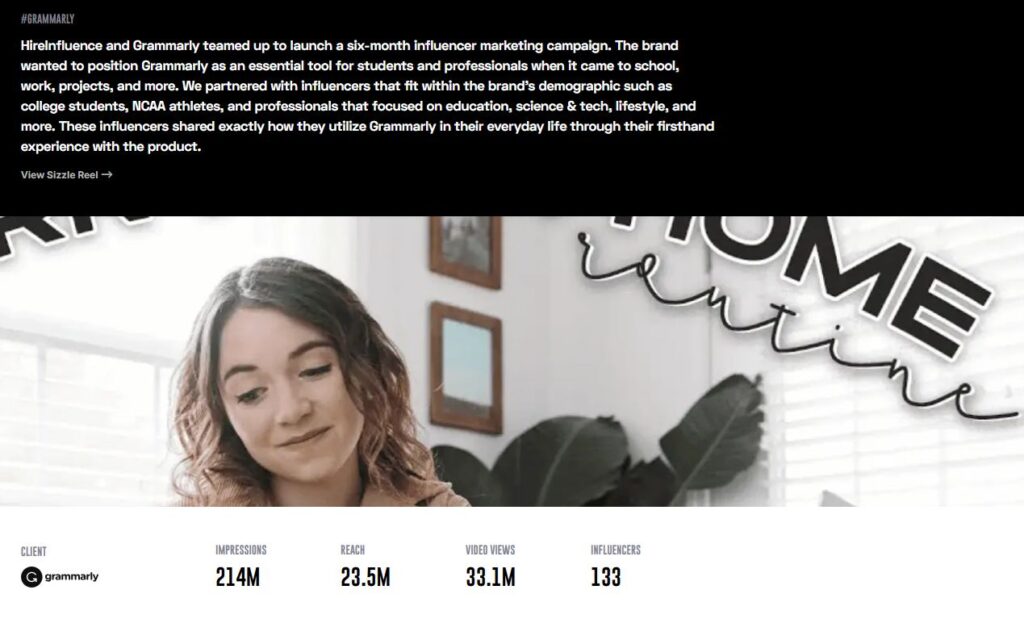
The Grammarly engagement is a useful benchmark for Chicago-based technology, SaaS, and professional services brands. The program activated 133 creators across YouTube, TikTok, and Instagram, producing 214 million impressions, 33.1 million views, and $15 million in earned media value. A 133-creator program at that scale requires the full video content marketing stack operating in coordination across creator sourcing, production direction, contracting, paid amplification, and reporting. The work portfolio documents how the agency scales across program complexity.
The Ricola #CoatYourThroat program demonstrates how creator-powered video integrates with commerce attribution for Chicago-based CPG and food and beverage brands. The campaign drove 26 million impressions, 20.5 million reach, a 13.17% engagement rate across 18 influencers spanning micro to celebrity tier, and 62,500 MikMak retail purchase clicks. For Chicago enterprise brands running video programs that need to connect to commerce outcomes, the Ricola case study documents how the integration works in practice.
The Oreo/McDonald’s #OREOShamROCKout campaign delivered 1.7 million impressions at $0.06 CPE. The MTV #MyMTVStyle TikTok campaign generated 16.1 million impressions at $0.01 CPV and $1.50 CPM with 216,600 engagements. Those efficiency numbers are what Chicago enterprise finance teams use to compare creator video spend against other paid channels.
The Southwest Airlines #SouthwestSaysAloha campaign drove 56 million impressions and 3 million engagements. For Chicago-based airline, travel, retail, and consumer brands, those scale numbers demonstrate what national video programs produce when the services engagement delivers full operational depth.
How Chicago Enterprise Brands Should Evaluate a Video Content Marketing Agency
Five evaluation questions separate credible enterprise-grade partners from surface-level offerings for Chicago video content buyers.
First, ask about production model scalability. Vidyard’s volume expansion data makes this the central question. The agency should describe how the production workflow scales to match enterprise video output requirements (potentially hundreds of percent year over year) without proportional cost increases. Traditional production-only models will not scale.
Second, ask about creator-powered production specifically. The volume expansion Vidyard documented happens through creator partnerships, not through internal production teams. The agency should describe how creator sourcing, creative direction, and production coordination function as the primary workflow.
Third, ask about AI integration. AI tools for pre-production, post-production, captioning, and format adaptation are baseline video agency capabilities now. The agency should describe specific tool integration in the production workflow.
Fourth, ask about cross-channel content lifecycle management. A single video production session should produce assets that flow across multiple channels. The agency should describe how creative planning, rights structuring, and distribution management enable multi-channel flow.
Fifth, ask about attribution methodology. UTM infrastructure, promo code systems, pixel tracking, conversion event integration, platform-specific video performance measurement. Generic answers about video performance tracking will not survive enterprise scrutiny.
The National Video Content Marketing Agency Model Serving Chicago
HireInfluence serves Chicago-based Fortune 500 brands through a national service delivery model. The agency operates from offices in Houston and The Woodlands, TX; Austin, TX; Los Angeles, CA; and New York, NY, and runs national creator-powered video programs for brands headquartered across major US markets including Chicago. That national footprint, combined with creator relationships built across more than a decade, positions the agency to deliver the kind of video content marketing engagement Chicago enterprise programs require.
HireInfluence was founded in 2011 and is recognized as one of the first full-service creator marketing agencies in the United States. Engagements typically start at approximately $100,000, reflecting the enterprise delivery standard. The client roster includes Microsoft, Southwest Airlines, Target, Coca-Cola, Walmart, Meta, McDonald’s, Oreo, Grammarly, Ricola, and MTV, clients whose categories align closely with the Chicago enterprise economy. Award recognition across 2024 and 2026 includes the MUSE Creative Awards, Netty Awards, NYX Awards, Global Digital Excellence Awards, U.S. Agency Awards, and Vega Digital Awards. The agency is also an exclusive TikTok Shop Lite Program partner since July 2024, which matters for Chicago retail and CPG brands whose video programs need to connect to the social commerce infrastructure TikTok provides.
Jason Pampell, Founder and CEO, launched HireInfluence in 2011 after managing content rights and strategic media partnerships for Forbes and Billboard. His 30+ years of leadership experience in sales, marketing, and team building for Fortune 1000 organizations informs how the agency structures creator-powered video engagements. His approach to building the company shaped how video content programs get delivered for enterprise clients across major US markets.
For Chicago Fortune 500 brands ready to evaluate what a creator-powered video content engagement should include, the HireInfluence team handles initial conversations directly. Brands benchmarking pricing should reference the cost of influencer marketing guide. Those evaluating TikTok-focused video strategies should review the TikTok influencer marketing resource. Brands integrating creator video with broader UGC strategy should review the UGC overview for context on how those capabilities complement each other.
Vidyard’s data documents where Chicago enterprise video is heading. Triple-digit year-over-year growth rates across professional services, financial services, consulting, high-tech, and adjacent sectors mean production volume requirements are expanding faster than traditional production models can scale. The video content marketing agency decision for Chicago Fortune 500 brands is the decision about which partner has the creator-powered, AI-accelerated, multi-platform production infrastructure to meet those volume requirements while delivering the attribution depth enterprise finance teams require. The brands winning in the current environment are working with partners built for the volume expansion, not the quarterly cadence that defined video production a decade ago.