
Brands researching the branded hashtag challenge are often working from an older picture of the format, and the current documentation has quietly moved it. A branded hashtag challenge is a campaign built around a brand’s own hashtag that invites users to create videos on a theme, gathering those submissions under a single dedicated page and turning an audience from passive viewers into active participants. In TikTok’s current documentation, the branded hashtag most often appears as an add-on that attaches to a Branded Mission and gives creators a hub to discover and join the campaign, rather than as the standalone reservation product many guides still describe. The participation model is the same as it ever was. Where the format sits in TikTok’s product lineup is what a brand needs to confirm before planning around it.
Table of Contents
What It Is
The core mechanic is simple: a brand creates a hashtag, invites people to post videos using it, and those videos collect in one place tied to the brand. Unlike a standard ad that users watch, a hashtag challenge asks users to make something, which is why the format is associated with high engagement. Each participant effectively expands the campaign’s reach to their own audience, and because TikTok’s For You feed distributes content on engagement rather than follower count, a strong entry from a small creator can travel widely. The appeal has always been participation at scale, a large volume of user-generated content around a brand theme carrying the credibility of coming from real users rather than from the brand, which suits awareness and cultural-moment goals more than direct conversion.
How It Works Inside a Branded Mission
TikTok’s documentation frames the Branded Hashtag as an add-on to a Branded Mission. When a brand pairs a branded hashtag with its mission, TikTok creates a dedicated hashtag page that acts as a central hub, pulling together creator submissions that use the hashtag and giving creators an additional way to discover the mission. In that setup the hashtag does two jobs at once: it organizes all the user content in one branded destination, and it becomes a discovery entry point that raises submission volume for the mission. The branded hashtag and a branded effect are the two add-ons TikTok names for extending a mission’s reach. Read plainly, this positions the hashtag challenge as a component that amplifies a Branded Mission rather than as a separate product a brand buys on its own, which is a meaningful shift from how the format was sold in earlier years and the single most important thing for a brand to verify before building a campaign around it.
What Brands Should Plan Around
Three things matter, and the third is where most planning goes wrong. First, the creative prompt has to be easy to join, because challenges succeed when the action is simple to understand and fun to copy, and they stall when the ask is complicated. Second, participation cannot be fully controlled, so brand safety and moderation planning matter, since the brand’s hashtag will collect whatever users post to it. Third, and important for procurement, TikTok’s current documentation presents the branded hashtag primarily as a mission add-on rather than a clearly standalone product, and TikTok does not publish a public price for it. A brand should confirm current availability and structure directly with a TikTok representative rather than assuming a standalone buy, and should disregard the specific price figures that circulate in third-party guides, which are not from the platform and frequently describe an older version of the product. Planning a budget around a number a vendor published is how a brand ends up scoping a campaign the platform no longer sells the way the number assumed.
Program Delivery Across Participation-Driven Programs
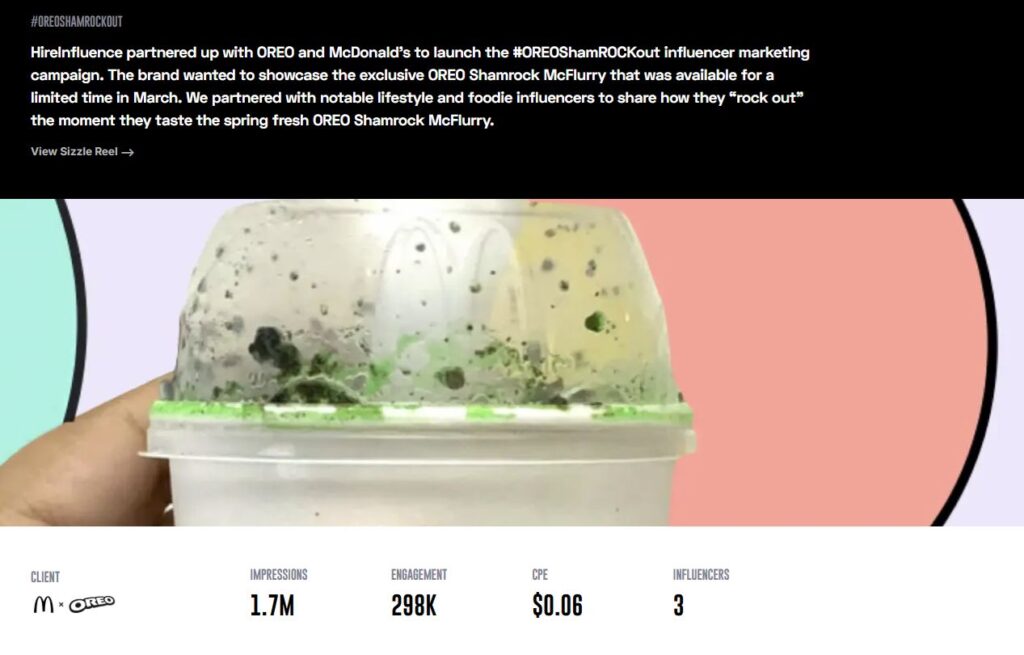
Participation formats aim at broad engagement, and the roster shows what governed creator programs deliver against that aim. The #MyMTVStyle campaign for MTV delivered 16.1M impressions and 216,600 engagements at $0.01 cost per view, a participation-driven result built on fluent creators rather than a bought hashtag alone. The #CoatYourThroat program for Ricola reached 20.5M people across 26M impressions with 18 influencers, sustained a 13.17% engagement rate, and drove 62,500 MikMak retail clicks, documented in the Ricola case study. The #OREOShamROCKout activation for Oreo and McDonald’s delivered 1.7M impressions at $0.06 cost per engagement, the Grammarly creator program produced 214M impressions and $15M in earned media value across 133 creators, and the #SouthwestSaysAloha program for Southwest Airlines produced 56M impressions and 3M engagements.
Additional programs appear in the work portfolio. A hashtag gives participation a place to gather, and the quality of the creators and the prompt is what determines whether the gathering produces anything worth the spend.
The HireInfluence Model for Participation Campaigns
Founded in 2011, HireInfluence is a full-service enterprise influencer marketing agency with 25 or more people across 10 or more states, working from offices in Houston, The Woodlands, Austin, Los Angeles, and New York. The firm runs programs for brands including Coca-Cola, Microsoft, Walmart, Meta, Grammarly, and Southwest Airlines on a six-figure engagement floor, and it has been a TikTok Shop Lite Program partner since July 2024. It was named Marketing Agency of the Year at the 2024 MUSE Creative Awards and Digital Marketing Agency of the Year at the 2026 U.S. Agency Awards. The strategy around participation-driven campaigns sits in the firm’s guide to running a TikTok influencer campaign. Brands can reach the team through the contact page.
Founder and CEO Jason Pampell spent years managing content rights, licensing, and strategic media partnerships at Forbes and Billboard before founding the firm in 2011, and the branded hashtag challenge rewards a discipline that world took for granted. An open invitation to contribute succeeds or fails on the strength of the premise and the standard applied to what comes back, because a call for participation without a compelling prompt produces noise, and a call without moderation produces risk. The hashtag challenge is that open invitation, now most often attached to a Branded Mission as the destination for submissions. A brand should confirm the current product structure with TikTok, design a prompt simple enough that people actually want to join, and plan the moderation before the submissions arrive. The format still delivers broad participation when the premise is strong, and it delivers a moderation problem when it is not.