
Marketing teams asking how to run a tiktok influencer campaign are usually asking a project question, and the 2025 industry spend research suggests the channel has outgrown the project frame entirely. US creator advertising more than doubled from $13.9B in 2021 to $29.5B in 2024, and it is projected to reach $44B in 2026. 48% of creator ad buyers now treat creators as an essential line rather than an optional one, placing the channel immediately behind paid search and social. Brands running these programs name one constraint above all others: identifying the right creators to partner with is their single biggest challenge, ahead of budget, creative, and measurement. Three in four brands are using or planning to use AI somewhere in their creator workflow. Campaigns still pursue awareness and reach most often, but sales now sits among the top objectives, which means the same campaign is being asked to do two jobs that used to belong to different teams. The research points at a channel that has become infrastructure, and infrastructure is not run as a campaign. It is operated.
Table of Contents
Why Channel Maturity Drives TikTok Influencer Campaign Planning
A one-off campaign has a start date, a flight, and a report. That structure made sense when creator work was a test line item borrowed from the social budget. It stops making sense once the channel absorbs enough spend to sit beside paid search, because at that scale the expensive part of the work is not the flight. It is everything the flight depends on: the relationships, the rights, the creative library, and the measurement baseline. A brand that stands all of that up, runs six weeks, and stands it back down has paid the fixed costs of a channel to receive the returns of a project.
The spend curve is the argument. Research from the Interactive Advertising Bureau tracks the category from $13.9 billion in 2021 to $29.5 billion in 2024, with a projection of $44 billion in 2026. Categories do not triple in five years because individual campaigns get better. They triple because organizations reorganize around them, hire against them, and move budget out of adjacent lines to fund them. The half of creator ad buyers who now treat the channel as essential are not describing a preference. They are describing a budget that has already been reallocated.
The reported top challenge is the most useful finding for anyone planning a campaign, because it is not the one most plans are built to solve. Brands do not say their biggest problem is creative quality or media efficiency or attribution. They say it is identifying the right creators. That is a sourcing and relationship problem, and it has an unfortunate property: it cannot be solved inside a campaign timeline. Creator relationships that produce good work are built before the brief exists, through prior collaboration, negotiated rights, and accumulated knowledge of how a given creator’s audience responds. A brand that begins looking for creators when the campaign is approved has already conceded the hardest variable.
The dual objective compounds the difficulty. When awareness remains the most common goal but sales has climbed into the top tier, a single roster is being asked to generate reach and revenue at once. Those goals recruit different creators, reward different creative, and are measured on different clocks. Reach is immediate and cheap to observe. Revenue is lagged, contaminated by other channels, and frequently realized somewhere other than the platform where it was created. Campaigns that refuse to choose a primary objective usually end up optimizing for whichever one reports fastest, which is reach, and then discovering at the readout that nobody can say what the program sold.
AI adoption sharpens the same point rather than softening it. Three in four brands are using or planning to use AI in creator workflows, and the tasks it absorbs are the ones that were never the bottleneck: shortlisting, drafting, versioning, summarizing. It compresses the mechanical work of a campaign and leaves the constraint untouched, since the judgment about which creator belongs with which product, on what terms, remains the part no tool performs. A brand that automates the easy half of a program without solving the hard half simply arrives at the hard half faster.
What Enterprise Brands Should Expect From a TikTok Campaign Partner
Program strategy and design. The agency has to force a primary objective before any creator is contacted, since a roster built for reach and a roster built for revenue diverge immediately and cannot be reconciled later. Objective setting, success criteria, and the measurement baseline all belong together at the front of the engagement, inside dedicated campaign services rather than in a post-launch reporting conversation.
Creator sourcing and verification. The agency has to arrive with relationships rather than build them on the brand’s clock, because the industry’s own research names creator identification as the top constraint and no campaign timeline is long enough to solve it from a standing start. Verification means recent performance, audience authenticity, and category history, and it means the agency can explain the creators it rejected as readily as the ones it recommends.
Platform and commerce integration. The agency has to wire the campaign to whatever transaction surface the brand actually uses, because a program carrying a sales objective needs a purchase path that exists before launch rather than one assembled midflight. Teams can orient themselves with the firm’s TikTok influencer marketing resource.
Creative direction and content production. The agency has to brief toward the platform’s actual reward function, which favors early payoff, completion, and content worth passing along. A UGC overview sets out the production model that supports this at campaign scale.
Audience and segment-specific execution. The agency has to assign each creator a defined segment and a defined job, so that a roster reads as a coverage map rather than a collection of people who were available. Two creators with comparable metrics can reach populations that barely intersect, and the value of a roster comes from that non-overlap. A partner that cannot state which segment each creator is responsible for is running a list, not a campaign, and the difference shows up as wasted duplication in the results.
Cross-platform orchestration. The agency has to sequence the campaign against everything else in market, because creator content that lands on the same day as a paid burst and an email push does not compound, it competes. Sequencing also determines how a program builds: an initial wave that establishes the creative premise, a second wave that varies it, and amplification behind whatever the first two waves proved. Campaigns that launch everything simultaneously forfeit the ability to learn from their own early signal.
Paid amplification. The agency has to treat amplification as a decision made during the flight rather than a budget committed before it, since the assets worth funding cannot be known until the audience has voted. That responsiveness belongs to a specialties and services capability able to reallocate quickly.
Attribution and measurement. The agency has to establish the baseline before launch and report against the primary objective rather than against whichever metric flatters the result. Doing so requires an analytics capability that was instrumented in week one, not reconstructed in week seven.
Program Delivery Across TikTok Campaign Formats
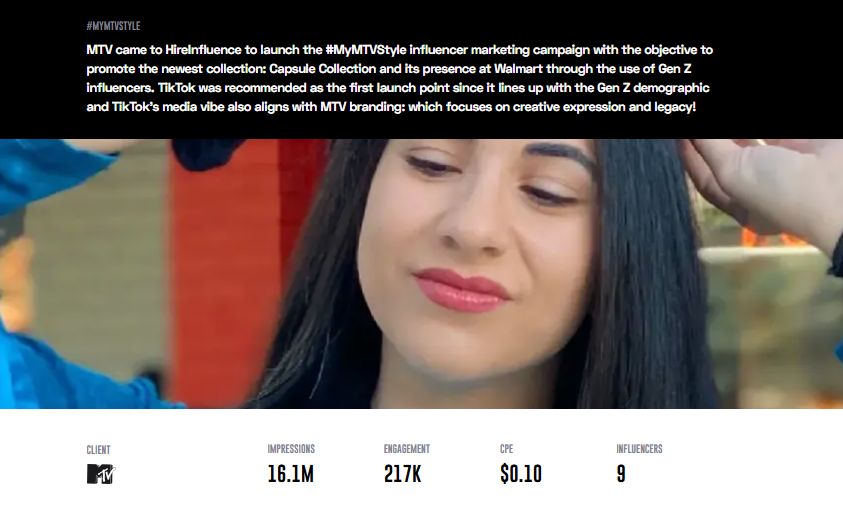
Campaign method is only worth as much as the record it produces. The #CoatYourThroat program for Ricola reached 20.5M people across 26M impressions with a deliberately small roster of 18 influencers, sustained a 13.17% engagement rate, and drove 62,500 MikMak retail clicks, which is the clearest demonstration that a tightly scoped roster with a defined objective outperforms an assembled one. The Grammarly creator program operated at the opposite end of the scale, coordinating 133 creators to produce 214M impressions and 33.1M views with $15M in earned media value, and it shows what roster design looks like when reach is the primary objective. The #MyMTVStyle campaign for MTV generated 16.1M impressions and 216,600 engagements at $0.01 cost per view and a $1.50 CPM on TikTok.
The #SouthwestSaysAloha program for Southwest Airlines delivered 56M impressions and 3M engagements, and the #OREOShamROCKout activation for Oreo and McDonald’s produced 1.7M impressions at $0.06 cost per engagement. The full record appears in the Ricola case study and the broader work portfolio. Comparing the 18-creator program against the 133-creator program is instructive: neither roster size is correct in the abstract, and each is correct for the objective it was built to serve.
How to Evaluate a TikTok Influencer Campaign Agency
First, ask the agency to state the campaign’s primary objective and what it will refuse to optimize for. The agency should choose, explain the tradeoff, and describe what the campaign will deliberately underperform on as a result.
Second, ask which creators the agency already has relationships with in the category. The agency should answer with specifics rather than a database size, since the industry’s own data identifies creator identification as the binding constraint, and a partner’s value is measured largely by how much of it is already solved.
Third, ask how roster size is determined. The agency should reason from objective, segment coverage, and content volume rather than from budget divided by rate card, and it should be willing to recommend a smaller roster than the brand expected.
Fourth, ask what the agency will know in week two that it does not know in week one. The agency should describe a learning sequence, the signals it watches, and the specific decisions those signals will trigger, because a campaign that cannot change in flight is a broadcast.
Fifth, ask what the program costs and which variables move it. The agency should separate creator fees, content volume, usage rights, and amplification into distinct lines and work from a published cost of influencer marketing guide rather than a number produced to fit an available budget.
The HireInfluence Model for TikTok Campaign Execution
Founded in 2011, HireInfluence is a full-service enterprise influencer marketing agency with 25+ people across 10+ states, working from four offices: Houston and The Woodlands in Texas, Austin, Los Angeles, and New York. The firm has run programs for Southwest Airlines, Walmart, Meta, McDonald’s, Grammarly, and Target on a six-figure engagement floor, a threshold that reflects the standing infrastructure a campaign draws on rather than the cost of any single flight.
HireInfluence has been a TikTok Shop Lite Program partner since July 2024, which matters for campaigns carrying a sales objective alongside a reach objective, since the purchase path has to exist before the creative does. The agency was named Marketing Agency of the Year at the 2024 MUSE Creative Awards and Digital Marketing Agency of the Year at the 2026 U.S. Agency Awards.
Before founding the firm in 2011, Jason Pampell spent years managing content rights, licensing, and strategic media partnerships for Forbes and Billboard, disciplines where a deal was assembled long before anything was published and where the terms of the arrangement determined what the finished work could do. Campaign execution rewards the same sequence. The rights, the roster, and the measurement baseline are settled first, and the flight is the visible consequence of decisions made earlier. The HireInfluence team runs campaigns on that order of operations, which is why its rosters tend to be smaller than expected and its briefs more specific. Brands can reach the firm through its contact page or read more about its background in the about section.
The spend research makes the closing point plainly. A channel approaching $44 billion, whose practitioners name creator identification as their hardest problem, is not a channel where campaigns are won during the flight. They are won in the relationships and the rights that existed before the brief was written, and a brand that starts the search when the budget clears has already spent its advantage.