
An agency that treats results claims as the primary constraint and understands that a membership sold is not a member retained. Body composition and outcome content is the category’s most persuasive material and its largest exposure, and the economics only work if the measurement runs months past the join date.
Table of Contents
- Results claims are the constraint
- There is also a duty-of-care dimension
- Membership economics change the measurement
- Local delivery, national brand
- What to ask an agency
- Where the strongest content actually sits
- Seasonality is severe and predictable
- The instructor question
- Program Delivery Across Membership and Retention Categories
- The HireInfluence Model for Health-Adjacent Categories
Fitness is one of the most creator-saturated categories and one where the standard playbook produces the worst outcomes. Fitness studio influencer marketing built around transformation content and a joining offer will generate signups and a churn profile that makes the campaign uneconomic, while creating claims exposure nobody reviewed. This article covers what the category actually requires.
Results claims are the constraint
Transformation content is a claim. A before-and-after implies a result attributable to the program, and results in this category are highly individual.
Timeframe claims compound it. In six weeks, in ninety days.
Body composition claims require substantiation and frequently qualification about typicality.
Health and medical adjacency. Content implying a program treats, prevents, or manages a condition moves into territory requiring far more care, and creators reach for this language naturally when describing their own experience.
A creator’s own result is not a claim about the program, and framing decides whether it reads as one. What happened to one person, alongside what else they were doing, is a personal account. The same content without that context is a product claim.
The controls are the regulated-category discipline: exact permitted phrasing, prohibited territory by concept, required qualification where results are atypical, and a claims sheet the creator keeps. Review must cover the caption alongside the video, since captions carry most claims and, on TikTok, lock permanently at authorization.
There is also a duty-of-care dimension
Fitness content reaches people at a vulnerable point in a decision about their bodies, and the category has an obligation most consumer marketing does not.
Content should not disparage bodies, including the creator’s own former one. This is both an ethical position and a commercial one, since audiences increasingly react against it.
Extreme protocols shown are protocols endorsed. Restrictive approaches, excessive volume, or training through injury shown in brand content is an implicit recommendation.
Beginner-appropriate framing matters, because the audience most likely to join is the audience least equipped to judge whether what they are watching is sensible for them.
Brands should write a position on this into the brief rather than hoping creators arrive with one, and should treat an agency that has never raised it as one that has not thought about the category.
Membership economics change the measurement
Joining offers select for offer-motivated members, who churn differently from full-price joiners.
The evaluation point is retention, not signup. A creator-attributed join measured at conversion says nothing about whether the member was still attending in month four, which is the number that determines whether the campaign paid.
Attendance predicts retention better than anything else, and it is measurable early. Members who attend in the first two weeks stay; those who do not, leave. That gives a leading indicator far earlier than a retention milestone.
Local capacity is finite. Unlike most consumer categories, a studio can only take so many members, and a campaign that fills a location beyond comfortable capacity damages the experience for existing members.
Local delivery, national brand
For multi-location operators the routing problem applies as it does in any locally delivered category: a creator’s audience is distributed and a studio serves a catchment. Geo-targeted amplification, creator selection built against the location map, and calls to action routing to a locator rather than asserting availability are all necessary.
What differs from other local categories is that the creator is frequently a member or an instructor, which is an advantage and a complication. An instructor advocating for their own employer is an employee endorsement with a material connection, and it needs the same disclosure treatment as any paid arrangement.
What to ask an agency
How are results and transformation claims controlled and qualified?
What is the position on body-disparaging content and extreme protocols?
At what point is a creator-acquired member evaluated? If the answer is signup, the measurement will not support the investment case.
How are instructor and member advocates handled for disclosure?
How is creator selection built against location capacity rather than audience size?
Where the strongest content actually sits
Fitness creator content defaults to results and performs better on something else entirely.
Community content showing what a class or a floor feels like addresses the real barrier for most prospects, which is intimidation rather than doubt about efficacy.
Instructor and coach content builds attachment to a person, and attachment to a person is what makes somebody return in week three.
Beginner content reaches the largest addressable audience and is the least produced, because creators in the category are advanced by definition.
Routine and habit content outperforms transformation content on retention-relevant outcomes, even where it underperforms on immediate signups.
A program weighted toward these carries far less claims exposure and produces better members.
Seasonality is severe and predictable
Fitness demand concentrates sharply, and a program built without reference to it wastes most of its budget.
January and early-year demand is enormous and heavily contested, with acquisition costs to match. It is also the cohort that churns hardest.
Late-summer and September is a smaller, more considered wave with better retention characteristics and far less competition.
Off-peak periods are where retention content belongs, addressing existing members rather than chasing new ones.
Brands that shift budget away from the January contest toward the shoulder seasons and toward retention frequently improve their economics without changing anything else about the program.
The instructor question
Instructors are the category’s most effective advocates and the most complicated to engage.
They have followings built at the studio, which raises a genuine question about whose audience it is.
They move between employers, taking the audience with them, which is a commercial exposure the brand should understand rather than resent.
They are employees or contractors, which makes their advocacy an employee endorsement with a material connection requiring disclosure.
Their content is the best in the category because they are demonstrating what they actually do.
The workable position is a structured, paid, disclosed program with clear terms rather than an informal expectation that instructors will post, which is both a better arrangement and considerably safer.
Program Delivery Across Membership and Retention Categories
The #CoatYourThroat program for Ricola drove 62,500 MikMak retail clicks, and the campaign is documented in full in the Ricola case study, an example of measuring the handoff toward a conversion the brand does not itself complete.
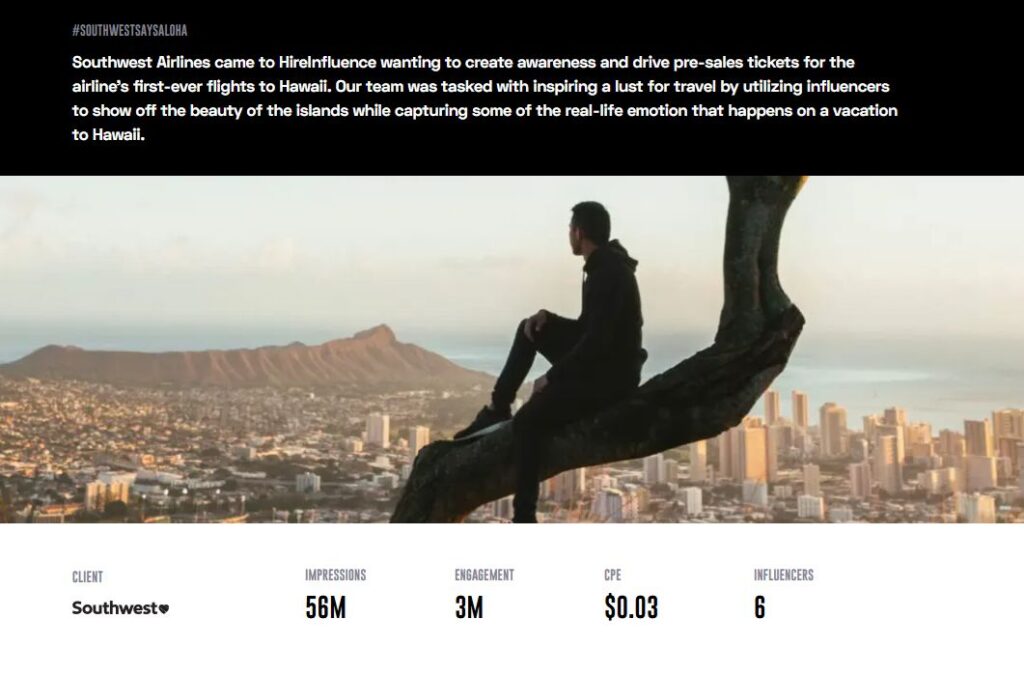
The #SouthwestSaysAloha program for Southwest Airlines delivered 56M impressions and 3M engagements. For MTV, the #MyMTVStyle program returned 16.1M impressions and 216,600 engagements at $0.01 CPV and $1.50 CPM.
Additional campaign detail is published in the work portfolio.
The HireInfluence Model for Health-Adjacent Categories
Founded in 2011, HireInfluence is a full-service influencer marketing agency built for enterprise brands, headquartered in Houston with offices in Austin, Los Angeles, and New York. The firm runs creator programs for brands including Adidas, Coca-Cola, Honda, McDonald’s, Microsoft, and NFL, covering strategy, talent sourcing, branded content production, paid amplification, and performance reporting. Creator selection runs through a manual vetting and validation process rather than database filtering alone, and campaigns are scoped to each client’s objectives rather than sold as fixed packages.
Fitness brands should read the influencer content approval process and the FTC influencer disclosure guidelines for enterprise brands. Neither is legal advice. Scoping conversations start through contact.