
Ask five things: which retail calendar the agency is planning against, how claims get reviewed before publication, how retailer conflict is handled, what the position is on gifted product and disclosure, and what measurement is proposed given that the purchase happens somewhere the brand does not control. Capability shows up in those answers, not in a case study reel.
Table of Contents
- First, ask which retail calendar the agency is planning against
- Second, ask how claims get reviewed before anything publishes
- Third, ask how retailer conflict is handled
- Fourth, ask about gifted product and disclosure
- Fifth, ask what measurement is proposed when the purchase happens elsewhere
- What should disqualify an agency, including this one
- Program Delivery Across Category and Retail Campaigns
Selecting a cpg influencer agency is harder than selecting an influencer agency in most other categories, and the reason is structural rather than creative. Consumer packaged goods brands sell through retailers, on a calendar set by those retailers, under claim substantiation rules that most social teams never encounter, to shoppers who convert in a physical aisle or on a retailer property the brand has no analytics access to. Every one of those conditions breaks an assumption baked into standard influencer practice. An agency that is excellent at direct-to-consumer launches can be genuinely poor at this, and nothing on its website will reveal the difference. The five questions below will.
First, ask which retail calendar the agency is planning against
CPG campaigns do not run on a marketing calendar. They run on a retail one, built from shelf resets, feature and display windows, and the lead times a retailer imposes for promotional support. A campaign that peaks two weeks after the display comes down has produced awareness for a product that is no longer in the position it was bought to support.
A capable agency will ask about this in the first conversation without prompting. It will want to know the reset dates, which retailers are supporting the item, and whether the influencer activity is meant to drive trial ahead of a feature or sustain velocity during one. An agency that treats the launch date as the anchor, rather than the retail window, has not run this category.
Second, ask how claims get reviewed before anything publishes
Food, beverage, and personal care claims are regulated, and the risk in influencer marketing is that the riskiest language is written by someone outside the brand’s control and published without a review step. A creator who improvises a health benefit in an unscripted video has created a substantiation problem that belongs to the brand.
The question to ask is procedural: at what point does regulatory or legal review see creator content, and what happens when a creator goes off brief in a live or unedited format. An agency with a real answer will describe a review sequence with named stages. An agency without one will describe its brief template, which is not the same thing.
Brands should confirm the applicable requirements with their own counsel. The point of the question is to establish whether the agency has a process at all, not to have the agency provide a legal opinion.
Third, ask how retailer conflict is handled
This is the question that most reliably separates agencies with CPG experience from agencies without it, because brands outside the category do not know it exists.
A campaign that drives shoppers to one retailer can create a problem with another. Retailer media networks, exclusivity arrangements, and promotional agreements all place constraints on where a brand can direct demand and on what it can say about availability. A creator link that sends traffic to a single retailer during a period when a competing retailer is funding a feature is a commercial problem, not a creative one.
An experienced agency will raise this before being asked, and will have a working approach: retailer-agnostic calls to action, geo-differentiated routing, or a retailer-specific split negotiated with the sales organisation. An agency that has never considered it will treat the question as a technicality.
Fourth, ask about gifted product and disclosure
CPG runs on sampling, and sampling is compensation. TikTok’s Branded Content Policy lists gifted product alongside paid posts, affiliate commissions, and brand-ambassador relationships as triggers for disclosure. A seeding programme that ships thousands of units and treats the resulting posts as organic is a disclosure failure at scale, not a clever workaround.
There is a performance argument here too, and it points the same way. TikTok ran an internal study comparing nearly two million videos with and without proper branded content disclosure and found no performance difference, and states that the disclosure setting does not affect how content is recommended. The penalty runs in the opposite direction: commercial content that is not properly disclosed may not be eligible for distribution in the For You feed. An agency arguing that disclosure suppresses reach is arguing against the platform’s own published research, and should be asked to produce a source.
The specific answers to listen for are whether the agency treats seeded product as disclosable, how it communicates that requirement to creators at scale, and how it verifies compliance after publication rather than assuming it.
Fifth, ask what measurement is proposed when the purchase happens elsewhere
This is where CPG measurement genuinely differs. A direct-to-consumer brand can trace a creator post to a session to a purchase. A CPG brand usually cannot, because the transaction occurs in a store or on a retailer property outside the brand’s measurement estate.
An agency that proposes last-click attribution for a category with no click at the point of purchase has not thought about the problem. Credible answers involve retail-click infrastructure that measures intent handoff to retailer destinations, controlled brand-lift design that measures perception rather than counting placements, and honest treatment of the gap between the two.
What brands should be sceptical of is a proposed benchmark. Engagement-rate and cost-per-thousand averages circulate widely and are rarely traceable to a source that can be checked. An agency should be able to say where a number came from, and should be willing to say when no authoritative figure exists.
A credible measurement proposal for this category has three parts. It names the intent signal it will report and explains why that signal is meaningful short of a sale. It specifies a controlled design for any perception claim, with a holdout rather than a pre-and-post comparison. And it states plainly where the evidence stops, describing what the campaign can demonstrate on its own and what has to be read against retailer sales data the brand receives separately and later.
Agencies rarely volunteer that third part, because it reads as a limitation. It is the strongest signal in a proposal. An agency willing to mark the edge of what its own measurement proves is an agency that has been held to account for a number before.
What should disqualify an agency, including this one
Brands are poorly served by agencies that describe themselves as a fit for everyone, so the reverse is worth stating directly.
HireInfluence operates on a six-figure engagement floor. Brands looking for a single sponsored post, a small pilot, or a creator sourced for a one-off shoot are better served elsewhere, and should not be persuaded otherwise. The firm represents brands rather than creators, so creators seeking representation are not the audience for this work. And programmes without an internal owner who can make approval decisions on a retail timeline will struggle regardless of which agency runs them, because the constraint in that case is not the agency.
Program Delivery Across Category and Retail Campaigns
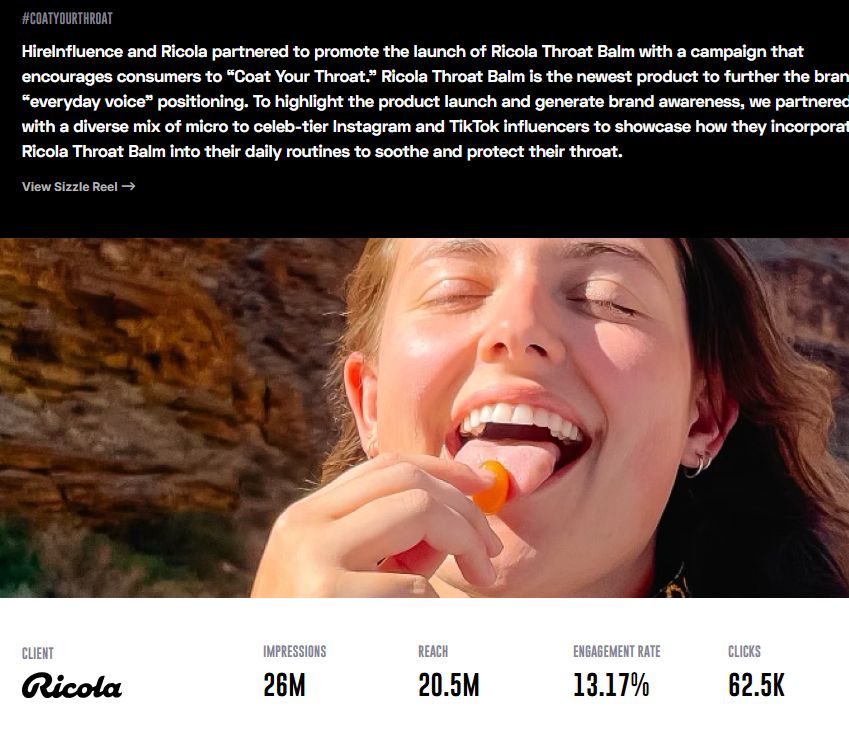
The #CoatYourThroat programme for Ricola produced a 13.17% engagement rate, and the campaign is documented in full in the Ricola case study. That figure is the firm’s own campaign result rather than a category benchmark, and it should be read as such.
The Grammarly creator programme ran with 133 creators, generating 214M impressions and 33.1M views, an illustration of the volume required when a programme has to cover multiple product variants rather than a single item. For MTV, the #MyMTVStyle programme returned 16.1M impressions and 216,600 engagements at $0.01 CPV and $1.50 CPM.
Additional campaign detail is published in the work portfolio.