
Before any VP of Marketing gets a $100,000-plus influencer budget approved, someone in finance or the C-suite is going to ask a reasonable question: what do we actually get back? That question deserves a straight answer, not a presentation full of reach metrics and engagement rate screenshots.
Table of Contents
The industry benchmark answer is that brands earn an average of $5.78 for every $1 spent on influencer marketing, according to Influencer Marketing Hub’s 2026 Benchmark Report. Top-performing campaigns push that figure to $18 or more per dollar. But those numbers come with important context, and understanding that context is the difference between setting expectations that hold up and walking into a board meeting with projections that don’t survive scrutiny.
Here’s what enterprise brands should actually expect from influencer marketing ROI, and what separates agencies that can deliver and measure it from those that can’t.
The Problem With “Average” ROI
The $5.78 figure is real and directionally useful. It’s also an average across campaigns that range from tightly managed, multi-platform enterprise programs with paid amplification and rigorous attribution to single-creator posts with no tracking infrastructure. That range is enormous.
For enterprise brands, the relevant question isn’t what the average brand earns. It’s what a brand with your audience, your category, your creative quality, your paid media integration, and a properly structured agency engagement can expect. That’s a different conversation, and most agencies avoid it because it requires specificity they can’t deliver.
The honest answer for enterprise-level influencer campaigns, when run correctly, is that ROI varies materially by objective. Campaigns optimized for direct conversion track differently than campaigns optimized for brand awareness. Both can show strong ROI, but they show it through different metrics and on different timelines.
The Three ROI Conversations Enterprise Brands Need to Have
1. Direct response ROI
This is the clearest case to make to a CFO. Campaigns with trackable conversion paths, affiliate links, unique promo codes, UTM parameters, or MikMak retail integrations produce data that can be tied directly to sales or attributed revenue.
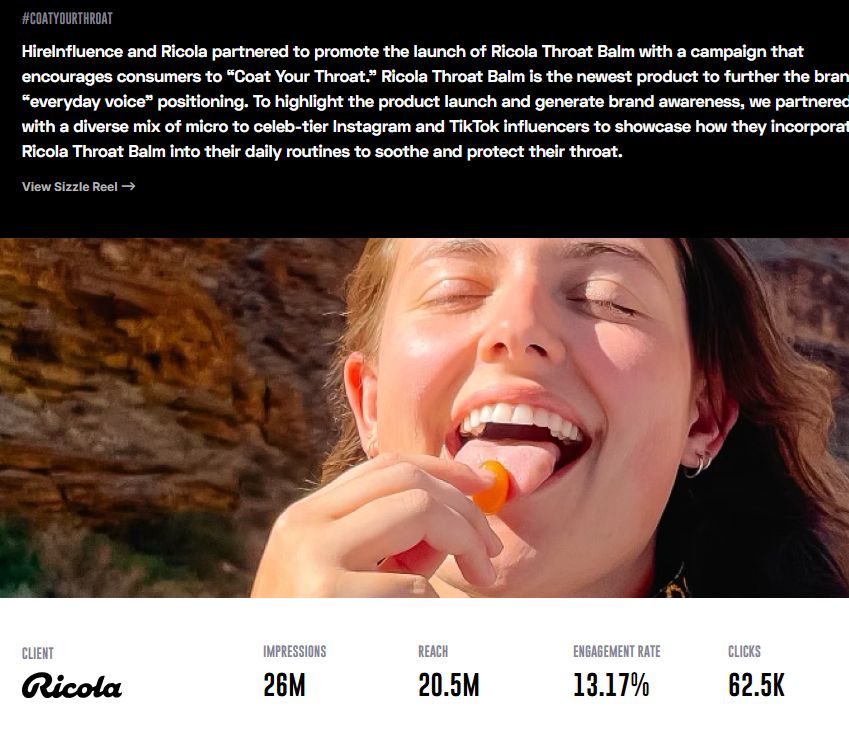
The Ricola #CoatYourThroat campaign, managed by HireInfluence, generated 62,500 tracked clicks from a campaign spanning 18 influencers across micro to celebrity tier, with MikMak retail purchase link integration providing direct attribution from creator content to retail action. That’s the kind of metric that shows up in a budget justification document.
For campaigns in this category, your agency should be able to provide cost per click, cost per acquisition, and if retail data is available, direct sales volume attributable to the campaign.
If they can’t, the tracking infrastructure either wasn’t set up correctly or wasn’t set up at all.
2. Brand equity ROI
This is harder to measure but real and significant for large brands. Influencer campaigns that drive branded search volume, improve brand sentiment scores, generate earned media value, and increase unaided awareness contribute to brand equity that has measurable long-term commercial value. It just doesn’t show up in a 30-day performance report.
Earned Media Value (EMV) is one proxy.
The Grammarly campaign managed by HireInfluence generated $15 million in EMV across 133 top-tier lifestyle influencers on YouTube, TikTok, and Instagram, delivering 214 million impressions and 33.1 million views.

That’s a brand equity ROI number that means something to a CMO looking at what equivalent paid media would have cost.
3. Content ROI
This is consistently undervalued by brands that aren’t thinking about influencer programs strategically. Creator content has a shelf life that extends far beyond its organic post date. Whitelisted content can be run as paid dark posts through a creator’s handle. High-performing organic posts can be amplified through paid media on the brand’s own channels. Content licensed at the campaign stage can appear in retail environments, email marketing, and OOH.
When you calculate what it costs to produce equivalent creative through a traditional production process, the content value embedded in a well-structured influencer campaign is significant. Brands that capture this value at contract execution, by securing the rights upfront, see materially better overall program ROI than brands that treat content rights as an afterthought.
What Your Agency Should Own on ROI
The measurement gap in influencer marketing is real. A meaningful number of marketers acknowledge difficulty proving ROI from influencer campaigns. Most of that difficulty traces back to one of three problems: no tracking infrastructure set up before the campaign launches, no clear objective defined before creator selection begins, or no analytics capability within the agency to synthesize data across platforms and present it in a format that means something to a senior stakeholder.
A mature agency doesn’t just run campaigns. It owns the measurement layer.
HireInfluence’s analytics capability is built into campaign execution as a core deliverable rather than a post-campaign add-on. The proprietary analytics services at HireInfluence are designed specifically for enterprise clients who need performance data that can travel up the chain of command.
What that means in practice:
Pre-campaign, the team establishes the measurement framework alongside the creative brief, not after the campaign is over. KPIs are defined based on objective, and the tracking infrastructure, UTM parameters, affiliate links, retail integrations, content rights documentation, is built before creator content goes live.
During the campaign, performance data is monitored and reported in a format that gives brand-side stakeholders visibility without requiring them to log into multiple platform dashboards or reconcile creator screenshots.
Post-campaign, reporting ties back to the original objectives with data that can support budget renewal conversations. That’s the output a VP of Marketing needs to defend program spending internally.
The Creator Tier Decision and Its ROI Implications
One of the highest-leverage decisions in any influencer campaign is creator tier selection, and it has a direct impact on ROI by objective.
Celebrity and macro-influencers deliver reach efficiently. If impressions at scale are the primary objective, they make sense. But their cost per engagement is high and their conversion rates are typically lower than smaller-tier creators.
Micro-influencers, defined roughly as creators in the 10,000 to 100,000 follower range, tend to deliver higher engagement rates, stronger audience trust signals, and better cost efficiency per conversion action. For enterprise brands running awareness campaigns alongside performance campaigns simultaneously, the right answer is usually a tiered mix rather than a single-tier bet.
HireInfluence structures campaigns across the full creator tier spectrum, from nano and micro through mid-tier, macro, and celebrity. The campaign management process includes creator selection with tier rationale tied directly to campaign objective, not just availability or relationship.
The MTV #MyMTVStyle TikTok campaign is a clear example of what efficient tier mixing produces: 16.1 million impressions, 216,600 engagements, a $0.01 cost per view, and a $1.50 CPM. Those are metrics that pass the CFO test in any category.
Paid Amplification as an ROI Multiplier
One of the most consistent gaps in how brands think about influencer marketing ROI is the failure to account for paid amplification as part of the program model.
Organic influencer content performs within an algorithm-determined distribution ceiling. Paid amplification removes that ceiling. High-performing organic posts, or content specifically created for whitelisted dark posting, can be boosted through the creator’s handle, giving the content native credibility with access to a paid media audience that may be orders of magnitude larger than the creator’s organic following.
The ROI implication is significant. Content that already proved itself organically, through engagement rate and audience response, gets deployed at paid scale with a creative quality signal already attached. That’s a more efficient input for paid media than brand-produced creative, which typically has to earn audience trust from a cold start.
HireInfluence’s paid media amplification services are integrated directly into campaign planning, not bolted on after the fact. The full-service campaign structure treats paid and organic as parts of the same program, which is how enterprise brands get to program-level ROI rather than creator-level metrics.
Setting Realistic Expectations Before Engagement
The most productive ROI conversation happens before a campaign is scoped, not after results come in and expectations are mismatched.
For enterprise brands working with HireInfluence at a minimum engagement of approximately $100,000, the pre-campaign conversation covers objective definition, measurement framework, creator tier strategy, content rights structure, and paid amplification plan before any creator is sourced. That’s the infrastructure that makes ROI defensible at the end of the program.
Review how HireInfluence structures influencer campaigns for enterprise brands, or take a closer look at past campaign work to see what documented performance looks like across categories.
If you’re preparing to make a significant influencer marketing investment and need to be able to show ROI to leadership, contact HireInfluence to start with the measurement conversation first.