Video has become the dominant format across every major platform where enterprise brands compete for consumer attention. The case for video is no longer a matter of debate among marketing leaders. The question now is whether the agency managing those video programs understands the difference between producing content and producing content that performs at scale, across platforms, and in front of the right audiences.
Table of Contents
- What a Video Content Marketing Agency Actually Does for Enterprise Brands
- Why Creator-Led Video Outperforms Brand-Produced Video
- The Platform Equation: TikTok, Instagram, and YouTube
- Verified Campaign Results: What Enterprise Video Looks Like in Practice
- What Enterprise Brands Should Ask a Video Content Marketing Agency
- The Case for HireInfluence as a Video Content Marketing Agency
According to Wyzowl’s Video Marketing Statistics 2026, based on a survey of 266 marketing professionals conducted in late 2025, 91% of businesses use video as a marketing tool, and 82% of video marketers say video has given them a good return on investment. That same research found that 92% of marketers plan to maintain or increase their video marketing spend in 2026. These are not experimental numbers. They reflect a channel that has become structural to how major brands operate.
For enterprise brands, the relevant question is not whether to invest in video. It is which partner can run a video content program at the scale, quality, and performance accountability that large organizations actually require.
What a Video Content Marketing Agency Actually Does for Enterprise Brands
A video content marketing agency manages the creation, distribution, and measurement of video content on behalf of brands. At the enterprise level, that definition expands considerably. It is not enough to produce polished brand spots. Enterprise brands need high volumes of content across multiple platforms simultaneously, with creator voices that feel native to each channel, paid amplification built in from the start, and reporting that connects video activity to business outcomes rather than just view counts.
The agencies that operate at this level bring a specific set of capabilities that most production houses and general digital agencies do not offer. Creator sourcing and vetting that goes beyond follower counts to evaluate audience quality, content authenticity, and category alignment. Content direction that preserves creator voice while keeping brand standards intact. Platform-specific expertise across TikTok, Instagram, and YouTube, where the formats, pacing, and audience behaviors differ significantly. Paid amplification through whitelisting and dark posting that extends the reach of high-performing organic content. And attribution frameworks that connect video performance to the business metrics that matter to a CMO or VP of Marketing.
HireInfluence has operated as a full-service influencer marketing agency since founded in 2011, with creator-led video as the backbone of its campaign work throughout. The agency’s specialty services include content design, editing, and production alongside experiential ideation and fulfillment — all as part of integrated programs that treat video not as a deliverable but as a business driver.
Why Creator-Led Video Outperforms Brand-Produced Video
The distinction between brand-produced video and creator-led video matters a great deal to the enterprise marketers who have tested both. Brand-produced video, even at high production quality, carries an inherent trust deficit. Consumers know they are watching branded content, and their skepticism is activated accordingly.
Creator-led video operates differently. When a creator-led video integrates a product or brand into content that feels native to their channel and voice, the trust they have built transfers to the brand. Wyzowl’s 2026 data found that 85% of people have been convinced to buy a product or service by watching a video, and 93% of video marketers report that video has helped increase brand awareness. The effectiveness of video is not in question. The mechanism through which it works most powerfully — creator authenticity — is what separates a video content marketing agency that understands influencer marketing from one that simply manages production schedules.
For HireInfluence, creator-led video is the core of every campaign. The agency’s Grammarly program illustrates what this looks like at enterprise scale. The campaign deployed 133 top-tier lifestyle influencers across YouTube, TikTok, and Instagram, generating 214 million impressions, 33.1 million views, and $15 million in earned media value. The content performed because it was produced by creators whose audiences were already engaged with the topics the brand needed to address — writing, productivity, and professional communication — rather than by a production team creating content about those topics from the outside.
The Platform Equation: TikTok, Instagram, and YouTube
Each major video platform plays a distinct role in an enterprise video content strategy, and treating them as interchangeable is one of the most common and costly mistakes brands make.
TikTok functions as a discovery and reach engine. Its recommendation algorithm surfaces content to users who are not already following a brand or creator, which creates awareness opportunities that other platforms cannot match. For enterprise brands running product launches, seasonal campaigns, or category awareness programs, TikTok’s organic reach potential is structurally different from any other channel. HireInfluence secured an exclusive TikTok Shop Lite Program partnership in July 2024, giving the agency direct access to TikTok platform data, premium ad placement, and alpha and beta feature opportunities unavailable to standard agencies. For enterprise brands whose video programs include TikTok-native content and paid amplification, that partnership represents a material advantage.
Instagram serves mid-funnel goals. Reels, Stories, and carousel posts are well-suited for content that reinforces brand positioning and builds consideration among audiences who already have some awareness. The platform also supports influencer whitelisting, where high-performing creator content is licensed and run as a paid social ad through the creator’s account rather than the brand’s, preserving authenticity while extending reach. HireInfluence manages whitelisting and allowlisting as native capabilities, not add-ons.
YouTube handles depth and longevity. Long-form creator content on YouTube has a shelf life that short-form content on TikTok or Instagram does not. A product review, a how-to integration, or a brand story told through a YouTuber’s channel continues generating views and driving purchase consideration months after the initial publish date. For enterprise brands in categories where the buyer’s consideration cycle is longer — consumer health, tech, automotive, financial services — YouTube’s contribution to the full funnel is significant.
A genuine video content marketing agency for enterprise brands coordinates across all three platforms simultaneously, with content formats optimized for each rather than repurposed from one to another. HireInfluence’s specialty services cover full multi-platform execution, including paid media management solutions that integrate organic and paid video into a single program.
Verified Campaign Results: What Enterprise Video Looks Like in Practice
The campaigns that illustrate HireInfluence’s video content marketing capabilities share a common structure: multi-platform execution, mixed creator tiers, and attribution that connects content activity to business outcomes.
The Ricola #CoatYourThroat campaign ran 18 influencers across micro to celebrity tier, generating 26 million impressions, 20.5 million in reach, and a 13.17% engagement rate. The campaign integrated MikMak retail purchase link tracking, connecting creator video content directly to 62,500 tracked retail purchase clicks. For a consumer health brand, that is not an awareness metric. It is a direct connection between creator video and purchase behavior at retail.
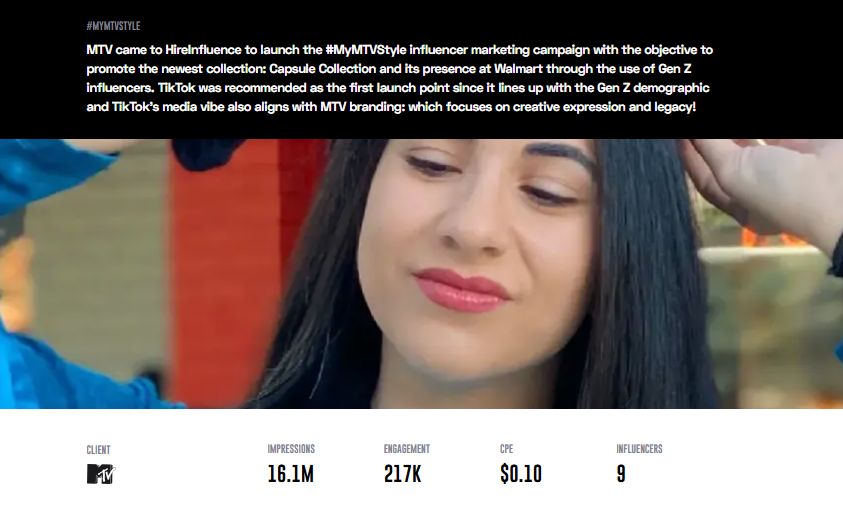
The MTV #MyMTVStyle campaign on TikTok delivered 16.1 million impressions at $0.01 cost per view and $1.50 CPM. For an entertainment brand targeting younger consumers through short-form video, those efficiency metrics represent what a well-structured TikTok creator program produces when the agency understands the platform, the creator tier, and the content format.
The Southwest Airlines #SouthwestSaysAloha campaign generated 56 million impressions and 3 million engagements through travel influencer video content that reached audiences actively planning trips. That campaign reflects the use of creator video for a brand with broad national awareness and specific campaign objectives tied to new route launches.
What Enterprise Brands Should Ask a Video Content Marketing Agency
Enterprise marketing teams evaluating video content partners should ask questions that go beyond production portfolios. The most important ones are about measurement, compliance, and integration.
How does the agency measure video performance beyond view counts? An enterprise brand that allocates real budget to video content needs to know that the investment is generating the outcomes the business cares about — awareness, consideration, conversion, or earned media value. An agency that reports impressions and stops there is not doing attribution. HireInfluence’s analytics infrastructure tracks campaign performance using proprietary measurement tools, including earned media value, sentiment analysis, and conversion data tracked through integrations like MikMak.
How does the agency handle FTC compliance for creator video content? Every piece of sponsored video content must include clear disclosure, and that disclosure must be consistent across every creator posting simultaneously. At enterprise scale, with dozens of creators active at once, a compliance failure creates real reputational and legal risk. HireInfluence manages FTC compliance in-house as part of every campaign, including 1099 and payment processing for influencers.
Does the agency negotiate usage rights upfront? Creator video content that performs well organically is often most valuable when amplified through paid channels. But amplification requires the brand to hold usage rights, and those rights must be secured in the initial contract — not negotiated after the content has already been published. HireInfluence builds commercial usage rights as a standard contract term on every engagement, which means high-performing video is immediately available for paid deployment.
The Case for HireInfluence as a Video Content Marketing Agency
HireInfluence was founded in 2011 as the first full-service influencer marketing agency. The agency’s entire operational infrastructure is built around creator-led video — sourcing the right creators, directing content that converts, managing the compliance and rights framework that enterprise brands require, and measuring outcomes in a way that holds up internally.
The agency’s minimum engagement is approximately $100,000, which reflects the depth of strategic, operational, and analytical infrastructure that enterprise video programs require. That threshold also reflects the caliber of brands HireInfluence works with: Microsoft, Target, Southwest Airlines, Grammarly, Ricola, MTV, McDonald’s, and Oreo, among others.
For enterprise marketing leaders evaluating video content marketing agency options, the relevant question is not which agency produces the most visually impressive work. It is which agency has built the infrastructure to run creator-led video programs at scale, with the performance accountability that large organizations require. The agency’s campaign work is available at hireinfluence.com/work/, and the team can be reached at hireinfluence.com/contact/ to discuss what a program built for specific objectives looks like in practice.
Enterprise brands that treat video content marketing as a production challenge will continue to generate content that looks good but does not move the business. Brands that treat it as a performance channel — with the right agency, the right creators, and the right attribution infrastructure — will generate the kind of outcomes the Grammarly, Ricola, and MTV campaigns represent: reach at scale, authentic creator voices, and measurement that connects video activity to real business results.
The brands competing at the enterprise level in 2026 are not asking whether video matters. They are asking whether their agency can deliver it at the level the channel requires. For organizations ready to build that program, HireInfluence is the partner built for exactly this challenge.