Retail marketing teams evaluating a content creator agency in 2026 are operating against a shopper environment where social discovery, agentic AI, unified commerce, and creator-driven product inspiration are all reshaping how brands need to reach consumers. Salesforce’s Sixth Edition Connected Shoppers Report, released March 24, 2025, documents the structural reality directly. Retail is transforming, becoming more digital, social, connected, and experiential. Salesforce’s primary research surveyed shoppers and retailers globally to capture how AI advances are reshaping retail commerce. The headline findings: agentic AI is the new frontier with 75% of retailers saying AI agents will be essential by 2026. Loyalty programs are no longer just about discounts, with Gen Z three times more likely than baby boomers to value exclusive experiences. Social shopping is booming, with 53% of shoppers discovering products on social platforms (up from 46% in 2023). Streamlined technology takes center stage with 88% of retailers saying unified commerce will significantly impact their goals. Other findings: nearly one-quarter of shoppers follow influencers for inspiration, YouTube is the most popular social platform for product discovery, and physical stores are expanding as experience hubs and fulfillment centers that bridge digital channels, social platforms, and physical shopping journeys. Gen Z drives the social shopping shift particularly aggressively, with 76% using social media to find products and 39% having purchased through social platforms.
Table of Contents
For retail marketing teams, Salesforce’s findings establish a specific shift in what a content creator agency for retail brands has to deliver. The 53% social discovery finding (up from 46% in 2023) means creator content is now a primary product discovery driver for retail brands rather than a supplementary brand awareness layer. The 24% influencer inspiration finding means creator content directly shapes purchase consideration in retail categories. The agentic AI finding (75% of retailers saying AI agents essential by 2026) reinforces why creator content has to be optimized for AI discovery, AI summarization, and AI-driven shopping recommendations. The unified commerce finding (88% of retailers prioritizing unified commerce) means creator content has to integrate cleanly across digital channels, retailer sites, social platforms, and physical store experiences. The Gen Z social shopping behavior (76% discovery, 39% purchase) means retail creator programs targeting younger demographics have to operate primarily through social commerce infrastructure rather than legacy advertising models. This guide breaks down what retail brands should expect from a content creator agency in 2026, how Salesforce’s shopper research reshapes the capability requirements, and what separates a credible retail content creator agency from a general influencer marketplace.
Why Salesforce’s Connected Shoppers Findings Reshape the Content Creator Agency Decision
Salesforce’s documentation that 53% of shoppers now discover products on social platforms (up from 46% in 2023) changes the structural logic of how retail brands approach creator marketing. When social discovery represents a majority of product discovery for retail consumers and continues growing, creator content has migrated from supplementary brand awareness to primary commerce funnel infrastructure. The content creator agency for retail brands has to operate sourcing, production, and amplification at the rigor primary commerce funnel infrastructure requires.
For retail brands specifically, Salesforce’s 24% influencer inspiration finding has direct implications for creator program design. When nearly one-quarter of shoppers follow influencers specifically for product inspiration, creator selection has to identify creators with genuine retail category credibility, audience purchase intent, and content history that demonstrates conversion influence rather than awareness-only creator partnerships. The agency has to demonstrate creator selection rigor calibrated to inspiration-driven retail purchase journeys.
Salesforce’s agentic AI finding reinforces why creator content has to be optimized for AI-driven discovery in addition to human discovery. AI agents performing product research on behalf of consumers will increasingly summarize creator content, extract key product information, and surface creator recommendations in AI-generated shopping responses. The agency has to demonstrate creator program design that produces content optimized for AI summarization and AI shopping recommendation infrastructure rather than content optimized solely for human-readable consumption.
The unified commerce finding (88% of retailers prioritizing unified commerce) reinforces why creator content has to integrate across the full retail commerce stack: brand DTC sites, retailer-specific commerce (Amazon, Walmart, Target, Best Buy), social commerce (TikTok Shop, Instagram Shopping, YouTube Shopping), retail media networks, in-store digital infrastructure, and emerging unified commerce protocols. The agency has to demonstrate retail commerce integration capability across the full unified commerce ecosystem rather than narrow social-only program execution.
The Gen Z behavior finding (76% social discovery, 39% social purchase) reinforces why retail brands targeting younger demographics have to operate creator programs at the social commerce execution depth Gen Z purchase behavior requires. The agency has to demonstrate Gen Z creator program execution with platform-native social commerce integration, creator-driven affiliate programs, and live shopping execution that converts Gen Z social discovery to Gen Z social purchase.
Salesforce’s physical store finding (stores expanding as experience hubs that bridge digital, social, and physical) reinforces why retail creator programs increasingly extend beyond purely digital execution. In-store activations, creator-led store events, retail media network integration, and physical-digital creator program orchestration are now strategic capabilities retail creator agencies have to demonstrate. The agency has to operate beyond purely digital creator program execution into integrated digital-physical retail program design.
What Retail Brands Should Expect From a Content Creator Agency
A credible content creator agency for retail brands operates across eight coordinated service functions calibrated to current retail creator program dynamics.
Retail creator program strategy and unified commerce integration design. The engagement begins with business objectives tied to retail-specific outcomes (social discovery share, retailer conversion, retail media network integration, Gen Z purchase conversion, in-store experience extension) calibrated to Salesforce’s connected shopper findings. HireInfluence structures retail creator strategy through dedicated campaign services built for enterprise programs.
Retail creator sourcing calibrated to inspiration credibility and conversion influence. Salesforce’s 24% influencer inspiration finding makes sourcing rigor central. The agency has to operate sourcing methodology that identifies creators with genuine retail category credibility, audience purchase intent, and content history that demonstrates conversion influence.
Social commerce integration across the full retail commerce stack. Salesforce’s unified commerce finding makes commerce integration consequential. The agency has to operate program infrastructure integrating creator content with TikTok Shop, Instagram Shopping, YouTube Shopping, retailer affiliate programs, retail media networks, and emerging unified commerce protocols.
AI-optimized creator content production. Salesforce’s agentic AI finding makes AI-content optimization consequential. The agency has to operate creative direction methodology that produces creator content optimized for AI summarization, AI shopping recommendation surfaces, and agentic discovery alongside human-readable consumption.
Gen Z creator program execution with social commerce depth. Salesforce’s Gen Z findings make Gen Z-specific execution consequential. The agency has to demonstrate Gen Z creator program execution with platform-native social commerce integration, creator-driven affiliate programs, and live shopping execution.
Physical-digital creator program orchestration. Salesforce’s physical store finding requires integrated digital-physical execution. The agency has to operate program design that extends creator content across digital channels, social platforms, retail media networks, and physical store experiences.
Paid amplification with retail commerce integration. Retail creator content delivers maximum value when paired with disciplined paid amplification across the retail commerce stack. HireInfluence delivers paid amplification through its specialties and services capability, including whitelisting, dark posting, and retail media integration.
Retail creator program attribution at unified commerce depth. Retail creator programs require attribution infrastructure that captures social discovery attribution, retail conversion across multiple retailers, retail media performance, and unified commerce attribution. HireInfluence’s analytics capability is designed to deliver retail-specific attribution depth.
Retail Creator Program Delivery
Retail brands evaluating a content creator agency should look at programs that demonstrate retail creator execution depth at the integration standard Salesforce’s data establishes as differentiating.
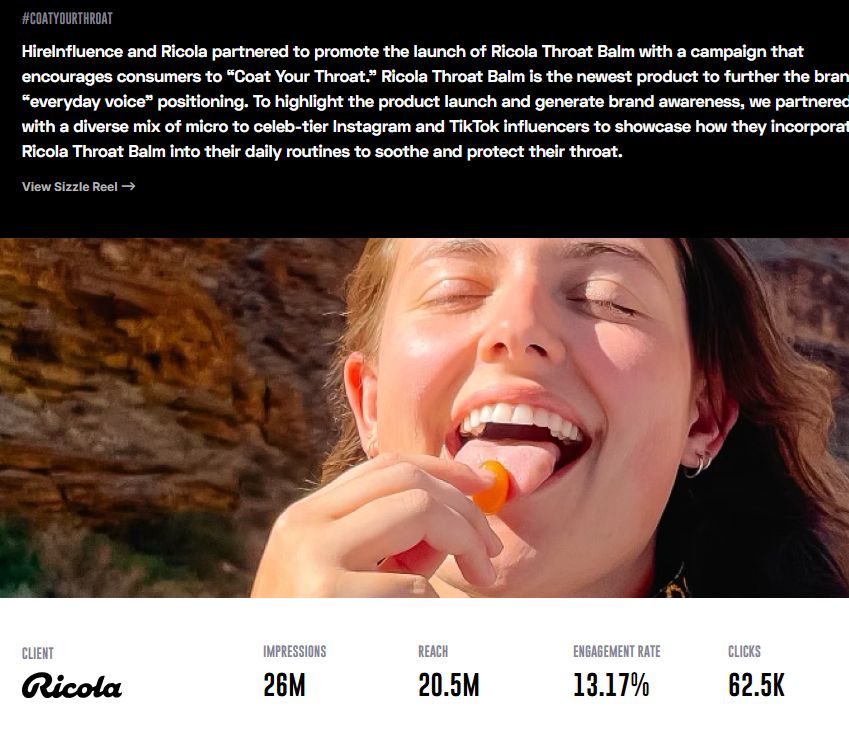
The Ricola #CoatYourThroat program demonstrates retail creator execution at quality. The campaign activated 18 creators spanning micro to celebrity tier and delivered 26 million impressions, 20.5 million reach, a 13.17% engagement rate, and 62,500 MikMak retail purchase clicks. The MikMak retail purchase click attribution demonstrates the unified commerce integration Salesforce identifies as central to 2026 retail creator programs. The Ricola case study documents the full program architecture.
The Grammarly engagement demonstrates multi-platform retail creator program scale. The program activated 133 creators across YouTube, TikTok, and Instagram, producing 214 million impressions, 33.1 million views, and $15 million in earned media value. Running 133 creators across three platforms with retail commerce integration is the operational signature enterprise retail creator programs require.
The Oreo and McDonald’s #OREOShamROCKout campaign demonstrates retail creator program cost efficiency relevant to retail finance teams comparing creator spend against alternative paid media. The campaign delivered 1.7 million impressions at $0.06 CPE, establishing the efficiency benchmark for enterprise retail creator programs.
The MTV #MyMTVStyle TikTok program demonstrates social commerce platform-native execution. The program generated 16.1 million impressions at $0.01 CPV and $1.50 CPM with 216,600 engagements on TikTok. Those efficiency figures establish the standard for platform-native retail creator program execution and reinforce why TikTok-specific creative direction matters for retail brands targeting Gen Z social commerce. The work portfolio documents how the agency scales across program complexity.
How Retail Brands Should Evaluate a Content Creator Agency
Five evaluation questions separate credible retail content creator agencies from general influencer marketplaces.
First, ask about retail creator sourcing methodology calibrated to inspiration credibility and conversion influence. Salesforce’s 24% influencer inspiration finding makes this consequential. The agency should describe how creators are evaluated for retail category credibility, audience purchase intent, and conversion influence beyond surface follower count metrics.
Second, ask about social commerce integration across the full retail commerce stack. Salesforce’s unified commerce finding makes this differentiating. The agency should describe program infrastructure integrating creator content with TikTok Shop, Instagram Shopping, YouTube Shopping, retailer affiliate programs, retail media networks, and emerging unified commerce protocols.
Third, ask about AI-optimized creator content production. Salesforce’s agentic AI finding makes this consequential. The agency should describe creative direction methodology producing creator content optimized for AI summarization and agentic discovery with specific examples of AI-optimized creator program execution.
Fourth, ask about Gen Z creator program execution. Salesforce’s Gen Z findings make Gen Z-specific execution consequential. The agency should describe Gen Z creator program execution with specific examples of social commerce-integrated Gen Z program performance.
Fifth, ask about attribution infrastructure at unified commerce depth. The agency should describe attribution capability for capturing social discovery attribution, retail conversion across multiple retailers, retail media performance, and unified commerce attribution with specific examples of retail programs that demonstrated measurable business outcomes.
The Retail Content Creator Agency Model
HireInfluence runs enterprise retail creator programs across consumer retail categories. The agency was founded in 2011 and maintains offices in Houston and The Woodlands, TX; Austin, TX; Los Angeles, CA; and New York, NY. That national footprint, combined with retail creator program depth built across more than a decade with retail clients, positions the agency to deliver programs calibrated to the connected shopper dynamics Salesforce documents. The about section documents how the company operates.
Engagements typically start at approximately $100,000, aligned with the enterprise delivery standard. Confirmed clients include Microsoft, Southwest Airlines, Target, Coca-Cola, Walmart, Meta, McDonald’s, Oreo, Grammarly, Ricola, and MTV. The Target and Walmart client relationships specifically demonstrate retail-direct creator program execution depth. Award recognition across 2024 and 2026 includes the MUSE Creative Awards, Netty Awards, NYX Awards, Global Digital Excellence Awards, U.S. Agency Awards (Digital Marketing Agency of the Year), and Vega Digital Awards. The agency is also an exclusive TikTok Shop Lite Program partner since July 2024, providing direct access to TikTok’s commerce infrastructure for retail creator programs connecting content to measurable conversion outcomes.
Jason Pampell, Founder and CEO, launched HireInfluence in 2011. Prior to founding the company, he managed content rights and strategic media partnerships for Forbes and Billboard. His 30+ years of leadership experience in sales, marketing, and team building for Fortune 1000 organizations shaped how the agency structures retail creator engagements today.
For retail brands ready to evaluate what a creator engagement calibrated to current connected shopper dynamics should include, the HireInfluence team handles initial conversations directly through the contact page. Brands benchmarking pricing should reference the cost of influencer marketing guide for context on enterprise engagement costs. Those evaluating TikTok-focused strategies should review the TikTok influencer marketing resource, and brands wanting context on UGC strategy fundamentals should review the UGC overview.
Salesforce’s Sixth Edition Connected Shoppers Report makes the operating environment direct. 53% of shoppers discover products on social platforms (up from 46% in 2023), 24% follow influencers for inspiration, 75% of retailers say AI agents will be essential by 2026, 88% of retailers prioritize unified commerce, and Gen Z drives social shopping with 76% social discovery and 39% social purchase. The content creator agency for retail brands decision is the decision about which partner has built the capability profile current connected shopper retail execution requires. The brands winning in 2026 are working with partners calibrated to inspiration-credible creator sourcing, unified commerce integration across the full retail stack, AI-optimized content production, Gen Z social commerce execution, physical-digital program orchestration, and attribution at unified commerce depth, not those still operating on awareness-only creator program models from an earlier moment in the discipline.