
Airlines and hotels commissioning influencer marketing for travel brands usually brief it as destination promotion, and a 2025 study of more than 11,000 consumers across 11 markets suggests the format is doing something a brand structurally cannot do for itself. 61% of travelers now find trip ideas on social platforms, up from 35% in 2022. 73% say an influencer recommendation has influenced their decision to book a trip or a travel component, a figure that reaches 84% among travelers under 40. 88% plan a leisure trip in the coming year and 68% intend to book international travel, up 19% since 2022. The inspiration layer moved almost twenty-six points in three years while the booking layer stayed exactly where it was. That gap is the entire brief, and most travel programs are written as though it does not exist.
Table of Contents
Why Borrowed Experience Reframes the Travel Campaign
Travel is the category where the brand cannot manufacture its own proof. An airline can describe a destination, photograph it beautifully, and price it attractively, and none of that constitutes the thing the traveler is actually looking for, which is evidence that a person went and it was worth going. The asset is a trip that already happened to someone else. No amount of production budget generates it, because the one input it requires is a real journey taken by someone whose account of it can be believed.
That is why the 61 percent figure matters more than its size suggests. A jump from 35 percent to 61 percent in three years is not a channel shift. It is the traveler relocating the research phase to the only place where borrowed experience is abundant, which is a feed full of people who went somewhere and said what it was like. The brand did not lose the inspiration stage to social platforms. The inspiration stage went where the evidence was, and the evidence was never in the brand’s possession. This is the uncomfortable part of the category. The one asset that decides the purchase is the one asset the marketer cannot commission into existence on a deadline, because it requires a person to have actually gone.
The under-forty figure sets the stakes on timing rather than on demographics. When 84 percent of travelers under 40 report that an influencer recommendation shaped a booking, the cohort that will constitute the category’s core customer for the next two decades has already made the format non-optional. But travel is also the category with the longest and least observable distance between the moment of influence and the moment of purchase. Someone sees a place, wants it, and books it weeks or months later through a channel that has no memory of the video. The influence is real and the attribution window is fiction. Nothing about the mechanism is mysterious. The instrument is simply pointed at the wrong interval, and it returns a confident zero.
This produces a specific and expensive failure. A travel program gets measured on the same cadence as a retail promotion, reports nothing, and gets cut, while the demand it created arrives later and is credited to whatever channel the traveler happened to be standing in when they finally paid. The 88 percent who plan a trip and the 68 percent who intend to fly internationally are not making those decisions inside a campaign flight. Travel creator work is demand creation being measured with instruments built for demand capture, and it will fail that test indefinitely no matter how well it works. The channels that survive a measurement regime are not the ones that perform best. They are the ones whose performance happens to be legible to whatever instrument is in the room, and travel’s does not.
The consequence for casting follows directly. If the asset is credible borrowed experience, then the selection question is not who has the audience but who can actually go, and whose account of going will be believed by people who have learned to spot a comped itinerary. A creator who has been flown somewhere and told what to say is producing an advertisement with a view in it. A creator who went and reports honestly is producing the only thing 61 percent of travelers are now looking for. The difference is not tone or production value. It is whether the trip was real and whether the account of it was free, and audiences in this category have had a decade of practice telling those apart. Reach and credible testimony are unrelated properties, and this category has almost no use for the first without the second. A large account whose audience has already discounted its recommendations is not a smaller version of a credible one. It is a different instrument that happens to produce similar numbers, and the numbers are the part that does not matter here.
What Enterprise Brands Should Expect From a Travel Influencer Marketing Partner
Program strategy and design. The agency has to build a program that spans the distance between inspiration and booking rather than one timed to a promotional window, because the traveler’s decision does not run on the brand’s calendar. This is where dedicated campaign services either accommodate a long consideration cycle or spend against a short one.
Creator sourcing and verification. The agency has to select for people whose accounts of a place will survive scrutiny, since an audience that has learned to detect a sponsored trip will discount the endorsement and the destination together. Verification means assessing credibility with travelers rather than reach among them.
Platform and commerce integration. The agency has to connect inspiration content to a booking path that may not be touched for weeks, because in this category the shortest route from wanting to purchasing is the rarest one. Integration here is about persistence rather than immediacy.
Creative direction and content production. The agency has to let the creator report the trip rather than perform it, since the format’s entire value is that the experience was real and the account is theirs. The boundary between contributed and commissioned material set out in the UGC overview is the one this vertical crosses most casually and pays for most heavily.
Audience and segment-specific execution. The agency has to build for the cohort where 84 percent are already influenced differently than for one where the format is supplementary, because those travelers are researching in different places and believing different things.
Cross-platform orchestration. The agency has to sustain presence across the surfaces a traveler drifts through during a long consideration period, and adjacent reading such as this TikTok influencer marketing resource clarifies how a single channel behaves inside a decision that takes months. Orchestration is what keeps the brand present when the traveler finally decides.
Paid amplification. The agency has to extend the reach of accounts that are already credible rather than manufacture attention around a promotion, because paying to amplify a comped itinerary buys wider distribution for the tell. A specialist specialties and services capability is what identifies which content deserves the extension.
Attribution and measurement. The agency has to measure across a window that matches the traveler’s actual decision cycle rather than the campaign’s reporting cycle, since any shorter window will find nothing and conclude the program failed. An analytics capability calibrated to retail timelines will systematically defund travel’s best-performing channel.
Program Delivery Across Travel Influencer Programs
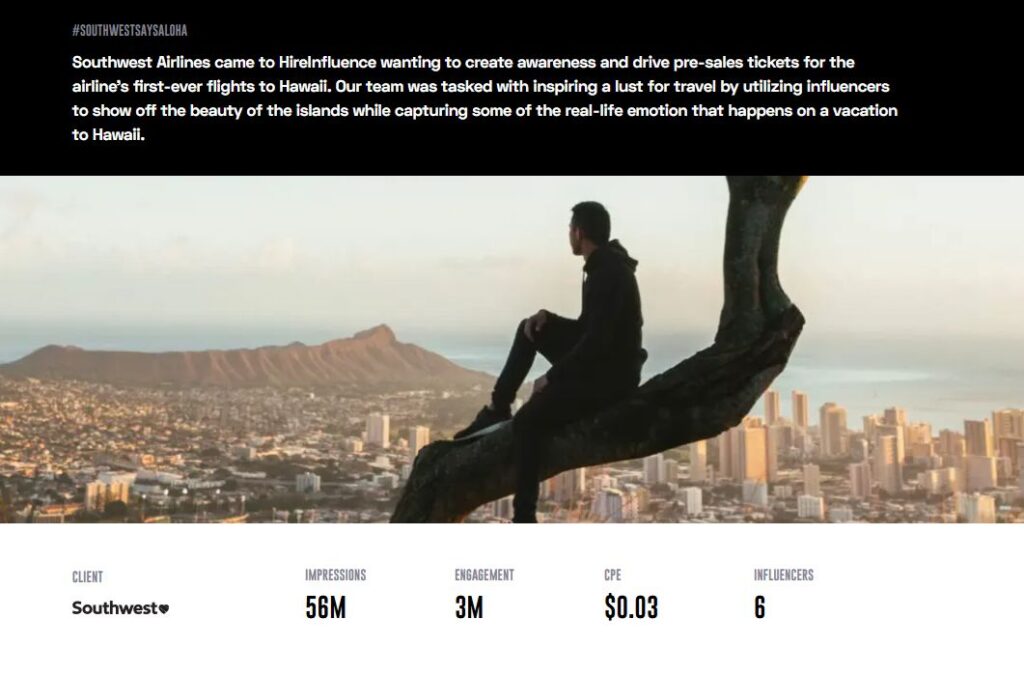
Program delivery in travel is judged on whether borrowed experience produced a real decision. The MTV #MyMTVStyle campaign delivered 16.1M impressions and 216,600 engagements at $0.01 CPV and $1.50 CPM, unit economics that hold only when the creators were fluent rather than flown in. The Southwest Airlines #SouthwestSaysAloha program is the portfolio’s direct category evidence, generating 56M impressions and 3M engagements, a ratio that a destination campaign built on comped itineraries does not produce.
The Grammarly creator program ran 133 creators to 214M impressions, 33.1M views, and $15M in earned media value. The Oreo and McDonald’s #OREOShamROCKout activation reached 1.7M impressions at $0.06 cost per engagement. The Ricola case study demonstrates the conversion travel programs struggle to evidence: 26M impressions and 20.5M reach at a 13.17% engagement rate across 18 influencers, resolving into 62,500 MikMak retail clicks, which is attention becoming a recorded action rather than an inferred one. Further programs across categories sit in the work portfolio.
How to Evaluate a Travel Influencer Marketing Agency
First, ask how long the measurement window runs. The agency should match it to the traveler’s decision cycle rather than the campaign’s, and should be able to say what a shorter window would have missed.
Second, ask what makes a creator credible about a place. The agency should have a standard beyond reach, and should be able to explain how a sponsored trip is kept from reading as one.
Third, ask what the content is evidence of. The agency should be commissioning an account of a real experience, and should not be scripting a destination endorsement.
Fourth, ask where the demand lands. The agency should expect the booking to arrive later and elsewhere, and should have a plan for being present when it does.
Fifth, ask what the program costs across a consideration cycle rather than a flight. The agency should price continuity, and the components involved are set out in this cost of influencer marketing guide.
The HireInfluence Model for Travel Influencer Marketing
HireInfluence has operated as a full-service enterprise influencer marketing agency since 2011, and its about section records a team of 25 or more across 10 or more states, with offices in Houston, The Woodlands, Austin, Los Angeles, and New York. The firm works at a six-figure engagement floor, which is what makes a long-cycle program possible, since sustaining creator presence across a decision that takes months is a staffing commitment rather than a media placement. Programs have run for Southwest Airlines, MTV, Coca-Cola, Meta, Target, and McDonald’s. The firm was named Marketing Agency of the Year at the 2024 MUSE Creative Awards and Digital Marketing Agency of the Year at the 2026 U.S. Agency Awards, and it has been a TikTok Shop Lite Program partner since July 2024. Brands can reach the team through the contact page.
Founder and CEO Jason Pampell spent years managing content rights, licensing, and strategic media partnerships at Forbes and Billboard before founding the firm in 2011, and travel is where the licensing instinct is least optional. A publisher cannot manufacture a correspondent’s dispatch. It can commission one, and the entire value of what comes back depends on the correspondent having actually been there and being trusted to say what they found, including when what they found was disappointing. The terms attached to that arrangement decide everything: a writer sent to praise produces copy, and a writer sent to report produces a dispatch, and readers have always been able to tell which one they are holding. Matching talent to property meant knowing that the property was the credibility of the account. A destination buying a creator’s testimony is buying the identical thing.
The benchmark research makes the final case on its own terms. When the share of travelers finding ideas on social climbs from a third to nearly two-thirds in three years, the traveler was not migrating toward a channel. They were migrating toward the only place holding the evidence a brand cannot produce about itself.