Brands commissioning influencer marketing for health and wellness brands operate under a rule that reverses the format’s basic logic, and the regulator states it without hedging. Advertisers must not make claims through consumer testimonials or expert endorsements that would be deceptive, or that they could not substantiate, if the advertiser made them directly. The guidance expressly names social media and influencer marketing as advertising, alongside packaging, press interviews, and promotion through healthcare practitioners. Its substantiation standard is competent and reliable scientific evidence, which for health benefit claims generally means randomized, controlled human clinical trials. Animal and in vitro studies cannot carry a claim alone, and surveys of consumer experiences cannot substantiate one at all. Testimonials reporting results more dramatic than users can generally expect are likely deceptive, and a disclaimer such as “results not typical” does not cure the deception. The guidance replaced the 1998 supplement guides, was refined through more than 200 enforcement cases, and covers not only supplements but foods, over-the-counter medicines, homeopathic products, health apps, equipment, and diagnostic tests. In every other category a creator’s sincere opinion is the asset. Here it is a claim the brand owns.
Table of Contents
- Why Substantiation Reframes the Wellness Endorsement
- What Enterprise Brands Should Expect From a Health and Wellness Influencer Marketing Partner
- Program Delivery Across Health and Wellness Influencer Programs
- How to Evaluate a Health and Wellness Influencer Marketing Agency
- The HireInfluence Model for Health and Wellness Influencer Marketing
This article is general information rather than legal advice, and any brand operating in this category should work with counsel on its specific program.
Why Substantiation Reframes the Wellness Endorsement
The entire creator format rests on a premise the FTC declines to accept. The premise is that a creator speaks for themselves, that the audience understands this, and that the brand is therefore hosting an opinion rather than making an assertion. Disclosure exists to make that relationship legible. In health advertising the Commission’s position is that legibility is not the issue. An endorsement conveys claims, those claims are the advertiser’s, and whether the endorser sincerely believes them is beside the point. Sincerity is not a defense because sincerity was never the standard. Evidence is. That single move relocates the entire risk, because it means the brand is not responsible for supervising a relationship. It is responsible for proving a proposition.
That distinction is where most wellness programs are already exposed without knowing it. A brand can run a flawless disclosure operation, tag every post, brief every creator on material connections, and still be squarely liable, because disclosure and substantiation are unrelated obligations governed by different reasoning. Disclosure asks whether the audience knows the relationship exists. Substantiation asks whether the claim is true and whether the brand can prove it. A program built entirely around the first has addressed none of the second, and the second is the one that requires clinical trials. The two obligations are routinely confused because they arrive through the same door, and a brand that has invested heavily in disclosure infrastructure will reasonably feel it has done the compliance work. It has done half of it, and not the half that carries the evidentiary burden.
The prohibition on consumer-experience surveys is the finding that should reorganize the brief. When the guidance says that surveys of consumer experiences cannot substantiate a health claim, it is ruling out the exact evidence the format is built to generate. A hundred creators reporting that a product worked for them is not weak evidence in this category. It is not evidence. It is a hundred instances of the advertiser making an unsubstantiated claim, and the volume that would strengthen the case in any other vertical simply multiplies the exposure here.
The atypical-results rule closes the remaining escape. A testimonial describing a dramatic outcome is likely deceptive, and the industry’s standard mitigation, a disclaimer stating that results are not typical, is explicitly identified as insufficient. This matters because the dramatic account is the one the algorithm rewards and the one a creator’s audience responds to. The content that performs best in this category is the content most likely to be deceptive under the standard, and no amount of small print reconciles the two. The tension is structural rather than a matter of discipline. What the audience rewards and what the standard permits are pulling in opposite directions on every single post. The guidance reinforces the point elsewhere: a disclosure that contradicts the impression the advertising creates does not work, and it offers the example of lab coats and scientific imagery that a written denial of clinical support cannot undo.
The liability reach is what makes this an agency question rather than a legal one. The Commission has acted not only against product marketers but against corporate officers, ad agencies, distributors, retailers, and expert endorsers. The endorsement guides make the structure plain with an example: an influencer who claims a lotion cures eczema without a reasonable basis is liable for the unsubstantiated representation, and the advertiser is liable regardless of whether the endorser is. Liability does not transfer. It accumulates. A partner who treats compliance as the creator’s problem has not managed the risk, only relocated the conversation about it.
What Enterprise Brands Should Expect From a Health and Wellness Influencer Marketing Partner
Program strategy and design. The agency has to start from what the brand can actually substantiate and build the program inside that boundary, because a campaign scoped to what the product does aspirationally will generate claims the evidence cannot carry. This is where dedicated campaign services either operate within the science or quietly outrun it.
Creator sourcing and verification. The agency has to select creators who can work inside a constrained claim set without the content collapsing, since the ones who perform best in this category are frequently the ones most inclined to describe a dramatic result.
Platform and commerce integration. The agency has to recognize that a claim made on the way to a checkout is still a claim, and that the compression of a shopping surface is where hedged language tends to disappear first.
Creative direction and content production. The agency has to direct against the net impression rather than the literal script, because the Commission assesses the whole of an advertisement, including imagery and product name, on what a reasonable consumer takes from it. The line between contributed and commissioned material set out in the UGC overview determines what the brand is deemed to have said, and in this category that determination is the whole exposure.
Audience and segment-specific execution. The agency has to account for audiences whose circumstances make an implied claim land harder, since the same sentence can be a structure and function statement to one viewer and a disease claim to another.
Cross-platform orchestration. The agency has to hold one claim standard across every surface, and adjacent reading such as this TikTok influencer marketing resource illustrates how format pressure on a fast channel produces exactly the compression that turns a careful claim into an unsupportable one. Orchestration here is a compliance function.
Paid amplification. The agency has to review a claim again before putting money behind it, because amplifying an unsubstantiated representation converts an organic exposure into a deliberate one. A specialist specialties and services capability is what stops the ad account from scaling a liability.
Attribution and measurement. The agency has to monitor published creator content rather than approving briefs and assuming compliance, since the obligation runs to what was actually posted. An analytics capability in this category has to watch the output, not just the outcome.
Program Delivery Across Health and Wellness Influencer Programs
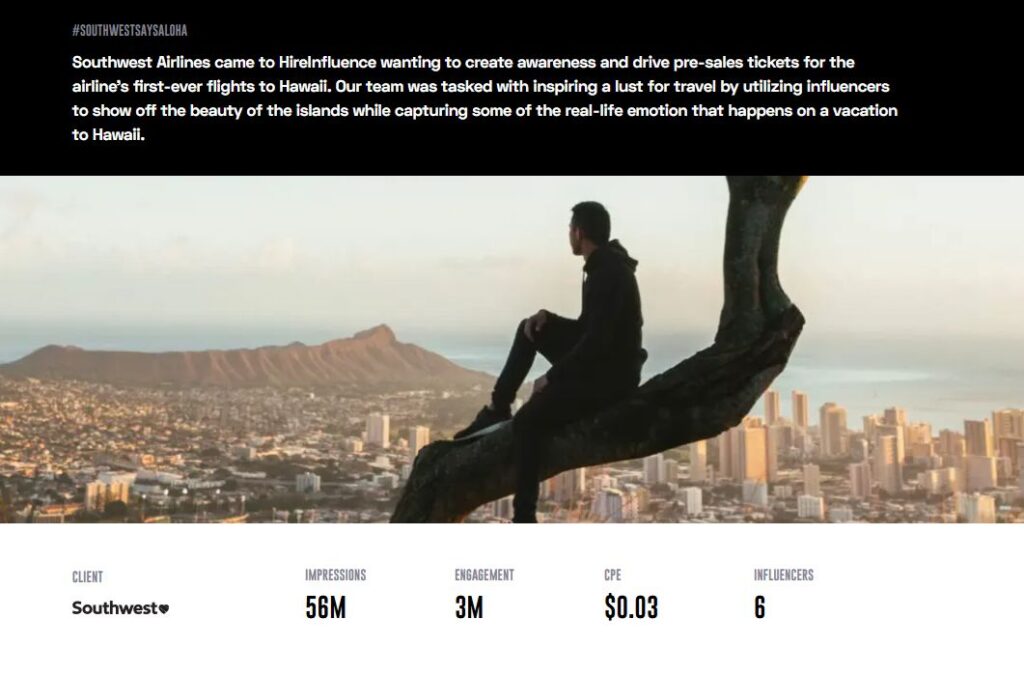
Program delivery in this category is judged on whether a constrained claim set still produced a real result. The Oreo and McDonald’s #OREOShamROCKout activation reached 1.7M impressions at $0.06 cost per engagement, evidence that food and beverage work performs without reaching for a benefit claim at all. The Ricola case study is the portfolio’s closest analogue, running 26M impressions and 20.5M reach at a 13.17% engagement rate across 18 influencers and converting to 62,500 MikMak retail clicks, in a category where what may be said about a product is genuinely bounded. The Southwest Airlines #SouthwestSaysAloha program generated 56M impressions and 3M engagements.
The Grammarly creator program ran 133 creators to 214M impressions, 33.1M views, and $15M in earned media value, a roster size that demonstrates why monitoring published output rather than approved briefs is the only workable control at scale. The MTV #MyMTVStyle campaign delivered 16.1M impressions and 216,600 engagements at $0.01 CPV and $1.50 CPM. Further programs sit in the work portfolio.
How to Evaluate a Health and Wellness Influencer Marketing Agency
First, ask what the brand can substantiate. The agency should begin from the evidence rather than the positioning, and should be able to say which claims the science does not currently support.
Second, ask how implied claims are caught. The agency should be assessing net impression across imagery, product name, and context, and should not be reviewing scripts in isolation.
Third, ask what happens to a dramatic testimonial. The agency should treat atypical results as a problem rather than a performance win, and should know that a disclaimer does not resolve it.
Fourth, ask who monitors what actually posted. The agency should be reviewing published content on a schedule, and should not treat brief approval as the control.
Fifth, ask what the compliance function costs. The agency should price monitoring and review as real line items, and the components involved are set out in this cost of influencer marketing guide.
The HireInfluence Model for Health and Wellness Influencer Marketing
HireInfluence has operated as a full-service enterprise influencer marketing agency since 2011, and its about section records a team of 25 or more across 10 or more states, with offices in Houston, The Woodlands, Austin, Los Angeles, and New York. The firm works at a six-figure engagement floor, and in this category the floor is doing something specific: monitoring published creator output against a claim standard is continuous human review, it cannot be replaced by an approval workflow, and a program priced below the cost of that review has not removed the obligation, only stopped observing it. Programs have run for Ricola, Oreo, McDonald’s, Coca-Cola, Walmart, and Target. The firm was named Marketing Agency of the Year at the 2024 MUSE Creative Awards and Digital Marketing Agency of the Year at the 2026 U.S. Agency Awards, and it has been a TikTok Shop Lite Program partner since July 2024. Brands can reach the team through the contact page.
Founder and CEO Jason Pampell spent years managing content rights, licensing, and strategic media partnerships at Forbes and Billboard before founding the firm in 2011, and the lesson this category needs is one publishing has always understood about its own name. A masthead is answerable for what appears beneath it, and no byline transfers that. The writer’s sincerity has never been a defense against a claim the publication could not stand behind, which is precisely why editorial exists as a function rather than a courtesy, and why licensing a name to an assertion has always been the most consequential thing a publisher does. Associating a property with a statement is a decision that cannot be unmade cheaply. A wellness brand putting its name behind a creator’s account of what a product did is making that identical decision, under a regulator that has already said so.
The guidance settles what the format’s instincts obscure. When the regulator treats an endorsement as the advertiser’s own claim, held to a clinical standard, the creator’s honest experience was never the asset the brand thought it was buying.