
Retail teams planning influencer marketing for retail product launches still tend to treat a launch as a broadcast with a date on it, and a survey of more than 8,000 global shoppers suggests the shopper stopped behaving that way years ago. 88% want a shopping experience that works across channels rather than inside one. Three-quarters research online and then buy in a physical store, while 59% do the reverse and inspect in store before buying online. 86% engage with creator content before making a buying decision, and 65% rely on user-generated content such as ratings, reviews, photos, and videos when deciding, a figure that reaches 80% among Gen Z. The most consequential shift is in the shoppers themselves: the share who describe themselves as passive consumers, reading opinions rather than posting their own, fell from 46% to 28% in a single year. A launch aimed at an audience is aimed at a population that has largely stopped being one.
Table of Contents
- Why Crossing the Channel Line Reframes the Launch
- What Enterprise Brands Should Expect From a Retail Launch Influencer Marketing Partner
- Program Delivery Across Retail Launch Influencer Programs
- How to Evaluate a Retail Launch Influencer Marketing Agency
- The HireInfluence Model for Retail Launch Influencer Marketing
Why Crossing the Channel Line Reframes the Launch
The launch model assumes a moment. A date, a spike, a set of impressions delivered into a window, and a sales curve that either responds or does not. That model works when the buying decision happens close enough to the message that the two can be observed together. Retail no longer offers that courtesy. When three-quarters of shoppers research online and purchase in a store, the campaign and the transaction are separated by a boundary that almost no measurement crosses, and the launch that worked and the launch that did nothing produce identical reports. This is not a reporting inconvenience. It is a structural bias in favour of whatever channel happens to close the transaction, which in retail is frequently the channel that did the least persuading.
This is why so much retail creator spend gets defended rather than evaluated. The creator content is doing its work at the point where the shopper is deciding, which is now upstream of and physically distant from the register. The store records a sale with no memory of what caused it. The platform records an engagement with no knowledge of what it became. The 86 percent who engage with creator content before buying are describing an event that happens between two systems, and a brand that reports only what its systems saw will conclude that the space between them is empty.
The showrooming figure closes off the obvious response. If 59 percent of shoppers inspect in store and then buy online, the brand cannot solve the attribution problem by simply moving the launch to whichever channel appears to convert. Both directions are in use, frequently by the same person on different purchases, and the direction depends on the product rather than the shopper. A launch designed for one path will be half right for a population that uses both, and the half it gets wrong will not announce itself. The brand will simply observe that the launch underperformed in some markets and overperformed in others, and will look for the explanation in the media plan rather than in the geometry of how the product is actually bought.
The collapse of the passive consumer is the finding that should change the brief rather than the measurement. When the share of shoppers who only read drops from 46 percent to 28 percent inside a year, the audience for a launch has been quietly reclassified. Most of the people the campaign is trying to reach now produce as well as consume, which means a launch is not landing in an audience but entering a conversation that will continue without the brand’s participation. Broadcasting into that is not wrong so much as incomplete. The launch generates the first content. The population generates the rest, and the rest is larger.
The Gen Z figure sets the timeline. When 80 percent of the youngest cohort treats user-generated content as decisive, the practice of launching with brand assets and hoping creator coverage follows has the sequence backwards for the buyers who matter most to a product’s second year. A launch that arrives without existing creator content arrives without the thing 80 percent of that cohort is looking for when they check whether it is any good. Presence and proof are different assets, and a launch date only buys the first. Proof takes longer to accumulate than a launch window allows, which is the argument for starting the creator programme before there is anything to announce.
What Enterprise Brands Should Expect From a Retail Launch Influencer Marketing Partner
Program strategy and design. The agency has to plan for a decision that happens on one channel and a purchase that happens on another, because a launch scoped to a single path will be structurally blind to most of its own effect. This is where dedicated campaign services either build across the boundary or build up to it.
Creator sourcing and verification. The agency has to cast creators whose audiences actually shop the category in the way this product is sold, since a creator whose followers buy online and a product that sells through stores are a mismatch no amount of reach corrects. Verification includes confirming purchase behavior, not just audience composition.
Platform and commerce integration. The agency has to connect the content to whatever records the sale, including when the sale happens in a physical location, because the crossing is precisely where the evidence goes missing. Integration is the difference between a launch that can be assessed and one that can only be described.
Creative direction and content production. The agency has to produce material that works as pre-purchase research rather than as announcement, since the shopper is consulting creator content to decide rather than to discover. The line between contributed and commissioned material set out in the UGC overview governs how much of that material a brand can direct without stripping it of the function it is being consulted for.
Audience and segment-specific execution. The agency has to build differently for a cohort where 80 percent treat shopper content as decisive than for one where it is supplementary, because the same launch cannot serve both with one asset set.
Cross-platform orchestration. The agency has to run the launch across the surfaces the shopper actually moves between, and adjacent reading such as this TikTok influencer marketing resource is useful for understanding how one channel behaves inside a multi-surface purchase. Orchestration is what keeps the launch present at the decision rather than only at the announcement.
Paid amplification. The agency has to amplify the creator content that is functioning as research rather than the content that performed as entertainment, because those are different assets and only one of them is being consulted at the point of decision. A specialist specialties and services capability is what tells them apart.
Attribution and measurement. The agency has to instrument the crossing between the channel where the decision forms and the channel where the money moves, since a launch report that stops at the boundary has measured the part of the journey nobody was worried about. An analytics capability built for a single path will confirm whatever the launch already assumed.
Program Delivery Across Retail Launch Influencer Programs
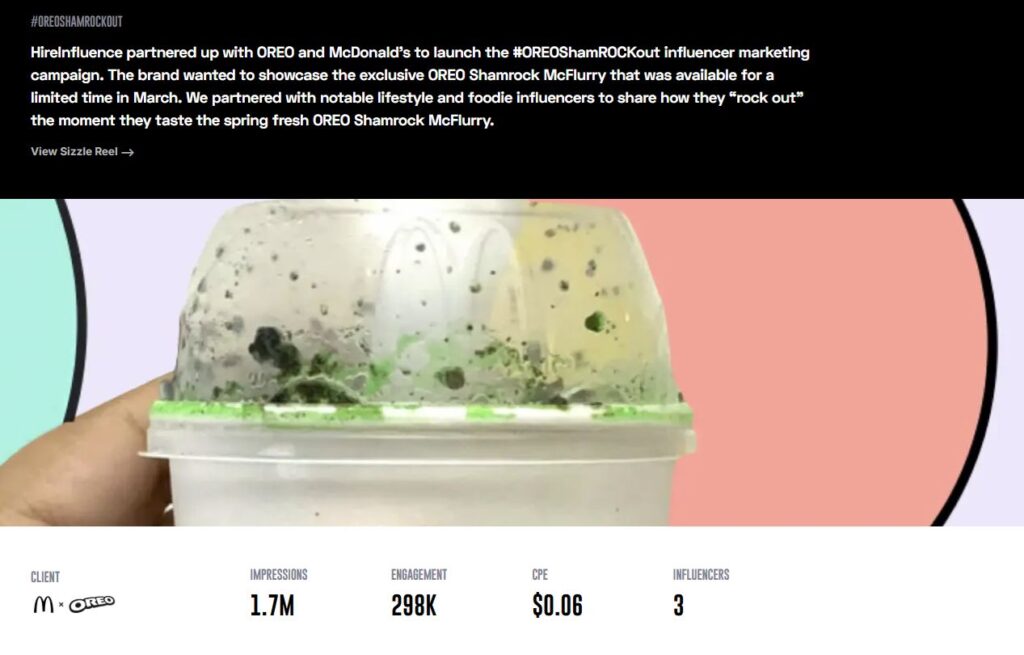
Program delivery in retail is judged on whether attention survived a change of channel. The Grammarly creator program ran 133 creators to 214M impressions, 33.1M views, and $15M in earned media value, a roster scale that matters for launches because coverage has to exist before the shopper goes looking rather than after. The Southwest Airlines #SouthwestSaysAloha program generated 56M impressions and 3M engagements. The MTV #MyMTVStyle campaign delivered 16.1M impressions and 216,600 engagements at $0.01 CPV and $1.50 CPM. The Oreo and McDonald’s #OREOShamROCKout activation reached 1.7M impressions at $0.06 cost per engagement, unit economics that a retail launch can actually plan against.
The Ricola case study is the portfolio’s direct answer to the crossing problem: 26M impressions and 20.5M reach at a 13.17% engagement rate across 18 influencers, resolving into 62,500 MikMak retail clicks. That last figure is the boundary being crossed and recorded, which is the thing most retail launches cannot show. Further programs sit in the work portfolio.
How to Evaluate a Retail Launch Influencer Marketing Agency
First, ask where the purchase actually happens. The agency should be able to describe both paths this product will be bought through, and should not assume the one that is easiest to track.
Second, ask how the crossing is measured. The agency should be instrumenting the move from research channel to purchase channel, and should say plainly where the measurement runs out.
Third, ask what exists before launch day. The agency should be building creator coverage the shopper can find when they go looking, and should treat launch day as the middle of the program rather than the start.
Fourth, ask what the content is for. The agency should be producing material that functions as pre-purchase research, and should distinguish that from material that performs as announcement.
Fifth, ask what the launch costs against what the program costs. The agency should separate the burst from the ongoing coverage, and the components behind those numbers are set out in this cost of influencer marketing guide.
The HireInfluence Model for Retail Launch Influencer Marketing
HireInfluence has operated as a full-service enterprise influencer marketing agency since 2011, and its about section records a team of 25 or more across 10 or more states, with offices in Houston, The Woodlands, Austin, Los Angeles, and New York. The firm works at a six-figure engagement floor, which is what funds the measurement infrastructure a launch needs to observe its own effect across a channel boundary, since connecting creator content to a purchase recorded somewhere else is integration work rather than a reporting setting. Programs have run for Walmart, Target, Grammarly, Oreo, Southwest Airlines, and Microsoft. The firm was named Marketing Agency of the Year at the 2024 MUSE Creative Awards and Digital Marketing Agency of the Year at the 2026 U.S. Agency Awards, and it has been a TikTok Shop Lite Program partner since July 2024, which matters directly for any launch where the shortest available path from discovery to purchase is worth having. Brands can reach the team through the contact page.
Founder and CEO Jason Pampell spent years managing content rights, licensing, and strategic media partnerships at Forbes and Billboard before founding the firm in 2011, and the relevant habit is one publishing learned expensively. A magazine’s launch was never the issue date. The issue was the visible part of a process that started months earlier in relationships, commitments, and terms, and that continued long after the newsstand, because the value of a placement was never confined to the week it appeared. Anyone who priced a property by its on-sale date was pricing the smallest part of it. Matching talent to property meant understanding that the asset had a life, and that the moment of publication was an event inside it rather than the whole of it. A retail launch is the same shape, and the same mistake is available.
The survey settles what launch reporting obscures. When three-quarters of shoppers decide in one place and pay in another, a campaign measured on the channel it ran in has reported on everything except the thing it was for.