Not necessarily, but the two cannot be separated cleanly. On Instagram, a brand cannot run partnership ads without permission granted by the creator, and that permission is a product of the relationship, not the media budget. Whoever holds the creator relationship controls whether the paid buy can run at all.
Table of Contents
- What the permission model actually requires
- Content-level and account-level permission are different assets
- Where a split model works, and where it fails
- What is changing, and why it should not be treated as settled
- What to ask before the scope of work is signed
- What should disqualify an agency, including this one
- Program Delivery Across Paid and Organic Creator Work
- The HireInfluence Model for Instagram Paid Media
The question of whether an instagram paid media agency and an influencer agency should be the same firm is usually framed as an organisational preference, and it is not one. Instagram’s own documentation describes a permission architecture in which the creator toggles the paid partnership label and tags the brand, the first tag sends a request to the brand, the label shows without the brand name until the brand approves, and the label is removed entirely if the brand denies it. Permission runs in two directions and either side can withdraw. A media plan built on creator content is therefore a plan built on a set of consents that a media agency, on its own, has no mechanism to obtain or renew. The org chart does not decide this. The permission model does.
What the permission model actually requires
Three requirements sit underneath every Instagram partnership ad, and each one is a checkable condition rather than a matter of judgment.
The creator must hold a professional account, and so must the brand partner. Instagram lists a personal or private account as a direct cause of the paid partnership label being unavailable. A campaign can be fully contracted and fully produced and still fail at publication because a creator switched an account type.
The brand must be approved before the creator can tag it. Branded content tools have to be enabled, and the brand partner has to be discoverable and approved in the creator’s settings. This is a setup task that happens weeks before any media is bought, and it is invisible on a media plan.
Access is standing-based. Instagram attributes loss of eligibility to policy strikes and repeated violations, not to audience size. This matters because a great deal of published advice asserts a fixed follower threshold as an official cutoff for branded content tools. Meta states no official minimum follower count for Creator Marketplace, and the label-unavailable causes it documents are account type, account privacy, standing, and the brand partner lacking a professional account. Brands should confirm eligibility per creator in-product rather than screening against a number circulating online.
Content-level and account-level permission are different assets
This is the distinction that decides the agency question, and it is routinely collapsed into a single line on a scope of work.
Content-level permission attaches to one post. The creator publishes organically, tags the brand, and enables promotion for that specific piece. It is appropriate for a defined set of agreed posts, and it expires as a practical matter when the campaign does.
Account-level permission is broader. It covers organic content where the brand is tagged and allows promotion without a fresh approval for every asset. Instagram describes it as the path that scales, and for an always-on programme it is the only workable arrangement.
The difference is not administrative. Account-level permission is a negotiated position inside a creator agreement, secured by whoever contracted the creator. A media agency handed a list of creator handles and a budget cannot produce it. It can only ask for it, through someone else, and wait. Every day of that wait is a day of unspent flighted budget.
There is a second consequence that shows up in reporting. When a creator tags a brand, both parties receive post performance through Instagram Insights, including reach, engagement, and audience demographics. That shared data replaces the screenshot reporting that dominated the category for years. It also means the influencer side of the programme holds performance data the media side needs, which is a second argument for a single accountable owner even when execution is split.
Where a split model works, and where it fails
A split arrangement can work, and for large advertisers with an incumbent media agency it is often the practical starting point. It works when three conditions hold.
The influencer partner owns the permission calendar. Someone must know which creators have granted account-level access, which have granted content-level access only, and which have granted nothing yet. That register belongs with the team holding the contracts.
The media partner owns the buy and the measurement design. Audience construction, placement mix across Feed, Stories, Reels and Live, budget pacing, and incrementality testing are media disciplines and should stay media disciplines.
One named person owns the seam. Not a committee and not a recurring status call. The failures in this model are almost never strategic. They are a creator who switched to a personal account, a permission that was never granted at account level, or an approval sitting unactioned in a brand inbox while a flight goes unspent.
The arrangement fails when the media agency is measured on delivery it does not control. That is the structural flaw, and no amount of process fixes it.
What is changing, and why it should not be treated as settled
Meta announced on June 23, 2026 that Creator Marketplace and the Partnership Ads Hub will merge into a new Meta Creator Marketing Hub later in the year. As of the most recent check the Help Center still documents Creator Marketplace as active, so the correct description is active with an announced transition rather than completed.
Brands should treat any agency that describes this area with total certainty as a warning sign. There are also documented category restrictions worth confirming before a plan is built: health, finance, and political branded content can face limited reach or additional approval, and political and government entities are largely ineligible for the tool, with narrow exceptions inside the United States for partners authorised to run ads about social issues, elections, and politics with a connected Facebook Page. The general position that the paid partnership label does not suppress reach holds for mainstream consumer categories, and Meta has not confirmed any algorithmic reduction tied to the label. It does not hold universally.
What to ask before the scope of work is signed
Four questions surface capability quickly, and each has a checkable answer rather than a persuasive one.
Who holds the permission register, and what does it record? The answer should name a team and describe fields: creator, permission type, grant date, and the account the permission sits under. An agency that describes this as something handled in the normal course of work does not have one.
What happens when a creator revokes permission mid-flight? Permission can be withdrawn by either side at any time, and Instagram notifies the creator when a brand removes itself, at which point the brand stops seeing insights. A credible answer covers how the loss is detected, how fast the affected creative is pulled, and how the budget is reallocated. An agency treating revocation as hypothetical has not run a programme long enough to have seen it.
When is account-level permission negotiated? It belongs in creator contracting, not in a request made afterwards. Asking for broader rights once content has published is a renegotiation from a weak position, and it usually costs money.
Who reads the shared insights, and how do they reach the media team? Both parties receive post performance once a tag is live. That data should reach media optimisation on a defined cadence rather than arriving as a monthly summary.
What should disqualify an agency, including this one
HireInfluence operates on a six-figure engagement floor, so brands seeking a single boosted post or a short pilot are better served elsewhere. The firm represents brands rather than creators. And a programme without an internal owner able to action permission approvals inside a flight will underperform regardless of which agency runs it, because in that case the constraint sits inside the brand rather than at the agency.
Program Delivery Across Paid and Organic Creator Work
HireInfluence has run this seam at enterprise scale rather than in theory. The #CoatYourThroat programme for Ricola generated 20.5M reach, and the campaign is documented in full in the Ricola case study.
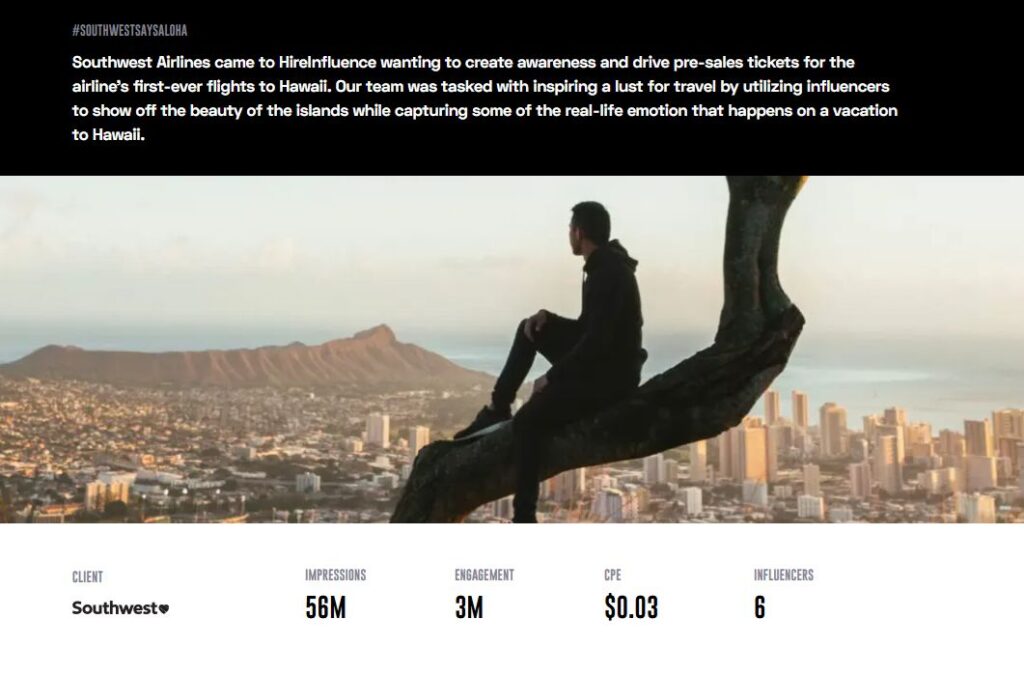
The #SouthwestSaysAloha programme for Southwest Airlines delivered 56M impressions and 3M engagements, a scale that only holds together when organic publication and paid amplification are sequenced rather than run in parallel by teams that do not share a permission register.
For MTV, the #MyMTVStyle programme returned 16.1M impressions and 216,600 engagements at $0.01 CPV and $1.50 CPM, figures that depend on creator content being cleared for paid use before the media was placed rather than after.
Further campaign detail is published in the work portfolio.
The HireInfluence Model for Instagram Paid Media
Founded in 2011, HireInfluence is a full-service enterprise influencer marketing agency with 25 or more people across 10 or more states, working from offices in Houston, The Woodlands, Austin, Los Angeles, and New York. The firm runs programs for brands including Coca-Cola, Microsoft, McDonald’s, Grammarly, Oreo, and Target on a six-figure engagement floor. It was named Marketing Agency of the Year at the 2024 MUSE Creative Awards and Digital Marketing Agency of the Year at the 2026 U.S. Agency Awards, and it has been a TikTok Shop Lite Program partner since July 2024.
That structure matters to the question at hand for one reason: permission management is a contracting function that has to sit beside a media function, and the two have to report to the same account. Brands weighing this decision should also read the guidance on the influencer content approval process and on measuring influencer brand lift, because approval sequencing and measurement design are the two places a split model most often breaks. Scoping conversations start through contact, and the firm’s background is set out on the about page.
Founder and CEO Jason Pampell spent years managing content rights, licensing, and strategic media partnerships at Forbes and Billboard before founding the firm in 2011, and permission on Instagram is the kind of thing that world had a settled answer for. The advertising department could sell the space, and did, but only the editor who had commissioned the contributor could clear the byline to appear beside the advertisement. Selling the placement was never the constraint. Clearing the name was, and the clearance lived with the desk that had signed the writer, because that desk was the only one with a relationship to renegotiate when the terms needed to change. Brands should decide who holds the creator agreements first, and let the media arrangement follow from that answer rather than the reverse.