Brands searching for Instagram branded content tools are usually looking for the setup steps, and the more valuable thing to understand first is what the tools are as a set: Meta’s built-in suite for creator-brand collaborations, comprising the branded content tags and paid partnership label, partnership ads, and the partnership approval workflows that connect them. They are not a single button. They are a system that takes a creator-brand relationship from disclosure through to paid amplification, and a brand that sets them up correctly gets compliance, shared measurement, and an amplification pathway in one configuration. This guide covers what the tools are and how a brand sets up its side of them.
Table of Contents
What the Tools Are
The branded content tools are Meta’s official infrastructure for running disclosed creator partnerships on Instagram. The set has three functional parts. The first is the disclosure layer: the branded content tag and the resulting “Paid partnership with [brand]” label, which is how a partnership is disclosed and how a brand’s name is attached to a creator’s post. The second is the measurement layer: the shared access to post performance through Instagram Insights that both creator and brand receive when content is properly tagged. The third is the amplification layer: partnership ads, which let a brand run a creator’s post as an ad under the creator’s handle. Together these turn an informal creator arrangement into a disclosed, measured, and amplifiable partnership, which is the reason the tools exist as a connected suite rather than as isolated features.
Setting Up the Brand Side
Using the tools requires the right account foundation and the right permissions. Both creator and brand need a professional account, either Creator or Business, because the branded content tools are not available to personal profiles. On the brand side, the central setup task is permissioning: a brand grants creators permission to tag it as a business partner, and it can do so at two levels. Content-level permission applies to a single post or a small, agreed set of posts, which suits a one-off partnership. Account-level permission is the more powerful setting, granting a brand the ability to work with any organic content a creator has published where the brand is tagged, which suits ongoing sponsorships, affiliates, and programs with many posts over time. Account-level permission is also what lets a brand boost tagged organic content into partnership ads without securing per-post permission each time, which is the setting that makes a program scalable rather than a series of individual approvals.
The setup guidance that follows from this is to match the permission level to the program. A brand running a single creator post can work at the content level. A brand running a continuous creator program should establish account-level permissions with its ongoing creators, because per-post approval becomes a bottleneck at volume and account-level access removes it while still keeping every post disclosed. Setting the permission structure correctly at the start is what determines whether the tools accelerate a program or slow it down.
What Correct Setup Produces
A brand that has set up the tools properly has three things at once. It has compliance, because the paid partnership label is applied and the brand is a recognized, approving partner rather than an undisclosed sponsor. It has measurement, because tagged content shares performance data through Insights, replacing screenshot reporting with verified figures. And it has an amplification pathway, because permissioned content can be run as partnership ads under the creator’s handle. The tools are worth setting up carefully precisely because a single correct configuration delivers all three, and a careless one, informal tags, missing permissions, personal accounts, forfeits compliance, data, and amplification together.
Program Delivery Across Tooled Creator Programs
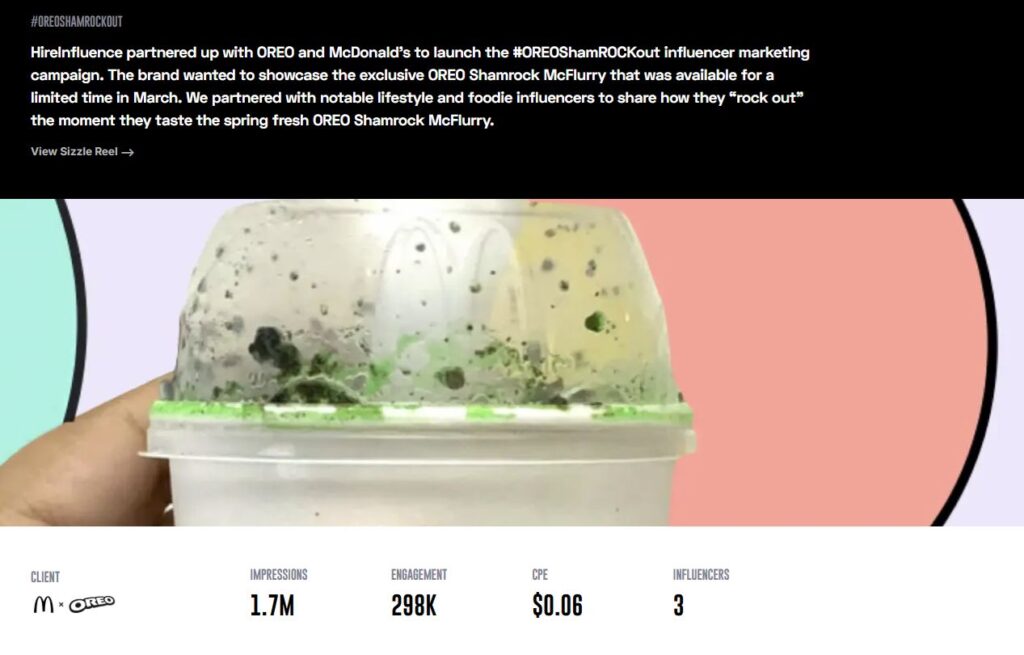
Correctly configured tools are the substrate of scaled Instagram programs, which the roster shows. The Grammarly creator program coordinated 133 creators to 214M impressions, 33.1M views, and $15M in earned media value, a volume that depends on account-level permissioning rather than per-post approvals. The #CoatYourThroat program for Ricola reached 20.5M people across 26M impressions with 18 influencers, sustained a 13.17% engagement rate, and drove 62,500 MikMak retail clicks, documented in the Ricola case study. The #OREOShamROCKout activation for Oreo and McDonald’s delivered 1.7M impressions at $0.06 cost per engagement, the #SouthwestSaysAloha program for Southwest Airlines produced 56M impressions and 3M engagements, and the #MyMTVStyle campaign for MTV delivered 16.1M impressions and 216,600 engagements at $0.01 cost per view.
Additional programs appear in the work portfolio. Programs at this scale run on properly configured branded content tools, because the disclosure, the shared data, and the amplification all flow from that configuration.
The HireInfluence Model for Branded Content Tooling
Founded in 2011, HireInfluence is a full-service enterprise influencer marketing agency with 25 or more people across 10 or more states, working from offices in Houston, The Woodlands, Austin, Los Angeles, and New York. The firm runs programs for brands including Coca-Cola, Microsoft, Walmart, Meta, Grammarly, and Southwest Airlines on a six-figure engagement floor, configuring branded content permissions at the level a program actually needs so disclosure, measurement, and amplification are all in place from the start. It was named Marketing Agency of the Year at the 2024 MUSE Creative Awards and Digital Marketing Agency of the Year at the 2026 U.S. Agency Awards, and it has been a TikTok Shop Lite Program partner since July 2024. How tooled partnerships connect to paid amplification is covered in the firm’s guide to creator amplification, and the disclosure obligation in its FTC disclosure guide. Brands can reach the team through the contact page.
Founder and CEO Jason Pampell spent years managing content rights, licensing, and strategic media partnerships at Forbes and Billboard before founding the firm in 2011, and Instagram’s branded content tools are the systematized version of the machinery that world ran on. A publishing operation had established processes for commissioning sponsored work, disclosing it, tracking its performance, and extending its distribution, and the operations that set that machinery up well ran partnerships at scale while the ones that improvised drowned in one-off arrangements. The branded content tools are that machinery for the feed, and the permission structure is the key setting. A brand should build on professional accounts, set account-level permissions for its ongoing creators, and treat correct setup as the single configuration that delivers compliance, measurement, and amplification at once.