Expect three things that surprise first-time buyers: the agency fee almost never includes creator payments, usage rights have to be negotiated before content exists rather than after, and the brand still supplies an internal owner who can approve on the campaign’s timeline. Judge on process, not roster.
Table of Contents
- What the fee does not cover
- Usage rights are negotiated before content exists, not after
- The platforms do not work the same way, and that is the agency’s job
- Gifted product counts as compensation
- How much work stays with the brand
- What a good first engagement is designed to produce
- What should disqualify an agency, including this one
- Two things that are not worth optimising for on a first engagement
- Program Delivery Across First Engagements and Long Programs
- The HireInfluence Model for a First Engagement
A brand engaging its first agency is making a decision without reference points, which is a different problem from choosing between known options. The specific risk is not picking a weak agency. It is agreeing to something that sounds complete and discovering later that the parts everyone assumed were included were never in scope. Selecting the best influencer agency for a first engagement is mostly a matter of knowing what the category actually contains, so this article sets out the things that reliably catch people out rather than a framework for comparing vendors.
What the fee does not cover
This is the largest single source of first-engagement budget shock, and it is consistent across every fee model.
An agency fee, whether structured as a retainer, a project fee, or a percentage of managed spend, covers the agency’s own time: strategy, sourcing, negotiation, campaign management, and reporting. It typically excludes creator payments, which are usually the largest line in the programme. It also excludes usage rights, paid media budget, content production beyond what creators deliver natively, and sampling and shipping costs, which are trivial for a small campaign and substantial for a seeding programme.
The practical protection is to ask for line-item separation in every proposal, and to ask each agency to state its assumptions about creator count, rights term, and media budget. Two proposals built on different assumptions cannot be compared, and an agency that has not written its assumptions down has not scoped the work.
Usage rights are negotiated before content exists, not after
First-time buyers frequently assume that paying a creator to make something means the brand can use it. It does not, and this is the most expensive assumption in the category.
Rights are bounded by three variables: term, territory, and media type. A creator paid to publish a post has granted the right to that post existing on their channel. Running it as an advertisement, repurposing it for a website, or extending it past its agreed window are separate grants, each with a price.
The sequencing matters more than the price. Negotiating rights before content is produced is a normal commercial conversation. Negotiating them after the content exists and has performed well is a renegotiation from a weak position, because both parties now know exactly how valuable the asset is. Brands should confirm at scoping that rights negotiation happens during creator contracting, and should treat any other answer as a cost that will arrive later.
The platforms do not work the same way, and that is the agency’s job
A first-time buyer reasonably assumes creator advertising works roughly the same everywhere. It does not, and the differences are structural.
TikTok grants advertising rights through an authorisation with a fixed term selected from a documented set, and expiry is terminal: an expired code cannot be reactivated. Instagram uses a two-way permission where the creator tags the brand and the brand approves, which either side can withdraw at any time. YouTube grants no rights at all through its linking mechanism, with Google stating that advertisers remain responsible for securing sufficient rights separately.
Three mechanisms, three failure modes, three different controls required. A brand does not need to know this in detail. It does need to know that an agency claiming the platforms are broadly similar is either simplifying for the room or has not run all three.
Gifted product counts as compensation
Brands new to the category often plan a seeding programme on the assumption that sending product without payment keeps it organic. It does not.
Compensation includes in-kind. TikTok’s Branded Content Policy lists gifted product alongside paid posts, affiliate commissions, and brand-ambassador relationships as triggering disclosure obligations. A programme shipping thousands of units creates an obligation attached to every recipient who chooses to post, most of whom have no contract and no brief.
There is no performance penalty for getting this right. TikTok ran an internal study comparing nearly two million videos with and without proper disclosure and found no performance difference, and states that the disclosure setting does not affect how content is recommended. The penalty runs the other way: undisclosed commercial content may not be eligible for distribution in the For You feed. An agency arguing that disclosure suppresses reach is arguing against the platform’s own published research.
How much work stays with the brand
Managed execution reduces a brand’s workload. It does not remove the brand’s decisions, and first engagements most often stall here rather than on anything the agency does.
At minimum the brand supplies someone who can approve creative on the campaign’s timeline, respond to platform permission requests, and make a call when a creator goes off brief. On Instagram, brand approval is a mechanical requirement rather than a courtesy: until the brand approves a tag, the paid partnership label displays without the brand name, and if the brand denies it, the label is removed from the content entirely. An unactioned request is not a neutral state.
Brands should name that person before signing, and should be honest with the agency about how fast approvals actually move internally rather than how fast they are supposed to.
What a good first engagement is designed to produce
A first programme should be scoped to answer questions as much as to deliver output, because the answers determine everything the brand does next.
Does creator content perform as paid media for this category? This is the highest-value question and it requires the rights to be in place before the test, which is why rights sequencing matters even on a small programme.
What is the brand’s actual approval speed? Not the target, the observed one. Every subsequent schedule depends on this number and no brand knows it accurately in advance.
Which creator profile suits the category? Follower tier, format, and tone, established by observation rather than assumption.
What does the internal workload really look like? Measured against what was expected. This determines whether the next programme is bigger, differently structured, or brought in-house.
A brand that runs a first engagement and can answer those four questions has bought something more durable than the campaign itself, and should say so at scoping so the programme is designed to produce the answers.
What should disqualify an agency, including this one
HireInfluence builds custom-scoped, fully managed programs rather than packaged or self-serve buys, so a brand wanting to test whether creator content works for its category at all is better served by a small direct programme first. The firm represents brands rather than creators. And a first engagement without an internal owner who can approve inside a flight will underperform regardless of which agency runs it.
Two things that are not worth optimising for on a first engagement
First-time buyers frequently over-index on two variables that turn out not to matter much.
Creator follower counts. Reach is the easiest number to compare and among the least predictive. Platform access rules have moved away from follower thresholds as well: Meta states there is no official minimum follower count for Instagram Creator Marketplace, and platform eligibility for branded content tools is standing-based rather than size-based, driven by account type, account status, and policy history. A brand screening creators on follower count is applying a filter the platforms themselves have largely abandoned.
Getting the lowest fee. A first engagement is partly an information-gathering exercise, and the cheapest version usually gathers the least. The output that matters most from a first programme is knowing what the brand’s own approval speed is, which creators suit the category, and whether creator content performs as paid media. A stripped scope tends to remove exactly the parts that answer those questions.
The variable genuinely worth optimising on a first engagement is learning rate. A programme designed to produce a clear answer about what works is worth more than one designed to produce the maximum number of posts.
Program Delivery Across First Engagements and Long Programs
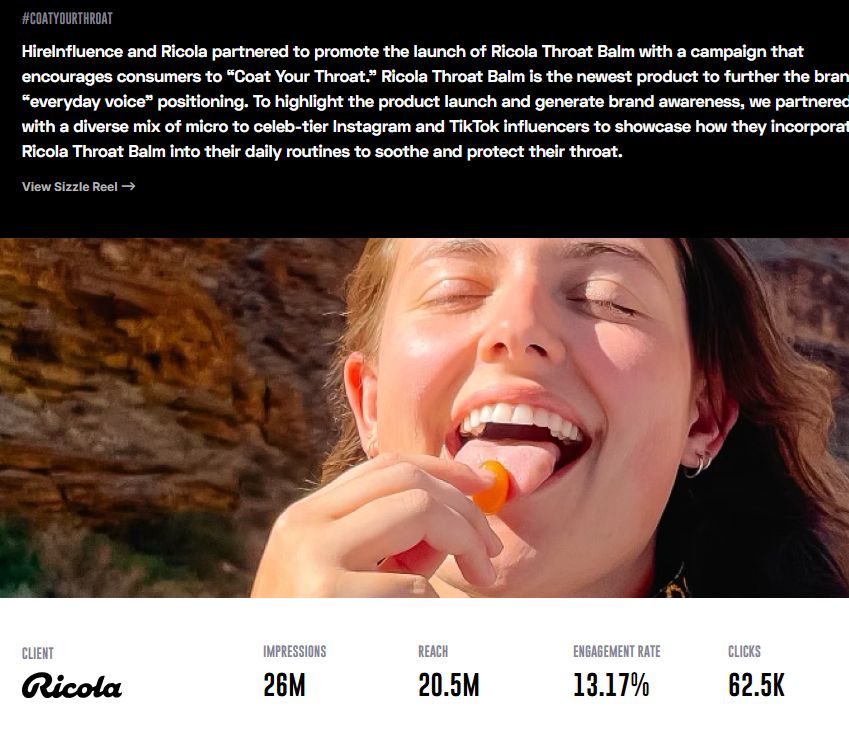
The #CoatYourThroat programme for Ricola produced a 13.17% engagement rate, and the campaign is documented in full in the Ricola case study. That figure describes one campaign’s result rather than a benchmark a first-time buyer should expect to be quoted.
The #OREOShamROCKout programme for Oreo and McDonald’s returned 1.7M impressions at $0.06 cost per engagement. The #SouthwestSaysAloha programme for Southwest Airlines delivered 56M impressions and 3M engagements.
Additional campaign detail is published in the work portfolio.
The HireInfluence Model for a First Engagement
Founded in 2011, HireInfluence is a full-service influencer marketing agency built for enterprise brands, headquartered in Houston with offices in Austin, Los Angeles, and New York. The firm runs creator programs for brands including Adidas, Coca-Cola, MTV, Microsoft, NFL, and Warner Bros, covering strategy, talent sourcing, branded content production, paid amplification, and performance reporting. Creator selection runs through a manual vetting and validation process rather than database filtering alone, and campaigns are scoped to each client’s objectives rather than sold as fixed packages.
Brands preparing a first engagement should read the cost of influencer marketing for how programme budgets are actually constructed, and the FTC influencer disclosure guidelines for the obligations a seeding programme creates. Scoping conversations start through contact, and the firm’s background is set out on the about page.