The work is the same and the organization is the constraint. Procurement cycles, legal review, and multi-stakeholder approval extend timelines more than any agency variable, and the approval architecture usually determines the outcome before an agency is selected. Programs fail internally far more often than they fail creatively.
Table of Contents
- Procurement is the first constraint and the least discussed
- Legal review is a design constraint, not a step
- Approval architecture usually decides the outcome
- Scale changes the administrative load non-linearly
- What internal ownership needs to look like
- What large organizations are genuinely better at
- What should disqualify an agency, including this one
- Where the program should sit in the organization
- Program Delivery Across Multi-Stakeholder Programs
- The HireInfluence Model for Enterprise Organizations
Marketers moving into Fortune 1000 influencer marketing from smaller organizations are frequently surprised by which parts got harder. Creator sourcing did not. Creative did not. What changed is that every step now passes through functions with their own timelines, their own risk positions, and no particular reason to prioritize a campaign. This article describes those constraints and what can be done about each, because most of them are addressable and almost none of them are addressed by changing agency.
Procurement is the first constraint and the least discussed
Before any creative conversation happens, a new agency relationship usually requires a master service agreement, security and data review, insurance verification, and onboarding into a vendor system with its own payment terms.
Three consequences follow. Lead time extends by weeks or months, and the extension happens before anyone has produced anything, which makes it invisible on a campaign plan drawn from the brief onwards. Agency selection narrows, because smaller firms sometimes cannot meet insurance or security requirements regardless of capability. And payment terms affect creators, because an agency on 90-day terms is financing creator payments and will price accordingly, or will pass the delay along to people with no standing to absorb it.
The practical response is to start procurement in parallel with the shortlist rather than after selection, and to ask finance what the terms will be before agreeing a fee, because the terms are part of the price.
Legal review is a design constraint, not a step
At scale, legal review stops being an approval gate and becomes something the program has to be designed around.
Four things legal reliably wants resolved: unscripted claims, because a creator speaking in their own words may say something the brand cannot substantiate; rights clarity, because ambiguity about term, territory, and media type creates exposure that outlasts the campaign; disclosure liability, since obligations attach to compensated advocacy including gifted product, and enforcement risk sits with the brand; and indemnity, meaning who carries the cost if something goes wrong.
Each has a structural answer. Claims are handled by specifying what must be said and what must not, while leaving structure to the creator. Rights are handled by settling term, territory, and media type at contracting rather than after publication. Disclosure is handled by verification after publication rather than briefing alone. Indemnity is a negotiation the agency should have had before.
The single most effective change available is bringing legal into scoping rather than approval. A legal function that helped design the guardrails approves faster than one presented with finished content.
Approval architecture usually decides the outcome
The number of people who can say no is the variable that best predicts whether an enterprise creator program succeeds, and it is set before any agency is engaged.
Programs at this scale routinely require sign-off from brand, legal, regulatory where applicable, regional teams, and sometimes retail or channel partners. Each reviewer is reasonable individually. Collectively they produce a timeline no agency can compress and a tendency toward the least distinctive option, because distinctiveness is what each reviewer is individually equipped to object to.
Two things help materially. Naming reviewers and booking their time before the brief exists, which removes the most common source of slippage. And agreeing what each reviewer is deciding, so that a regulatory reviewer is not offering creative opinions and a brand reviewer is not adjudicating claims.
There is also a platform-mechanics consequence. On Instagram, brand approval of a creator tag is mechanical rather than discretionary: until the brand approves, the paid partnership label displays without the brand name. An approval queue that treats platform permissions as low priority produces live content with degraded labeling.
Scale changes the administrative load non-linearly
An enterprise program is not a larger version of a small one, because three things scale faster than creator count.
Rights registers. Term, territory, media type, and expiry per creator per platform. TikTok authorization expires terminally and cannot be reactivated. Instagram permission is revocable by either party at any time. YouTube conveys no advertising rights through linking at all and enforces no expiry, so the contract is the only control. Running all three at volume is an operations function.
Disclosure verification. Checking after publication that requirements were met, across a roster and across a seeding program where most recipients have no contract.
Regional variation. Different markets, different regulators, different platform availability, and different creator ecosystems, frequently with different agencies.
What internal ownership needs to look like
Enterprise programs need a named internal owner with three specific authorities, and the absence of any one of them is the most common cause of underperformance.
Authority to approve inside a flight, not to route approvals. Access to the rights register, so the brand can answer what it holds without asking the agency. And a standing relationship with legal, so that a novel question does not restart a review cycle.
A program without this person will underperform regardless of which agency runs it, because the constraint is not on the agency’s side.
What large organizations are genuinely better at
The constraints above are real and the picture is not one-sided. Three advantages come with scale and they are frequently squandered by teams focused on the friction.
Negotiating position. A brand committing to a continuous program across multiple waves is a materially different counterparty from one buying a single campaign, and both agencies and creators price accordingly.
Measurement capability. Enterprise organizations usually have the spend thresholds required for controlled studies, panel data, and retailer sales feeds that smaller brands cannot access. The instruments exist; the failure is usually that nobody connected them to the creator program.
Institutional memory, where it is captured. A rights register, a creator performance history, and a record of what has been approved before are compounding assets. Organizations that maintain them get faster each cycle rather than slower.
The third one is where most value leaks. Programs that rebuild their knowledge each planning cycle pay the full internal cost every time and never accumulate the advantage that scale is supposed to provide.
What should disqualify an agency, including this one
HireInfluence builds custom-scoped, fully managed programs rather than packaged or self-serve buys, so a brand needing a packaged, quickly-comparable engagement is better served elsewhere. The firm represents brands rather than creators. And a brand unable to name an internal owner with approval authority should resolve that before engaging anyone, because it is the single strongest predictor of how the program will go.
Where the program should sit in the organization
Reporting line matters more than it appears to, and three placements are common.
Inside brand or social. Fastest for creative decisions, weakest for procurement and legal, because the team has no standing with either.
Inside media. Strong on measurement and paid amplification, frequently weak on creator relationships and contracting, which are not media disciplines.
As a standalone function reporting to marketing leadership. Slowest to establish and strongest once running, because it holds the rights register, the agency relationship, and the legal relationship in one place.
The placement that reliably underperforms is the one where the program is an additional responsibility for someone whose primary job is something else. The administrative load described above does not fit alongside a full role, and the failure is silent: the register stops being updated before anyone notices it has.
Program Delivery Across Multi-Stakeholder Programs
The #CoatYourThroat program for Ricola ran with 18 influencers, and the campaign is documented in full in the Ricola case study. Coordinating a roster that size against a single flight window is the practical form the constraints above take.
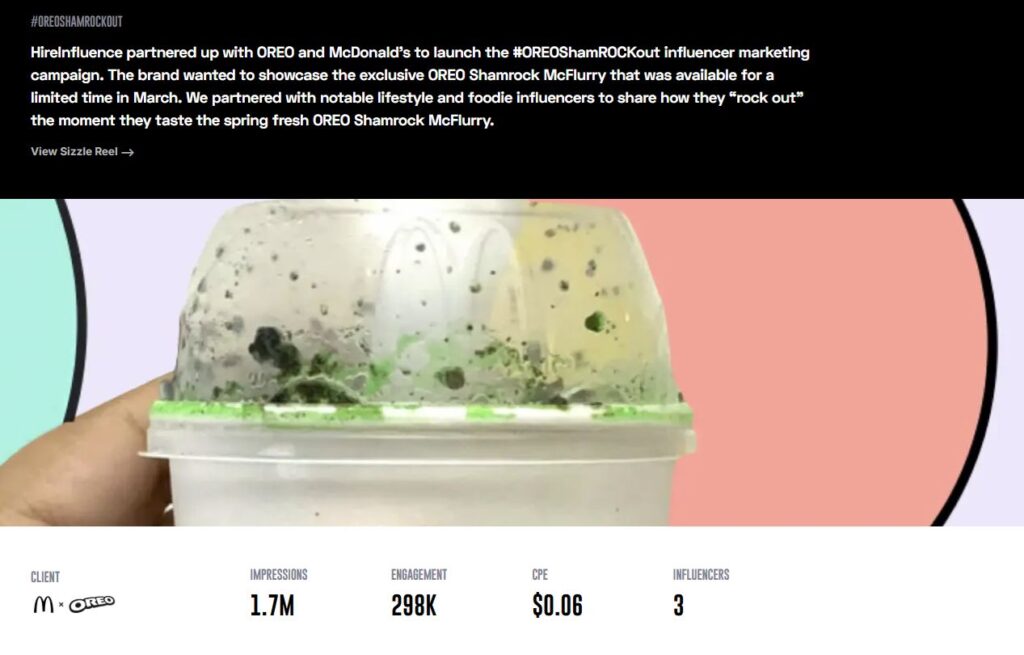
The #OREOShamROCKout program for Oreo and McDonald’s returned 1.7M impressions at $0.06 cost per engagement across a two-brand partnership, which doubles the approval architecture described here. The #SouthwestSaysAloha program for Southwest Airlines delivered 56M impressions and 3M engagements.
Additional campaign detail is published in the work portfolio.
The HireInfluence Model for Enterprise Organizations
Founded in 2011, HireInfluence is a full-service influencer marketing agency built for enterprise brands, headquartered in Houston with offices in Austin, Los Angeles, and New York. The firm runs creator programs for brands including Adidas, Honda, Microsoft, NFL, Target, and Warner Bros, covering strategy, talent sourcing, branded content production, paid amplification, and performance reporting. Creator selection runs through a manual vetting and validation process rather than database filtering alone, and campaigns are scoped to each client’s objectives rather than sold as fixed packages.
Brands building an internal program should read the influencer content approval process, which covers the approval architecture in operational detail, and the FTC influencer disclosure guidelines, which covers the obligations legal will want resolved. Scoping conversations start through contact, and the firm’s background is set out on the about page.