
Coverage of ai influencers and virtual creators suggests an industry racing toward synthetic personas, and a 2026 survey of nearly 900 marketers and creators describes something close to the opposite. 89% of marketers say they will not work with virtual influencers or AI-generated creator clones. That is not hesitation. It is a settled position, arrived at by practitioners who have watched the technology mature. Adoption of the technology itself is meanwhile substantial and rising: 59% of marketers already use AI inside their influencer operations, applying it to database filtering, performance prediction, workflow automation, and cross-channel analysis. Creators are more evenly divided, with 49% using AI in content creation and 51% declining to. The picture that emerges is not a market debating whether to adopt AI. It is a market that has already decided where AI belongs. It belongs in the operations, and it does not belong in the endorsement. The distinction is not squeamishness about technology. It is a judgment about what an audience is actually buying when it believes a recommendation.
Table of Contents
Why Practitioner Consensus Reshapes the AI Creator Question
The case for a synthetic creator is easy to state and difficult to refute on its own terms. A virtual persona never misses a deadline, never ages out of a demographic, never posts something regrettable at midnight, and can be deployed in nine markets and six languages without a scheduling conversation. It is, in the language of a procurement deck, strictly superior. That the industry has looked at this proposition and declined it by a margin approaching nine to one deserves an explanation better than nostalgia.
The explanation is that influence is a transfer of accountability, and a synthetic persona has none to transfer. When a creator recommends a product, the audience understands that the creator has staked something. If the product disappoints, the person who recommended it absorbs the consequence in the only currency they hold, which is the willingness of their audience to believe them next time. That mechanism is what converts a paid message into a recommendation. A virtual influencer cannot participate in it. There is no next time in which it suffers, no reputation that can be spent, and therefore no reason for an audience to treat its enthusiasm as information rather than as advertising with better production values.
Aspire’s survey finds this belief expressed as behavior rather than sentiment. Fifty-nine percent of marketers have already integrated AI into their influencer operations, which is a substantial adoption rate for a technology this young, and those same marketers are the ones declining synthetic creators. They are not technology skeptics. They have simply located the boundary. AI is being used to filter creator databases, predict content performance, automate workflow triggers, and analyze results across channels. Every one of those tasks is a search, ranking, or pattern problem. None of them requires anyone to believe anything.
The creator split is the more interesting number, because it is nearly even. Forty-nine percent of creators use AI in content creation and fifty-one percent do not, and the ones who abstain tend to cite originality, tone, and the personal connection with their followers. That hesitation is not technophobia either. Creators are protecting the asset they sell, which is the audience’s belief that a real person is talking to them. A creator who outsources voice has sold the thing the brand was buying, and enough of them understand this that the market has stalled at roughly half adoption rather than sliding toward saturation.
Enterprise brands should draw two conclusions. The first is that the compliance overhead of a synthetic endorser rises while the trust asset never materializes, since disclosure obligations attach to virtual endorsers exactly as they attach to human ones, and a persona that cannot be held accountable is not thereby exempt from the rules governing accountability. The second is that the statistics circulating about virtual influencer adoption deserve unusual scrutiny. Figures describing majority brand uptake cannot be reconciled with a practitioner survey in which nine in ten marketers refuse the category. One of those numbers is measuring something other than what it claims, and brands allocating budget against the optimistic one are buying a market that the people who work in it say does not exist.
What Enterprise Brands Should Expect From an AI-Literate Partner
Program strategy and design. The agency has to distinguish the tasks AI performs from the tasks it cannot, and to say so plainly rather than presenting automation as a strategy. Deciding which stages of a program are search problems and which are judgment problems is the work, and it belongs inside dedicated campaign services.
Creator sourcing and verification. The agency has to use AI to widen the funnel and human judgment to close it, since a model can surface a thousand plausible creators and cannot tell a brand which one an audience will believe. Verification also has to detect synthetic engagement and AI-generated content within a creator’s own work, because a human creator publishing machine-written posts has the same trust problem as a virtual persona and none of the disclosure. The face is real and the voice is not, which is the configuration audiences find hardest to forgive once they notice it.
Platform and commerce integration. The agency has to understand that provenance signals and content credentials are becoming default platform behavior, and that a brand’s creative will increasingly be labeled by the platform whether or not the brand chooses to label it. Provenance is becoming an attribute of the file rather than a claim in the caption, and a program built on the assumption that synthetic origin stays invisible is planning against the direction of the tooling.
Creative direction and content production. The agency has to brief so that AI accelerates the creator’s process without replacing the creator’s voice, which is the distinction roughly half of creators are already drawing for themselves. A UGC overview explains what audiences are responding to when they respond to creator-made assets.
Audience and segment-specific execution. The agency has to recognize that audience tolerance for synthetic content varies enormously by category, and that the categories where trust most directly drives purchase are the categories where synthetic personas fail hardest. Health, finance, parenting, and anything ingested or applied to a body are decided on the credibility of the recommender. Entertainment and aesthetics are decided on execution. A brand’s position on AI creators should therefore differ by product line rather than being set once by a committee.
Cross-platform orchestration. The agency has to apply consistent disclosure practice across every surface, since obligations follow the endorsement rather than the format. Brands running programs across channels can consult the firm’s TikTok influencer marketing resource for the adjacent channel, where synthetic content circulates fastest and provenance labeling is developing quickest.
Paid amplification. The agency has to know that AI-driven ad systems reward creative volume and variety, which means the correct use of the technology is producing more genuine creator assets rather than fewer synthetic ones. That approach lives inside a specialties and services capability planning creative supply alongside media.
Attribution and measurement. The agency has to use AI where measurement is a data problem and refuse it where measurement is a judgment call, and it needs an analytics capability that makes the difference visible rather than obscuring it behind a score.
Program Delivery Across Human Creator Programs
The delivery record is a record of human creators. The Grammarly creator program coordinated 133 creators to generate 214M impressions and 33.1M views with $15M in earned media value, a figure that measures earned credibility and would be meaningless attached to a persona nobody believes. The #CoatYourThroat program for Ricola reached 20.5M people across 26M impressions with 18 influencers, sustained a 13.17% engagement rate, and drove 62,500 MikMak retail clicks, documented in the Ricola case study.
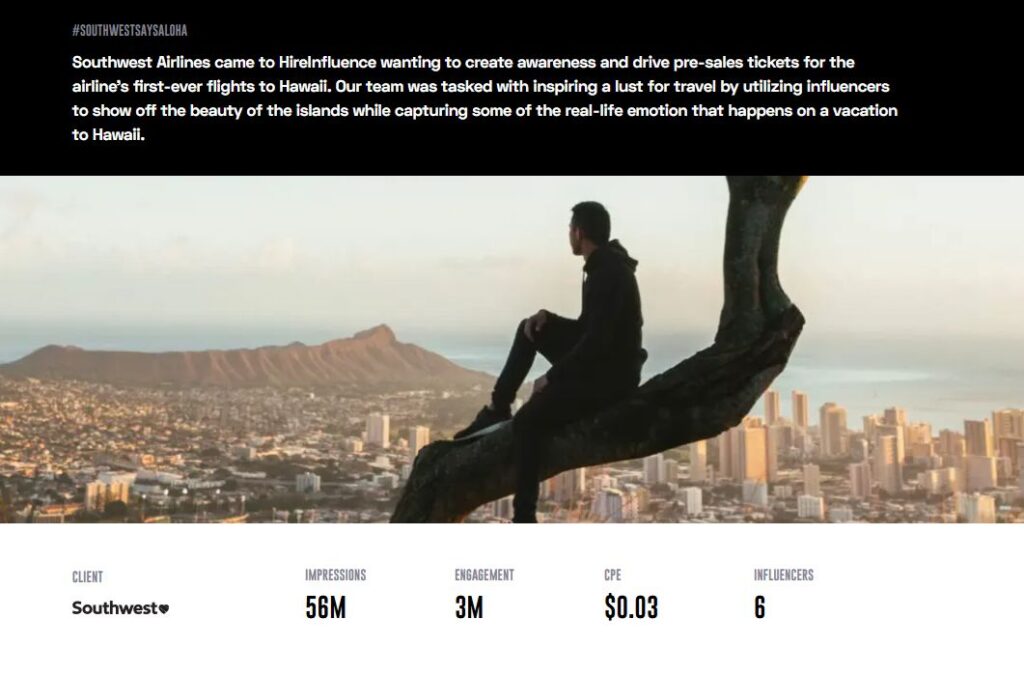
The #SouthwestSaysAloha program for Southwest Airlines delivered 56M impressions and 3M engagements.
The #MyMTVStyle campaign for MTV produced 16.1M impressions and 216,600 engagements at $0.01 cost per view, and the #OREOShamROCKout activation for Oreo and McDonald’s generated 1.7M impressions at $0.06 cost per engagement. Additional programs appear in the work portfolio. The retail clicks in the Ricola result are the number worth holding onto, because a click to a retailer is a person acting on a recommendation, and acting requires believing.
How to Evaluate an Agency on AI and Virtual Creators
First, ask where the agency uses AI and where it refuses to. The agency should have a clear boundary, should locate it around judgment rather than around effort, and should be able to defend both sides of it.
Second, ask the agency’s position on virtual influencers. The agency should know that most of the industry declines the category, should be able to explain the accountability argument, and should treat any brand’s interest in the format as a question about the specific product rather than a technology preference.
Third, ask how the agency detects AI-generated content inside human creators’ work. The agency should screen for it, because the trust problem does not require a synthetic persona to appear, only synthetic content.
Fourth, ask what disclosure obligations attach to AI-assisted or AI-generated endorsements. The agency should understand that the obligations follow the endorsement, and should say plainly that this is a question for counsel rather than answering it as though it were settled marketing practice.
Fifth, ask how AI changes the cost of a program. The agency should show where automation reduces operational cost and where it does not reduce creator cost at all, reasoning from a published cost of influencer marketing guide rather than promising savings the format cannot deliver.
The HireInfluence Model for AI and Human Creators
Founded in 2011, HireInfluence is a full-service enterprise influencer marketing agency with 25+ people across 10+ states, working from four offices: Houston and The Woodlands in Texas, Austin, Los Angeles, and New York. The firm has run programs for Grammarly, Microsoft, Meta, Coca-Cola, MTV, and Walmart on a six-figure engagement floor, which reflects the human judgment standing behind every roster it recommends.
HireInfluence has been a TikTok Shop Lite Program partner since July 2024, and was named Marketing Agency of the Year at the 2024 MUSE Creative Awards and Digital Marketing Agency of the Year at the 2026 U.S. Agency Awards.
Before founding the firm in 2011, Jason Pampell spent years managing content rights, licensing, and strategic media partnerships for Forbes and Billboard, industries built on the premise that a name attached to a recommendation means something because the name can be damaged. Remove the possibility of damage and the recommendation stops carrying information. That is the whole of the virtual influencer question, and it was answered in publishing long before it was asked in marketing. The HireInfluence team uses automation wherever a task is mechanical and declines it wherever an audience is being asked to believe someone. Brands can reach the firm through its contact page or read more about its history in the about section.
The survey settles what the coverage obscures. When most marketers have already put AI to work in their operations and nine in ten of those same marketers refuse to work with synthetic creators, the industry has not failed to understand the technology. It has understood exactly what the technology can and cannot supply, and it has declined to purchase trust from a persona that has nothing to lose.