Brand ambassador programs deliver the highest ROI of any influencer campaign type. That’s not a positioning claim. It’s the top finding from Aspire’s State of Influencer Marketing 2025 report, based on survey data from over 1,000 marketers and creators. And it tracks logically: a creator who has worked with your brand across multiple campaigns, who genuinely knows the product, and whose audience has seen that relationship build over time converts at a fundamentally different rate than a creator posting about your brand once and moving on.
Table of Contents
The problem for enterprise brands isn’t recognizing that ambassador programs work. Most marketing teams at the VP or CMO level already know this. The problem is execution. Running a long-term influencer ambassador program at enterprise scale is operationally demanding in ways that a one-off campaign isn’t, and most brands that try to run one without the right agency infrastructure end up with a program that looks like an ambassador program but performs like a series of disconnected activations.
Here’s what separates a real influencer ambassador program from a recycled creator roster, and what to look for in an agency built to run one.
What an Influencer Ambassador Program Actually Is
The term gets used loosely, so it’s worth being precise. A genuine influencer ambassador program is a structured, long-term creator relationship where the brand and creator operate as ongoing partners rather than transactional counterparties.
That means recurring content activations on a defined schedule. It means the creator is briefed deeply on the brand’s product and positioning, not just handed a one-time talking points document. It means the creator’s audience develops a real association between that creator and the brand over time. And it means the commercial relationship is structured for continuity, with contracts that cover content rights, exclusivity terms, payment schedules, and performance expectations across a program period rather than a single campaign.
What it isn’t is a brand that works with the same ten creators every quarter without any of that structural investment. Familiarity alone doesn’t produce ambassador program results. The program infrastructure does.
Why Ambassador Programs Outperform One-Off Campaigns
The ROI difference between ambassador programs and single-activation campaigns comes down to trust accumulation over time.
When a creator posts about a brand once, their audience receives it as a recommendation. When that same creator has posted about the same brand consistently over six or twelve months, the audience receives it as an endorsement from someone they trust to have an actual opinion. That distinction shows up in conversion rates, in the quality of the purchase decisions being made, and in the downstream brand loyalty of customers acquired through ambassador content versus one-off sponsorships.
There’s also a content efficiency argument. A creator who has worked with your brand repeatedly produces better content faster. They know the product. They’ve developed a vocabulary for talking about it that resonates with their audience. They don’t need the same level of briefing and revision cycles that a new creator relationship requires. For enterprise brands managing large creator rosters, that efficiency compounds significantly across a program.
And unlike campaign-by-campaign influencer sourcing, ambassador programs create a strategic asset. The relationship itself has value. The content library built over the course of a multi-month program has value. The audience association the creator has developed with your brand has value. These are things that disappear when a one-off campaign ends.
The imPress Nails Example
HireInfluence structured its imPress Nails partnership around exactly this kind of intentional creator alignment. The program paired the brand with luxury fashion influencers whose audience profile matched the imPress positioning, activated during New York Fashion Week to maximize cultural relevance, and was built around direct sales objectives with CTAs driving directly to the imPress website.
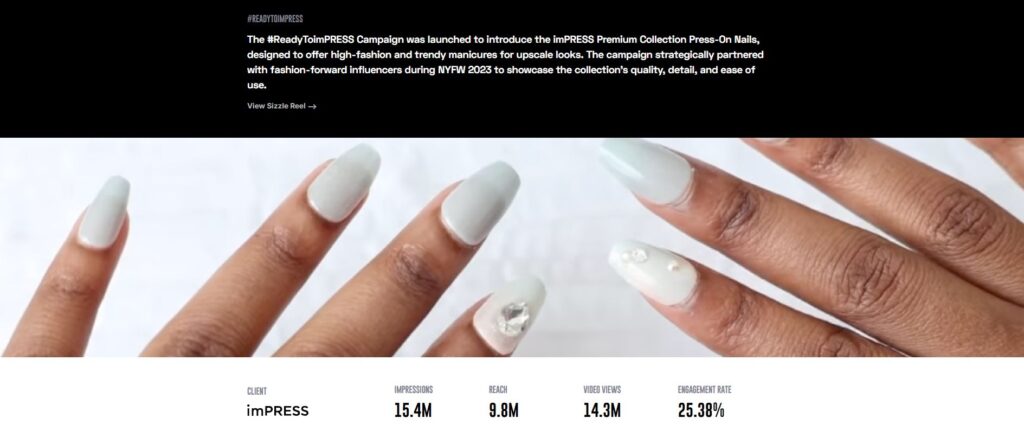
That’s a program where every element of creator selection, timing, content framing, and conversion architecture was deliberate. The creators weren’t chosen because they were available. They were chosen because the fit between their audience and the brand’s positioning was precise, and the activation moment was designed to make that fit visible at maximum impact. That’s what ambassador-level program thinking looks like in practice, even in a single campaign window.
What the Agency Infrastructure Needs to Support
Running an influencer ambassador program at enterprise scale requires agency infrastructure across several dimensions that most agencies aren’t built to deliver simultaneously.
Long-term creator relationship management. Ambassador programs require ongoing communication with a creator roster, not just campaign-window coordination. Briefings need to be refreshed as brand priorities evolve. Performance needs to be reviewed and discussed with creators as partners, not just reported upward to the brand. Contracts need to be renewed or renegotiated on program-aligned timelines. An agency without dedicated relationship management capability will let these programs drift into the same transactional dynamic that makes one-off campaigns underperform.
Content rights and licensing architecture. Ambassador program content has a longer commercial life than campaign content. Brands running ambassador programs want to repurpose that content across paid media, retail environments, owned social channels, and email over an extended period. Getting the rights structure right at the contract stage is the only way to make that repurposing possible without going back to creators for permission and fees each time. HireInfluence structures content rights agreements as part of standard engagement terms, covering the full anticipated use case before any content is produced.
Multi-platform execution. Enterprise ambassador programs don’t live on a single platform. A creator who posts on Instagram and TikTok is creating content with different native characteristics on each platform, and the program needs to be briefed and managed accordingly. HireInfluence’s multi-platform campaign management covers TikTok, Instagram, YouTube, Facebook, Pinterest, and LinkedIn, with platform-specific briefing and content strategy built into the program design rather than treated as an afterthought.
FTC compliance across recurring activations. Disclosure requirements apply to every piece of sponsored content, including the fifteenth post from an ambassador who has been working with a brand for a year. An agency that manages FTC compliance for one-off campaigns but relies on creators to self-manage disclosure in recurring programs is creating liability for the brand. HireInfluence’s compliance management covers every activation regardless of where it falls in the program timeline.
Payment and 1099 services. Ambassador programs involve ongoing payments to a consistent creator roster over an extended period. Managing that payment infrastructure, including 1099 documentation, payment scheduling, and regulatory compliance, is operationally significant for enterprise brands. HireInfluence handles influencer payment and 1099 services as a core service offering, removing that burden from the brand’s internal finance and legal teams.
How HireInfluence Structures Ambassador Programs
HireInfluence has offered recurring and on-demand influencer-generated content activations and long-term ambassador programs as named services since the agency’s founding in 2011. The full-service campaign structure is built to support both campaign-based and always-on program models, with the creator sourcing, vetting, content management, compliance, payment, and analytics infrastructure to run them at enterprise scale.
The Grammarly program illustrates what that scale looks like: 133 top-tier lifestyle influencers across YouTube, TikTok, and Instagram, producing 214 million impressions, 33.1 million views, and $15 million in earned media value. Managing a creator roster of that size requires the kind of program infrastructure that isn’t built overnight, and isn’t available from an agency that primarily handles single-activation campaigns.
You can review additional examples of HireInfluence’s long-term and multi-creator program work at the campaign portfolio.
The Enterprise Fit Question
Ambassador programs require a level of operational commitment from the brand side as well as the agency. The brand needs to be willing to invest in a relationship-based model rather than a transaction-based one, to allocate budget across a program period rather than a single campaign, and to give the agency the runway to let creator relationships and audience associations develop.
HireInfluence works with enterprise brands at a minimum engagement of approximately $100,000. That threshold exists because the program infrastructure required to run ambassador-level work properly, across creator management, content production, compliance, payment services, paid amplification, and analytics, isn’t viable at lower investment levels.
For brands that are ready to move beyond one-off campaigns and build a creator relationship asset that compounds over time, the starting point is understanding what a program is actually designed to deliver. Review how HireInfluence structures influencer campaigns for enterprise brands, explore the full platform and service specialties, or contact HireInfluence to start a conversation about building a program.