Healthcare brands occupy a distinctive position in the influencer marketing landscape. The category includes pharmaceutical companies, health systems, medical device manufacturers, telehealth platforms, health insurance providers, and consumer health product lines — each with its own regulatory environment, audience trust dynamics, and content requirements. What they share is a common challenge: marketing products and services in a space where credibility is non-negotiable, misinformation risk is real, and the gap between a poorly executed campaign and a compliant one can carry legal and reputational consequences.
Table of Contents
HireInfluence is a full-service influencer marketing agency founded in 2011, built specifically for enterprise and Fortune-class brands. Its campaign infrastructure spans multi-platform execution, paid media amplification, and creator management at scale. The agency’s specialty services include influencer whitelisting, ambassador programs, and TikTok Shop integration, supported by a dedicated analytics infrastructure designed to connect campaign activity to measurable business outcomes.
According to Market.us Media’s analysis of social media in healthcare, 86% of healthcare marketers now use influencer marketing to promote products and services, and 63% of healthcare consumers trust health information shared by influencers. Those figures reflect a fundamental shift in how healthcare audiences make decisions. Patients, caregivers, and healthcare professionals are not waiting for press releases or clinical white papers. They are learning, asking questions, and forming opinions through the creators they follow. For healthcare brands at the enterprise level, meeting that audience where it already is has become a strategic requirement.
Why Healthcare Is a Distinct Influencer Marketing Category
Influencer marketing in healthcare is not simply influencer marketing with a compliance checkbox added at the end. The category requires a fundamentally different approach to creator selection, content development, brief construction, and legal review. Getting any of these wrong does not just underperform — it can generate regulatory exposure or public backlash that far outweighs the value of the campaign itself.
The FTC’s disclosure requirements apply to every piece of sponsored content, but healthcare adds additional layers. Pharmaceutical campaigns must navigate FDA guidelines around drug promotion, including fair balance requirements and restrictions on off-label claims. Medical device campaigns face their own content constraints. Health insurance and managed care campaigns must comply with state-specific insurance marketing regulations. Consumer health product lines face FTC scrutiny on efficacy claims.
Most influencer agencies are not built to operate inside that regulatory framework at any consistent level of quality. They understand FTC disclosures because those apply to every category. The deeper compliance architecture that healthcare and pharma require — the brief-level restrictions, the content review workflows, the creator contracting clauses — demands an agency with the operational infrastructure to execute it correctly every time.
For enterprise healthcare brands whose legal and compliance teams have significant influence over marketing program decisions, this is often the first filter applied to agency selection. An agency that cannot demonstrate a genuine compliance process is not a viable partner, regardless of its creative capabilities.
The Trust Equation in Healthcare Influencer Marketing
Trust is the central currency of healthcare marketing, and influencer campaigns are only valuable to the extent that they borrow credibility from voices audiences already trust. That creates a creator selection challenge that differs from most other categories.
Healthcare influencer programs typically work across multiple creator types. Credentialed healthcare professionals — physicians, nurses, pharmacists, registered dietitians, licensed therapists — bring authority and clinical credibility. Patient advocates and community voices bring relatability and lived experience. Wellness creators and lifestyle influencers bring reach and cultural relevance. The right mix depends entirely on the specific product, audience, and campaign objective.
A pharmaceutical brand running a disease awareness campaign has different needs than a telehealth platform driving new patient acquisition or a medical device company targeting healthcare professionals rather than consumers. The creator selection framework has to be built around those distinctions, not applied as a one-size-fits-all approach.
What enterprise healthcare brands cannot afford is a creator who, once contracted, posts content that contradicts the campaign brief, makes unsubstantiated claims, or engages in behavior that creates brand safety risk. At enterprise scale, with campaigns running across dozens of creators, the quality control challenge is significant. It requires a systematic content review process, not just a final approval step.
Campaign Architecture for Healthcare Brands
Enterprise healthcare campaigns require more operational scaffolding than campaigns in most other categories. The brief has to be more specific. The content review has to be more structured. The creator contracting has to include representations and restrictions that go beyond standard influencer agreements. And the measurement framework has to connect influencer activity to outcomes that matter at the enterprise level.
For consumer health product brands, that often means connecting influencer activity to purchase behavior. The Ricola #CoatYourThroat campaign, managed by HireInfluence, demonstrates what this looks like in practice. HireInfluence deployed 18 influencers across micro to celebrity tier and generated 26 million impressions, 20.5 million in reach, and a 13.17% engagement rate.
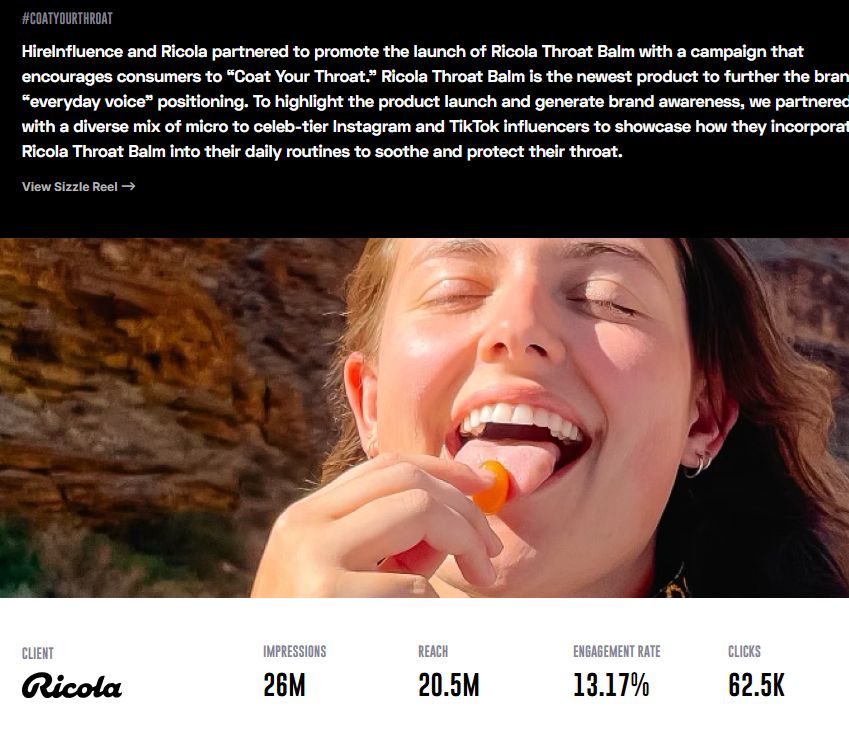
The campaign used MikMak retail purchase link integration to track 62,500 retail purchase clicks, attributing influencer-driven consumer behavior directly to tracked retail activity. For a consumer health brand managing relationships with multiple retail partners simultaneously, that level of attribution is the difference between a campaign that can be defended to senior leadership and one that cannot.
For health systems and healthcare service brands, the measurement framework shifts toward patient acquisition metrics — appointment bookings, telehealth session initiations, new patient enrollments, and similar conversion events. For pharmaceutical brands, campaign objectives are often awareness and educational rather than conversion-focused, given the regulatory restrictions on direct-response drug promotion. The agency has to understand which measurement approach applies to which campaign type and build the analytics infrastructure accordingly.
Multi-Platform Execution in Healthcare
Healthcare audiences are distributed across platforms in ways that require a differentiated content strategy rather than a repurposed one. TikTok has emerged as a significant health information channel, particularly among younger demographics. Market.us Media data indicates that 63% of healthcare consumers trust health information shared by influencers, and a substantial portion of that trust-building happens in short-form video environments. Instagram remains critical for visual storytelling and community building around chronic conditions, wellness habits, and consumer health products. YouTube supports longer-form educational content, product explainers, and patient testimony formats.
An enterprise healthcare brand running a multi-platform program needs an agency that can manage platform-specific content requirements without sacrificing compliance consistency. A disclosure that is sufficient for a 60-second Instagram Reel may need to be executed differently in a 12-minute YouTube video. The content that performs on TikTok for a health and wellness brand differs structurally from what works on Instagram. Managing those variations while maintaining brand safety and regulatory compliance requires operational depth that many agencies lack.
HireInfluence’s status as an official TikTok Shop Lite Program exclusive partner since July 2024 gives the agency direct access to TikTok platform data, exclusive ad capabilities, and early access to new platform features. For healthcare brands targeting younger consumer audiences on TikTok, that access provides a material advantage in campaign targeting and performance measurement beyond what standard agency relationships provide. The agency’s systematic content review workflows ensure that creator content meets both brand standards and regulatory requirements before going live.
Whitelisting and Paid Amplification for Healthcare
Influencer whitelisting — running paid media through an influencer’s account rather than the brand’s own channels — is particularly valuable for healthcare brands because it preserves the trust signal while extending reach and adding targeting precision. A post amplified through a credentialed healthcare professional’s account carries a different trust weight than the same content run through a brand’s paid media account. For categories where credibility is a primary purchase driver, that distinction matters.
Whitelisting also gives healthcare brands precise control over who sees the content, which is especially important for campaigns with specific audience targeting requirements. A pharmaceutical brand running a disease awareness campaign has regulatory reasons to target audiences with demonstrated interest in the relevant condition rather than a broad reach objective. Whitelisting enables that targeting precision through creator accounts rather than brand accounts.
HireInfluence’s specialty services include whitelisting and dark posting as part of its core campaign infrastructure. Those capabilities are available as part of a full-service engagement, integrated with the rest of the campaign’s creator management, content review, and measurement infrastructure.
Why Enterprise Healthcare Brands Choose HireInfluence
HireInfluence was founded in 2011 and is recognized as the first full-service influencer marketing agency, with a team of 25+ professionals across 10+ states and offices in Houston and The Woodlands, TX, Austin, TX, Los Angeles, CA, and New York, NY. A full overview of the agency’s background and founding history is available on the about page. The agency’s minimum engagement of approximately $100,000 reflects the level of strategic, operational, and analytical infrastructure brought to every campaign — a structure appropriate for enterprise healthcare brands, not brands running experimental programs with limited budgets and no performance requirements.
The Ricola #CoatYourThroat campaign stands as a model for what purchase attribution looks like in a consumer health context. HireInfluence deployed 18 influencers across micro to celebrity tier and generated 26 million impressions, 20.5 million in reach, and a 13.17% engagement rate, with MikMak retail purchase link integration tracking 62,500 retail purchase clicks directly attributable to influencer activity.
The agency’s award record reflects consistent recognition for campaign excellence. HireInfluence received the MUSE Creative Awards for Marketing Agency of the Year, the Netty Awards for Best Digital Marketing Campaign, the NYX Awards for Best Influencer Marketing Campaign, and the Global Digital Excellence Award for Integrated Digital Agency of the Year — all in 2024. In 2026, the agency has already received the U.S. Agency Awards for Digital Marketing Agency of the Year and the Vega Digital Awards for Best Influencer Marketing Campaign.
For healthcare brands evaluating agency partners, the relevant question is not just whether an agency has run health-adjacent campaigns. It is whether the agency has the compliance infrastructure, the measurement capabilities, and the operational depth to run a campaign that performs well and holds up to scrutiny from legal, compliance, and senior leadership simultaneously. HireInfluence operates at exactly that standard.
Enterprise healthcare brands that need a full-picture view of HireInfluence’s campaign capabilities and client results can review the agency’s portfolio at hireinfluence.com/work/. Those ready to discuss a specific program can initiate a conversation through the agency’s contact page at hireinfluence.com/contact/.
For healthcare brands, influencer marketing is not a channel to test casually. It is a channel to enter with the right partner, the right compliance infrastructure, and the right measurement framework from the start. The cost of getting it wrong — in regulatory exposure, brand safety incidents, or wasted spend — exceeds the cost of selecting the right agency the first time.