Most enterprise brands understand that influencer marketing drives organic reach and audience trust. Fewer have fully operationalized the paid media component that turns high-performing organic creator content into a scalable performance asset. Influencer whitelisting — the practice of running paid ads from a creator’s account rather than the brand’s own ad accounts — is where the organic and paid channels converge, and where a significant portion of influencer marketing ROI is actually generated.
Table of Contents
According to Influencer Hero’s analysis of whitelisting best practices, influencer whitelisting improves return on ad spend by 1.5 to 2 times compared to standard paid social campaigns run from brand accounts. The mechanism is straightforward: when a paid ad runs from a creator’s handle, audiences process it as content from someone they follow rather than as advertising from a brand. That trust signal carries through to engagement rates, click-through rates, and conversion behavior. The content performs more like organic creator content — which is why it outperforms brand-produced creative — while benefiting from the targeting precision and audience reach of a paid media placement.
For enterprise brands with both influencer programs and paid social budgets, the failure to connect these two systems is one of the most common sources of underperformance in marketing spend. An influencer whitelisting agency that manages both sides of this equation — the creator relationship and the paid media execution — is what closes that gap.
What Influencer Whitelisting Actually Involves
Whitelisting requires more than simply getting permission to run ads through a creator’s account. It involves a defined operational workflow that most brands and agencies handle poorly when they have not built native expertise in the capability.
At the contract stage, the agency must negotiate whitelisting permissions as part of the creator agreement, specifying the duration, the platforms, the ad formats, and the specific rights being granted. Usage rights need to be explicitly addressed: the brand needs authorization to run the creator’s image, voice, and content in paid placements, not just to repost organic content. Without this, brands frequently discover after a campaign ends that they cannot amplify the best-performing content because they do not have the rights to do so.
At the platform level, whitelisting on Meta requires that the creator grants advertising access through their Meta Business Suite, allowing the brand to create ads that appear to originate from the creator’s page. On TikTok, the equivalent mechanism is Spark Ads, which runs through TikTok Business Center. On YouTube, the process involves creator authorization for TrueView ads. Each platform has specific technical requirements for setup, and agencies that have not built operational muscle in these setups create delays and errors that reduce campaign performance.
Dark posting — running paid content that does not appear on the creator’s organic feed but does run as a targeted paid placement — is a related capability that requires the same whitelisting infrastructure. For brands that want to test different creative variations against different audience segments without cluttering a creator’s public profile, dark posting is the right approach, and it requires an agency that has the technical and contractual infrastructure to manage it.
Why Whitelisting Demands a Dedicated Agency Capability
Many influencer agencies describe whitelisting as a service they offer. Far fewer have actually built it into their standard operating model. There is a meaningful difference between an agency that can whitelist and an agency that whitelists by default.
The distinction shows up in where the capability sits in the campaign workflow. An agency with genuine whitelisting infrastructure negotiates usage rights at the contracting stage, before content is produced. It sets up platform permissions during creator onboarding, not after content goes live. It builds paid amplification strategy into the campaign brief, identifying which content formats are being created specifically for paid deployment versus organic. And it delivers integrated reporting that connects organic and paid performance into a single view, so the brand understands total campaign return rather than two separate performance snapshots.
An agency that treats whitelisting as an add-on typically tries to negotiate permissions after the campaign is already underway, which creates friction with creators and delays amplification. It delivers organic campaign results and paid results as separate reports. And it misses the content planning decisions — format, length, call-to-action placement — that make creator content work in paid placements rather than just in organic feeds.
HireInfluence as an Influencer Whitelisting Agency
HireInfluence is a full-service influencer marketing agency founded in 2011, operating as one of the most experienced enterprise creator agencies in the United States. With offices in Houston and The Woodlands, TX, Austin, TX, Los Angeles, CA, and New York, NY, and a team of 25+ professionals across 10+ states, the agency manages whitelisting and dark posting as core components of its campaign infrastructure rather than optional add-ons.
HireInfluence’s specialty services include influencer whitelisting and allowlisting across Meta, Instagram, and YouTube, as well as TikTok Spark Ads through the agency’s exclusive TikTok Shop Lite Program partnership secured in July 2024. That TikTok-specific capability — which includes direct platform data access and exclusive ad infrastructure — gives HireInfluence clients a technical and targeting advantage in TikTok-native paid amplification that standard agencies cannot replicate.
Usage rights and content licensing are negotiated at the contracting stage on every engagement, so paid amplification decisions do not create renegotiation friction after content has already gone live. The agency’s proprietary analytics infrastructure consolidates organic and paid performance into integrated reporting, giving enterprise marketing teams a complete picture of campaign return across both channels.
Campaign Evidence: What Whitelisting-Integrated Programs Deliver
The Ricola #CoatYourThroat campaign demonstrates what HireInfluence’s full-service program delivers when organic creator content, paid amplification, and attribution infrastructure are integrated from the brief stage. Eighteen influencers across micro to celebrity tier generated 26 million impressions, 20.5 million in reach, and a 13.17% engagement rate, with 62,500 tracked retail purchase clicks through MikMak integration. That level of commercial attribution — connecting creator content to purchase behavior at the retail level — requires an agency that manages the full stack from creator selection through paid distribution and conversion tracking.
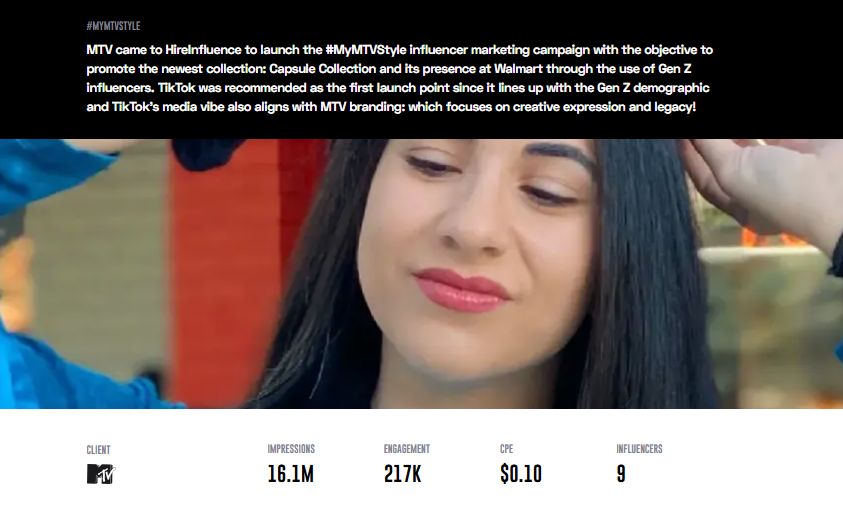
The MTV #MyMTVStyle TikTok campaign delivered 16.1 million impressions at $0.01 cost per view and $1.50 cost per thousand, with 216,600 engagements. Efficiency metrics at this level reflect what happens when organic creator content is amplified through properly structured paid placements on a platform where the agency has exclusive ad access.
The Grammarly campaign, which produced 214 million impressions, 33.1 million views, and $15 million in earned media value through 133 lifestyle influencers across YouTube, TikTok, and Instagram, illustrates the scale at which HireInfluence’s multi-platform paid amplification operates. The UGC and content services connected to that program ensure that creator assets feed paid channels, product pages, and email programs well beyond the original campaign window.
The Enterprise Standard for Whitelisting
HireInfluence’s minimum engagement of approximately $100,000 reflects the operational depth this level of integrated campaign management requires. The agency has received the MUSE Creative Awards for Marketing Agency of the Year, the Netty Awards for Best Digital Marketing Campaign, and the NYX Awards for Best Influencer Marketing Campaign in 2024, followed by the U.S. Agency Awards for Digital Marketing Agency of the Year and the Vega Digital Awards for Best Influencer Marketing Campaign in 2026.
Enterprise brands that want to understand the full scope of HireInfluence’s paid amplification and whitelisting capabilities can review the agency’s portfolio at hireinfluence.com/work/. Background on the agency is available at hireinfluence.com/about/. Brands ready to discuss an integrated influencer and paid media program can connect at hireinfluence.com/contact/.
Whitelisting is not a feature to add to an influencer campaign after the creative is done. It is a structural decision that shapes creator selection, contract terms, content format, and amplification strategy from the first day of planning. Brands that build it in from the start consistently outperform those that try to retrofit it, and the difference in ROI is