
The shift to performance accountability in influencer marketing is not a trend. It is now the industry standard. According to TopRank Marketing’s 2025 B2B Influencer Marketing research, performance-based compensation has become the most frequently used influencer payment model, with 53% of programs structured around measurable outcomes rather than flat fees alone. The same research found that 85% of marketers now run influencer programs, up from just 34% in 2020. As the channel has scaled, so has the expectation that it performs like every other line item in a marketing budget: with evidence.
Table of Contents
For enterprise brands, this shift matters in a specific way. When influencer marketing was a smaller part of the mix, a CMO could justify it on brand equity grounds without clean attribution. That window has closed. Influencer programs now sit alongside paid search, paid social, and programmatic in the same budget review, held to the same standard of accountability. Brands that cannot demonstrate a clear connection between creator spend and business outcomes are not going to keep growing those budgets.
That is the environment that defines what a performance-based influencer marketing agency actually needs to do. It is not just about finding the right creators. It is about building the measurement infrastructure that makes performance visible, optimizing the program in real time based on what is working, and delivering results the business can actually act on.
What Performance-Based Influencer Marketing Actually Means
The phrase gets used loosely, so it is worth being precise. Performance-based influencer marketing refers to programs where results are tracked, attributed, and used to make spending decisions. It can involve performance-linked compensation structures, where creators earn based on outcomes rather than flat fees. It always involves proper attribution infrastructure: UTM parameters, unique promo codes, pixel-based conversion tracking, and real-time reporting dashboards.
What it does not mean is that influencer marketing becomes purely transactional or that brand awareness is abandoned. The most effective performance programs combine both: broad awareness content that builds familiarity and trust, plus conversion-focused content with clear calls to action and trackable paths to purchase. The awareness layer makes the conversion layer work better. Running performance tracking without awareness infrastructure just means you are measuring the bottom of a funnel you have not filled. UGC and TikTok content in particular have demonstrated strong conversion performance when paired with proper tracking, because both formats carry the authenticity signals that drive purchase intent.
The distinction between a performance-oriented agency and one that reports on vanity metrics is visible in how they set up a campaign before it launches. A genuinely performance-oriented agency asks the following questions before a creator is contracted: What does a conversion look like for this brand? How will we track it? What is the attribution window? What content format and platform combination has the highest conversion intent for this audience? What does success look like at 30 days, 60 days, and 90 days?
An agency that cannot answer those questions before launch is not a performance agency, regardless of what it calls itself.
The Four Pillars of Real Performance Measurement
Building a performance-based influencer program requires four things working together: attribution infrastructure, creator selection tied to performance signals, paid amplification of high-performing content, and reporting that connects campaign activity to business outcomes.
Attribution infrastructure. Every piece of creator content needs a trackable path to conversion. That means unique UTM parameters for each creator and each piece of content, promo codes tied to specific creators, and where applicable, pixel-based conversion tracking that captures downstream actions like purchases, sign-ups, or demo requests. Without this in place before the campaign launches, performance measurement is impossible after it ends.
Creator selection tied to performance signals. Follower counts are not a performance metric. For a performance-based program, creator selection needs to factor in historical conversion rates from sponsored content, audience quality scores, and engagement patterns that signal genuine purchase intent rather than passive consumption. Sourcing and vetting creators through this lens requires real data, not just a database search.
Paid amplification of high-performing organic content. Organic creator content reaches a fraction of the audience it can reach when amplified through whitelisting and paid media. For performance programs, this step is critical: take the creator content that is already converting and put paid budget behind it, targeting the right audience segments with the exact creative that has proven to work. Brands that use creator content as paid ads consistently see stronger engagement and lower cost per acquisition than brand-generated creative, because the creative carries the creator’s authenticity even in a paid placement.
Analytics and reporting that connects activity to outcomes. Impressions, reach, and engagement rates are input metrics. Performance reporting measures outputs: conversions, cost per acquisition, attributed revenue, pipeline influenced, and lifetime value of influencer-sourced customers. The reporting cadence needs to surface these signals during the campaign, not just in a post-mortem, so that budget can be reallocated toward what is working while the campaign is still live.
What the Ricola Campaign Demonstrates About Performance Attribution
HireInfluence’s Ricola #CoatYourThroat campaign is one of the clearest examples in the portfolio of what performance attribution looks like in practice. The campaign generated 26 million impressions, a 13.17% engagement rate, and 62,500 tracked retail purchase clicks through MikMak retail link integration across 18 influencers spanning micro to celebrity tier.
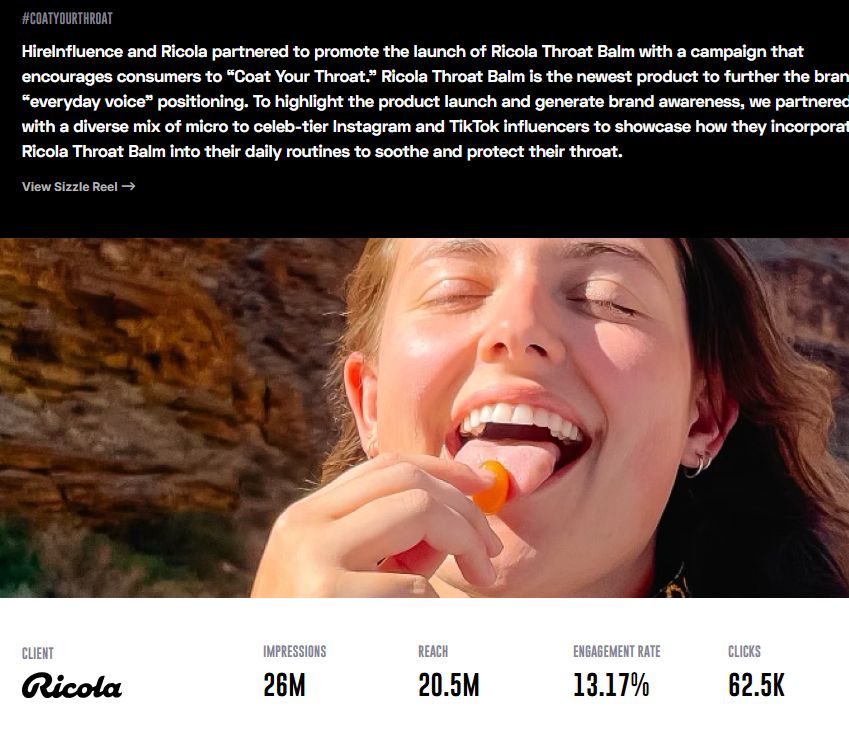
The MikMak integration is the detail that matters most here. MikMak is a retail purchase link platform that connects social content directly to in-store purchase behavior, allowing the brand to see which creator posts drove actual product sales rather than just digital engagement. That is not a vanity metric. That is a direct line between an influencer post and a retail transaction, which is the kind of attribution that justifies continued investment at scale.
The Grammarly campaign delivers a different version of the same principle: 133 creators, 214 million impressions, 33.1 million views, and $15 million in earned media value. At that scale, performance tracking requires infrastructure that can handle hundreds of content pieces across three platforms simultaneously, maintain UTM discipline across every post, and report on outcomes in a way that senior marketing leadership can actually use to make decisions.
Why Enterprise Brands Need a Performance Infrastructure Partner
The difference between a performance-based influencer program and a standard influencer campaign is not the compensation model. It is the measurement infrastructure built around the campaign from day one. Most agencies do not have it. They have reporting dashboards that aggregate engagement data and surface it in a PDF. That is not performance measurement.
A genuine performance infrastructure partner builds the tracking before the campaign launches, maintains it throughout the campaign with real-time visibility, uses the data to make mid-campaign optimization decisions, and delivers reporting that connects directly to the business metrics that matter to the CMO and CFO reviewing the spend.
HireInfluence has been building performance-measured campaigns since 2011. The client roster, which includes Microsoft, Grammarly, Oreo, McDonald’s, Ricola, and Meta, reflects a consistent requirement from enterprise clients: results that are measurable, attributable, and defensible in a budget review. The full-service campaign work across those clients demonstrates what performance accountability looks like when it is built into the operating model of every campaign rather than added as an afterthought.
Understanding what performance-based influencer marketing costs at enterprise scale starts at approximately $100,000 per engagement, which reflects the measurement infrastructure, attribution tooling, paid amplification, and reporting overhead required to run a program that actually performs.
Performance-based influencer marketing is not a different kind of influencer marketing. It is influencer marketing done correctly, with the measurement infrastructure to prove it. The question for enterprise brands is not whether to demand performance accountability. It is whether their agency partner is built to deliver it.