
Performance teams adopt ugc for paid ads because the format converts, and the sales-contribution research explains the mechanism more precisely than most brands realize. A meta-study of nearly 450 CPG campaigns across digital and television, analyzing 18 features grouped under five drivers of effectiveness, found that creative contributes 49% of a brand’s incremental sales lift from advertising. Brand contributes 21%, up from 15% in the previous analysis. Targeting contributes 11%, up from 9%. Reach and recency divide the remainder. The study also found that brands with the highest consumer loyalty earned twice the incremental sales of brands with average or low loyalty. Read the ranking honestly and an uncomfortable conclusion follows. Roughly half of what advertising achieves is determined by the asset itself, and roughly a tenth by the targeting decisions that consume most of a performance team’s attention. The constraint on paid social is not the media buy. It is the rate at which a brand can produce creative worth buying media against.
Table of Contents
Why Sales-Contribution Data Drives UGC Creative Supply
Performance marketing organized itself around the levers it could pull quickly. Targeting settings change in an afternoon. Bidding strategies change in an hour. Creative takes weeks, requires other departments, and cannot be optimized inside the platform where the results appear. Predictably, teams built expertise in the fast levers and treated creative as an input that arrives from somewhere else. The contribution data says they industrialized the wrong half of the problem.
The NCSolutions meta-analysis puts creative at 49 percent of incremental sales lift and targeting at 11 percent. The ratio is roughly four to one in favor of the thing most performance teams do not control. That is not an argument against targeting, which has grown more influential over time and now contributes more than it once did. It is an argument that a brand which perfects its audience strategy while starving its creative pipeline has optimized a minority stake in its own performance and left the majority to whatever the agency delivered last quarter.
Creative supply, not creative quality, is where this becomes a UGC question. A brand can commission one exceptional television spot and run it for a year. Paid social does not permit that. Audiences saturate, the auction discounts repetition, and a single asset that opens strongly decays as the same people see it repeatedly. Sustaining performance requires a stream of distinct assets, tested against one another, refreshed before decay sets in. Studio production cannot supply that stream at a price any performance budget can absorb, which is the entire economic case for creator-produced content in the ad account.
The loyalty finding sharpens what that content needs to accomplish. Brands with the highest consumer loyalty earned twice the incremental sales of brands with average or low loyalty, and brand contribution has risen while creative held steady. The two facts belong together. Loyalty is what accumulates when creative works repeatedly, and creative works repeatedly when it is credible. Content in which a recognizable person demonstrates a product and describes a real result builds the brand impression that later shows up as loyalty and gets counted separately. A brand running only extractive direct-response creative harvests the loyalty it inherited and replaces none of it.
None of this makes creator content automatically superior. It makes creator content the only affordable answer to a supply problem the data says dominates outcomes. A brand that treats this format as a cheap substitute for polished work will produce cheap work and conclude the format failed. A brand that recognizes it is buying the ability to test ten credible executions where it previously tested one has understood the finding. Creative contributes half the result. Supply is what determines how many attempts a brand gets at that half.
What Enterprise Brands Should Expect From a UGC Creative Partner
Program strategy and design. The agency has to plan creative volume against the decay rate of the ad account rather than against a campaign calendar, since the number of assets a brand needs is a function of spend, audience size, and frequency rather than of how many quarters remain. That planning belongs inside dedicated campaign services at the outset.
Creator sourcing and verification. The agency has to recruit for on-camera credibility and delivery reliability, because a creative pipeline that misses deadlines is not a pipeline. Verification here concerns production history and category authenticity rather than audience quality, since the creator’s followers are not part of the purchase and their absence changes nothing about the asset’s performance in a paid placement.
Platform and commerce integration. The agency has to build the purchase path the creative implies, because content that demonstrates a product creates the expectation that the product can be obtained immediately, and a friction-heavy checkout wastes the credibility the creative just established. The asset and the destination are one artifact, and testing them separately produces two results that neither explains.
Creative direction and content production. The agency has to vary structure rather than only faces, since platforms compare creatives on signals and five videos with different presenters and identical hooks are read as one repeated asset. A UGC overview describes the production model that supports structural variety at volume.
Audience and segment-specific execution. The agency has to produce creative that speaks to each segment in that segment’s own terms, which is where creative and targeting stop being separate disciplines. A precisely targeted audience receiving generic creative converts like an untargeted one, because the persuasion never happened. Given that creative carries roughly four times the sales contribution of targeting, the correct response to a segment insight is a new asset rather than a new audience definition. Most teams have the reverse instinct, because building an audience takes minutes and building an asset takes a week, and the instinct costs more than the week would have.
Cross-platform orchestration. The agency has to secure rights that allow a proven asset to run wherever it earns its place, and to know which creative survives a platform change and which does not. Brands running creator-channel programs alongside owned-channel content can consult the firm’s TikTok influencer marketing resource for the adjacent channel, where the content stays on the creator’s account and the economics of the arrangement invert.
Paid amplification. The agency has to move budget behind winners quickly and retire decaying assets before they drag the account, which requires media and creative teams operating on one clock inside a specialties and services capability rather than in sequence.
Attribution and measurement. The agency has to attribute performance to creative variables rather than only to placements, so the next production cycle inherits knowledge about which hook, proof structure, and demonstration format actually worked. That demands an analytics capability built to compare assets rather than campaigns.
Program Delivery Across Creative and Paid Programs
Creative supply arguments are only worth the outcomes attached to them. The #MyMTVStyle campaign for MTV generated 16.1M impressions and 216,600 engagements at $0.01 cost per view and a $1.50 CPM, cost efficiency that is a creative achievement before it is a media one. The Grammarly creator program coordinated 133 creators to produce 214M impressions and 33.1M views with $15M in earned media value, which is what a genuinely deep creative library makes possible. The #CoatYourThroat program for Ricola reached 20.5M people across 26M impressions with 18 influencers, sustained a 13.17% engagement rate, and drove 62,500 MikMak retail clicks, recorded in the Ricola case study. The #SouthwestSaysAloha program for Southwest Airlines delivered 56M impressions and 3M engagements, and the #OREOShamROCKout activation for Oreo and McDonald’s produced 1.7M impressions at $0.06 cost per engagement.
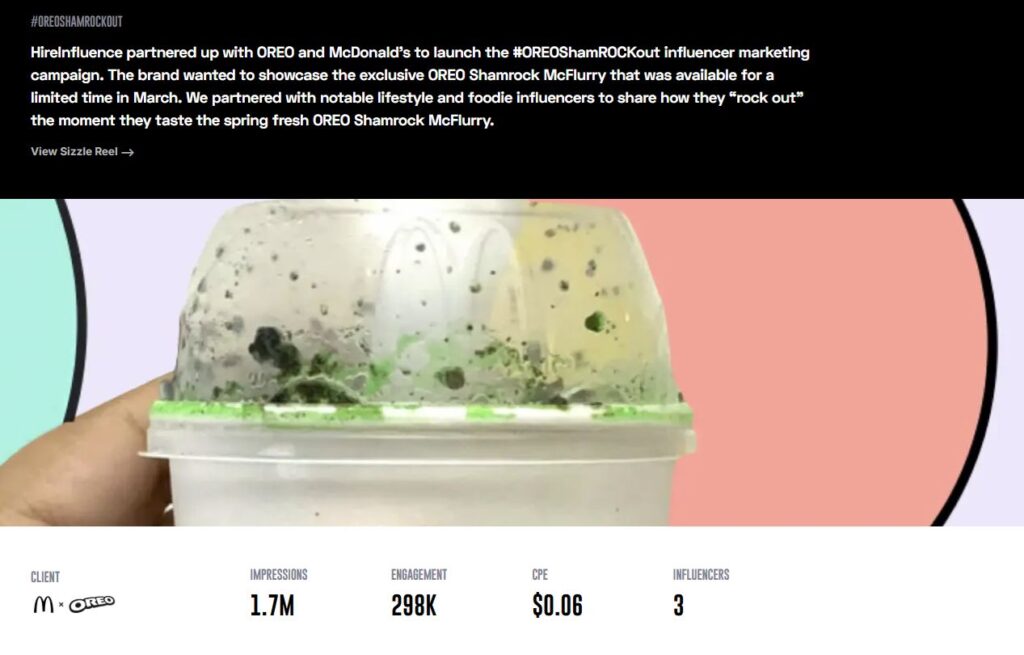
Additional programs appear in the work portfolio. The MTV cost per view and the Oreo cost per engagement are the numbers a performance team should study, because neither can be bought. Both were earned by creative that audiences chose not to skip.
How to Evaluate a UGC Creative Agency
First, ask how the agency determines creative volume. The agency should reason from spend, audience size, and frequency rather than from a fixed monthly deliverable, and it should be able to explain how it knows when an asset has begun to decay, naming the signals it watches and the threshold at which a replacement ships.
Second, ask how the agency varies creative structurally. The agency should distinguish between changing the presenter and changing the hook, proof structure, and emotional arc, and it should be able to show a test plan in which each asset answers a different question.
Third, ask what the agency does with losing assets. The agency should retire them quickly and extract the learning, rather than defending production spend by keeping weak creative in rotation. A losing asset that stays live because someone paid for it is costing the account twice, once in production and once in the impressions it wastes.
Fourth, ask how creative decisions connect to targeting decisions. The agency should treat a segment insight as a creative brief rather than an audience setting, and should be able to justify that ordering with reference to what actually drives sales contribution. An agency that cannot articulate why creative outranks targeting has not read the evidence its own discipline rests on.
Fifth, ask what a creative pipeline costs and which variables move it. The agency should separate per-asset production, revision rounds, usage rights, volume, and media into distinct lines and work from a published cost of influencer marketing guide rather than presenting creative as an incidental cost of media.
The HireInfluence Model for Creative Supply
Founded in 2011, HireInfluence is a full-service enterprise influencer marketing agency with 25+ people across 10+ states, working from four offices: Houston and The Woodlands in Texas, Austin, Los Angeles, and New York. The firm has run programs for MTV, Grammarly, Coca-Cola, Meta, McDonald’s, and Microsoft on a six-figure engagement floor, which reflects the production capacity and rights infrastructure that sustained creative supply demands.
HireInfluence has been a TikTok Shop Lite Program partner since July 2024, and was named Marketing Agency of the Year at the 2024 MUSE Creative Awards and Digital Marketing Agency of the Year at the 2026 U.S. Agency Awards.
Before founding the firm in 2011, Jason Pampell spent years managing content rights, licensing, and strategic media partnerships for Forbes and Billboard, businesses in which the asset was always the work itself and everything else was distribution. Publishing understood before performance marketing did that the audience arrives for the content, not for the delivery mechanism. Paid social has spent a decade proving the same thing more expensively. The HireInfluence team plans creative volume before media flights and negotiates the rights that let a winning asset keep working, which is the only way a brand converts the half of performance that creative controls. Brands can reach the firm through its contact page or read more about its history in the about section.
The contribution data leaves little room for argument. When creative determines close to half of incremental sales and targeting determines roughly a tenth, a performance organization that has staffed heavily against targeting and thinly against creative supply has built its expertise where the influence is smallest, and the format that fixes the imbalance is the one that produces credible assets at a price the account can absorb.