An agency that recognizes this is a two-sided market and builds two programs. Content that attracts candidates and content that wins client contracts speak to different people about different things, and a single program aimed at both will underperform on each.
Table of Contents
- The two programs
- Candidate-side content that works
- The advocate complication
- Where the category is unusually well positioned
- Measurement differs by side
- What to ask an agency
- Where the category has an unfair advantage
- Sector specificity beats scale
- Compliance in a regulated employment context
- Program Delivery Across Two-Sided Categories
- The HireInfluence Model for Talent-Facing Programs
Staffing and recruitment brands sit between two audiences whose interests are not identical. Recruitment influencer marketing has to fill a candidate pipeline while persuading employers to buy, and the content that does one rarely does the other. This is also a category where the creator population overlaps the audience almost completely, since the people with credibility about work are people doing it, which brings employer complications and an unusual set of opportunities. This article covers both sides.
The two programs
Candidate attraction is the higher-volume side and the one creator content suits best. The audience is reachable, the message is concrete, and the outcome is measurable in applications rather than in a procurement decision.
Client acquisition is B2B with a long cycle, committee decisions, and contracts that renew infrequently. Creator content here influences a shortlist rather than closing a sale, and measuring it against direct conversion will read as failure.
The two need different rosters, different platforms, and different measurement, and a proposal that treats them as one program has not understood the business.
Candidate-side content that works
Day-in-the-life content from people doing the job is the category’s strongest format, and it works because the audience is genuinely trying to find out what a role involves.
Pay and progression transparency performs disproportionately, because the audience is looking for it and most employers will not provide it.
Sector-switching content reaches people considering a move, which is exactly the moment a staffing brand wants to be present.
Process content, explaining how hiring actually works in a sector, builds trust with an audience that frequently feels the process is opaque.
What does not work is employer-brand content that describes a culture rather than a job. Candidates discount it, and creator audiences discount it faster.
The advocate complication
The credible voices are people currently employed, which brings the same employer issues any practitioner engagement carries.
Employment contracts and social media policies may restrict discussing work publicly, particularly pay.
Naming a current employer implies an institutional endorsement the individual cannot give.
Confidentiality obligations apply to processes, clients, and colleagues.
The credential expires when they change roles, which for a category built on people’s jobs happens frequently, and evergreen content presenting somebody by a role they have left needs a refresh, retitle, or retire decision made at contracting.
There is also a disclosure dimension specific to this category. Where a staffing brand compensates someone to talk about their work or to recommend the brand, that is a material connection, and it applies equally where the compensation is a referral fee, a placement bonus, or preferential access to roles. Referral incentives are compensation, and content promoting a brand’s roles in exchange for one requires disclosure like any other paid arrangement.
Where the category is unusually well positioned
Placed candidates are advocates with a genuine story, and their content is credible precisely because the outcome is real. Contracting them properly, with disclosure, is straightforward and underused.
Recruiters themselves can be creators. Several categories have seen recruiters build substantial audiences, and a staffing brand employing them has an owned creator function rather than a purchased one. This is employee advocacy and carries the same disclosure obligation.
Sector communities are dense, which means a small, well-chosen roster reaches a large share of the addressable candidate population.
Measurement differs by side
Candidate side is measurable and should be measured properly: applications by source, quality of application, and placement rate by acquisition channel rather than volume alone. A creator driving many low-fit applications is a cost.
Client side should be measured on shortlist presence and inbound inquiry rather than conversion, with honest acknowledgment of the gap.
An agency proposing one measurement framework across both is describing a report the brand cannot act on.
What to ask an agency
Which side is this program for, and is there a plan for the other?
How are employed advocates’ contractual positions handled?
How are referral and placement incentives treated for disclosure?
What is the application quality measure, not just volume?
Has the agency worked with employee-creator programs?
Where the category has an unfair advantage
Staffing brands hold something almost no other category does: a continuous supply of genuine outcome stories.
Every placement is somebody whose working life changed, and a proportion of them will talk about it. That is authentic advocacy generated by the core business rather than purchased, and it costs almost nothing to systematize.
Three things make it work. Ask at the right moment, which is shortly after a placement settles rather than immediately. Make participation genuinely optional and unconnected to any ongoing relationship. And handle disclosure properly where any compensation or incentive is involved, since a placed candidate receiving anything for advocacy has a material connection.
Brands that build this have a content engine. Brands that do not are buying from creators what their own business produces for free.
Sector specificity beats scale
Staffing spans sectors with almost nothing in common, and a program built at brand level rather than sector level underperforms both audiences.
Candidate audiences are sector communities. Nurses, developers, drivers, and accountants are separate populations following separate creators, and content aimed at candidates generally reaches none of them well.
Client audiences are sector buyers with sector-specific problems.
The credible advocate is always sector-specific, since credibility comes from doing that job rather than from working.
The implication is more programs, each smaller, rather than one large one. Brands operating across many sectors should sequence rather than attempt all of them, and should start where the placement margin justifies the focus.
Compliance in a regulated employment context
Recruitment content touches employment law in ways general marketing does not, and it is worth flagging.
Job content is advertising for employment, which carries obligations around discrimination, accuracy of role description, and pay transparency where it applies.
Targeting parameters on employment-related advertising are restricted on several platforms, and a creator campaign amplified as paid media may fall inside those restrictions.
Claims about placement rates, salaries, or outcomes require the same substantiation any performance claim does.
Brands should establish the position with employment counsel before designing targeting, because retrofitting compliance into a live campaign in this area is expensive and occasionally means discarding the audience work entirely.
Program Delivery Across Two-Sided Categories
The #CoatYourThroat program for Ricola generated 20.5M reach, and the campaign is documented in full in the Ricola case study.
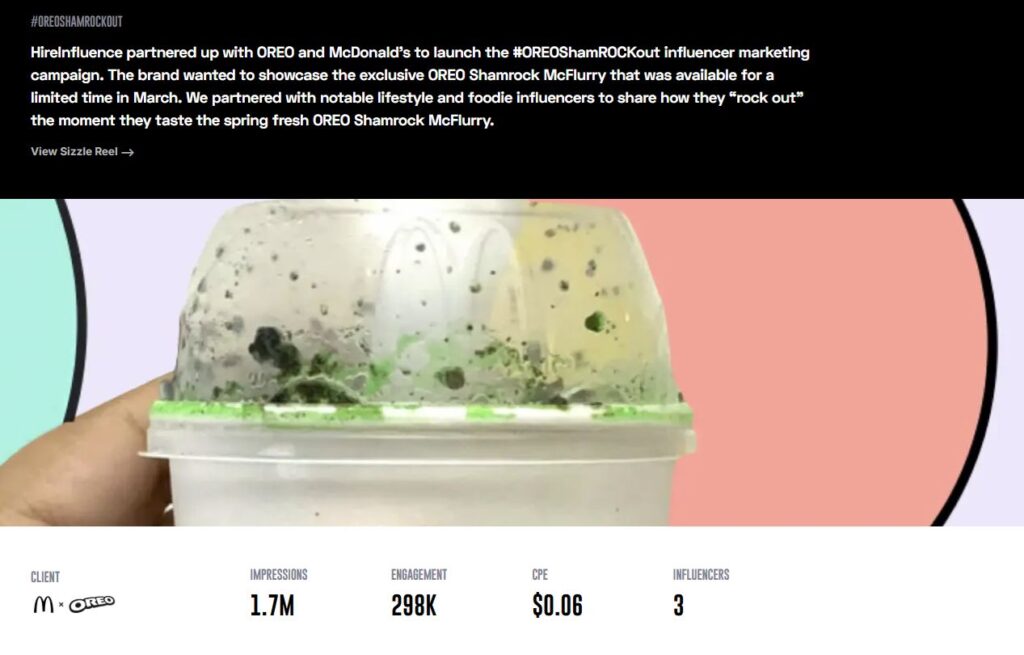
The #OREOShamROCKout program for Oreo and McDonald’s returned 1.7M impressions at $0.06 cost per engagement across a partnership requiring two organizations to align. For MTV, the #MyMTVStyle program returned 16.1M impressions and 216,600 engagements at $0.01 CPV and $1.50 CPM.
Additional campaign detail is published in the work portfolio.
The HireInfluence Model for Talent-Facing Programs
Founded in 2011, HireInfluence is a full-service influencer marketing agency built for enterprise brands, headquartered in Houston with offices in Austin, Los Angeles, and New York. The firm runs creator programs for brands including Honda, Microsoft, NFL, Southwest Airlines, Target, and Warner Bros, covering strategy, talent sourcing, branded content production, paid amplification, and performance reporting. Creator selection runs through a manual vetting and validation process rather than database filtering alone, and campaigns are scoped to each client’s objectives rather than sold as fixed packages.
Staffing brands should read the FTC influencer disclosure guidelines for enterprise brands, which covers the material connection question referral incentives create, and the influencer content approval process. Scoping conversations start through contact.