
Deliverables and fees are the easy part and are rarely where engagements fail. The clauses that decide whether a program works are ownership of the rights register, who performs disclosure verification, who manages platform authorizations, and what the brand is still responsible for. Most statements of work name none of the four.
Table of Contents
- The four clauses most SOWs omit
- What to specify precisely in the deliverables section
- The commercial clauses worth attention
- The clauses that matter at the end
- What not to over-specify
- How specific is too specific
- The review that should happen before signature
- Program Delivery Across Contracted Enterprise Programs
- The HireInfluence Model for Scoped Engagements
An influencer marketing statement of work is usually written as a list of outputs: creators, posts, reports, and a fee. That describes what will be produced and says nothing about the machinery that produces it, which is where engagements actually break. A brand and an agency can agree entirely on deliverables and discover in month three that neither believed it was responsible for tracking usage rights. This article covers what to add beyond the deliverable list, and it is the difference between a document that describes an engagement and one that governs it.
The four clauses most SOWs omit
Ownership of the rights register. Name the party that maintains it, the fields it records, the update cadence, and the brand’s right to obtain it on demand. This single clause prevents the most expensive recurring failure in the category, which is nobody being able to say what the brand is licensed to use. Where the agency holds it, specify that a copy transfers to the brand quarterly, because an agency-held register is a service rather than an asset.
Disclosure verification. Distinct from briefing creators on requirements, and the step most often assumed. Specify that verification happens after publication, who performs it, and what evidence is retained. Compensation includes in-kind, so gifted product falls inside scope and should be named.
Platform authorization management. Who secures authorizations, who tracks expiry, and what the warning threshold is. The platforms behave incompatibly: TikTok authorization runs for a fixed term where expiry is terminal and a new code must be generated, Instagram permission is revocable by either party at any time, and on YouTube Google states the advertiser is responsible for securing rights while the platform tracks no expiry at all. A SOW that treats these as one item has not been written against the mechanics.
Brand-side obligations. Approval turnaround, response time on platform permission requests, named decision-makers, and what happens when the brand misses a deadline. Agencies rarely push for this and it protects both sides, because the most common cause of a stalled program is an approval queue rather than an agency failure.
What to specify precisely in the deliverables section
Creator count by tier, with a defined substitution process for dropout rather than an assumption.
Content volume and format, including revision rounds and the rate for work beyond them, since uncounted revisions are where agency margin and brand goodwill both erode.
Rights, by term, territory, and permitted media type. Not “usage rights included.”
Reporting, by content, cadence, and recipient. A monthly deck is not a specification.
Paid amplification, whether it is in scope, and if so whether the media budget flows through the agency.
The commercial clauses worth attention
Fee model and what it covers, with an explicit list of what is billed separately. Creator fees, rights, media, production, and shipping are excluded from most agency fees and should be named as excluded rather than left silent.
Assumptions the fee rests on. Creator count, rights term, media budget. When these move, the fee moves, and stating that in advance converts a dispute into an arithmetic exercise.
Payment terms, including how creators are paid and when.
Change control. How additional scope is agreed and priced. Influencer programs generate scope changes routinely, and a SOW without a change process handles them as arguments.
The clauses that matter at the end
Transition and handover. What is delivered on termination, in what format, within what period. Rights register, executed agreements, platform asset ownership, reporting history, and creator contact detail. Free to include at signature and unobtainable once a relationship is ending.
Platform asset ownership. Ad accounts, Business Center and Business Manager assets, pixels, audiences, and creator marketplace access created during the engagement. Where these sit under agency ownership, the brand loses them at exit, and this is the single most damaging discovery in an agency transition.
Survival of usage rights. Whether content already produced remains licensed after the engagement ends. Frequently unaddressed and frequently the thing a brand most needs.
Who holds the creator agreements. If the agency is the counterparty, the brand may have no direct contractual relationship with its own creators. Decide this deliberately at SOW rather than discovering it during a transition.
What not to over-specify
Creative structure. A SOW dictating content structure will produce content that reads as advertising and undermines the reason creators were engaged.
Named creators, unless a specific individual is genuinely the point. Locking a roster into a contract removes the ability to substitute when someone becomes unavailable, which happens routinely.
Performance guarantees. Where offered, they are usually defined narrowly enough to be meaningless, and they distort what the agency optimizes.
How specific is too specific
A statement of work can be over-written as well as under-written, and the failure mode differs.
An under-written SOW produces disputes about who was responsible. An over-written one produces change orders for everything, because any variation from a highly detailed specification technically falls outside scope. Agencies working under an over-specified document become defensive about scope rather than helpful about outcomes, which is worse for the brand than a slightly loose agreement.
The rule that works is to specify responsibilities and controls tightly, and activities loosely. Who owns the rights register, who verifies disclosure, who manages authorizations, and what the brand must do are all worth writing precisely, because ambiguity there is expensive. How many creator calls happen per week, or what the internal briefing format looks like, are not.
A related discipline is to review the SOW annually rather than treating it as permanent. Programs change shape, and a document written for a first engagement will describe a service the brand outgrew in year two. The annual review is also the natural moment to add the transition and ownership clauses that a first SOW frequently omits.
The review that should happen before signature
One pass through the draft with a specific question saves most of the disputes that follow: for every activity described, is it clear which party performs it, and what happens if they do not.
Statements of work fail on unassigned verbs. A clause saying content will be reviewed before publication names no reviewer and no deadline, which reads as agreed and governs nothing.
Program Delivery Across Contracted Enterprise Programs
The #CoatYourThroat program for Ricola generated 26M impressions, and the campaign is documented in full in the Ricola case study.
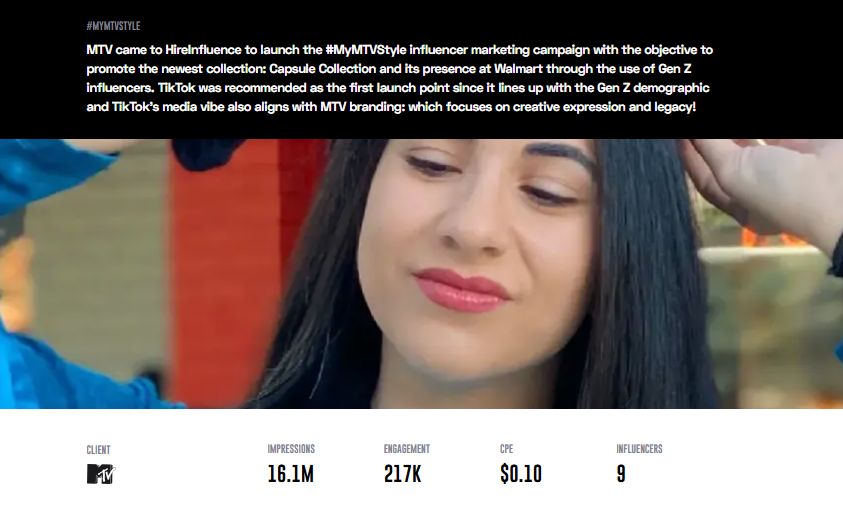
The #OREOShamROCKout program for Oreo and McDonald’s returned 1.7M impressions at $0.06 cost per engagement. For MTV, the #MyMTVStyle program returned 16.1M impressions and 216,600 engagements at $0.01 CPV and $1.50 CPM.
Additional campaign detail is published in the work portfolio.
The HireInfluence Model for Scoped Engagements
Founded in 2011, HireInfluence is a full-service influencer marketing agency built for enterprise brands, headquartered in Houston with offices in Austin, Los Angeles, and New York. The firm runs creator programs for brands including Adidas, Honda, NFL, Target, Warner Bros, and eBay, covering strategy, talent sourcing, branded content production, paid amplification, and performance reporting. Creator selection runs through a manual vetting and validation process rather than database filtering alone, and campaigns are scoped to each client’s objectives rather than sold as fixed packages.
Brands drafting a statement of work should read the influencer content approval process, which covers the brand-side obligations worth writing down, and the influencer exclusivity clauses guide. Scoping conversations start through contact.