Deciding how to hire influencers has become a revenue question, and new consumer research explains why. A November 2025 survey found that 76 percent of Americans follow influencers, that half of those followers made at least one influencer-driven purchase in 2025, and that the average buyer completed three purchases totaling $372 in a single year. The same study found that 60 percent of followers remember a brand mention from an influencer more readily than a traditional advertisement, and that more than half of influencer-driven purchases happened through direct links or creator storefronts, often within moments of viewing the content. Those figures raise the cost of getting the hiring decision wrong. Creator selection now sits one click away from revenue, which means the influencer hiring process deserves the same rigor an enterprise applies to any other commercial partnership.
Table of Contents
Why New Consumer Data Reshapes How Brands Hire Influencers
The research, fielded by PartnerCentric in November 2025, is most useful where it declines to flatter the channel. Consumers ranked crowdsourced opinions from other shoppers (63 percent) and AI-generated recommendations (20 percent) ahead of influencers themselves (17 percent) as their most trusted source of product advice, and 72 percent of respondents said they do not believe influencer culture is healthy. At the same time, 29 percent reported feeling a personal, almost one-sided relationship with the creators they follow. Read together, these data points describe an audience that buys through influencers while remaining selective about which ones it believes. Trust is conditional, and it attaches to specific creators rather than to the format.
That conditionality changes what it means to hire an influencer. A brand is not purchasing reach; reach is abundant and inexpensive. A brand is borrowing a specific relationship between a specific creator and a specific audience, and the transaction only produces revenue when that relationship is genuine. The survey’s tier data sharpens the point: 51 percent of Americans primarily follow macro-influencers with 100,000 to one million followers, 23 percent follow mega-influencers above one million, and the remainder follow micro- and nano-creators. Audiences prefer creators who are established but still approachable, which is precisely the band where careful sourcing matters most and where follower counts alone reveal the least.
Platform behavior adds another layer to the influencer hiring process. Instagram leads as the place Americans follow influencers at 34 percent, with YouTube and TikTok effectively tied at 24 percent each. A hiring plan that concentrates on a single platform ignores how purchase journeys actually distribute across feeds, and a plan that treats all three platforms identically ignores how differently their audiences engage. YouTube audiences reward depth and tolerate longer integrations, TikTok audiences reward immediacy and native trends, and Instagram audiences respond to polished lifestyle context, so the hiring brief for each platform should read differently even inside a single campaign. Finally, the research surfaces a risk that did not exist in earlier hiring playbooks: 6 percent of followers knowingly follow an AI-generated influencer, another 9 percent are unsure whether they do, and 13 percent of buyers attribute at least one purchase to an AI influencer’s recommendation. Synthetic personas are now part of the supply pool. Screening them out, or engaging them deliberately with full disclosure, is a vetting decision that has to be made before a contract is signed, not after a campaign underperforms.
There is one more finding hiring teams should weigh. Nineteen percent of respondents said an influencer has changed their opinion on a political or social issue, which means creators carry persuasive authority well beyond product categories. For an enterprise brand, that authority cuts both ways: a well-matched creator transfers credibility onto the brand, while a poorly vetted one transfers controversy. Values alignment, content history review, and audience sentiment analysis belong in the influencer hiring process for the same reason background checks belong in executive recruiting. The influence being purchased is real, so the diligence should be too.
What Enterprise Brands Should Expect From the Influencer Hiring Process
Enterprise programs treat hiring as a coordinated discipline rather than a procurement task. Brands evaluating how to hire influencers at scale should expect eight functions to operate together.
Hiring strategy and program design. Before any outreach begins, the program defines what the hired creators must accomplish: awareness, retail conversion, content production, or a sequenced combination. HireInfluence structures this through dedicated campaign services that translate business objectives into creator requirements, so selection criteria exist before selection begins. The dedicated campaign services function anchors every downstream decision.
Sourcing and verification. With 13 percent of influencer-driven buyers already citing AI personas and audience skepticism running high, sourcing has to combine discovery with forensic vetting: audience authenticity analysis, engagement pattern review, brand safety screening, and disclosure history. The finding that consumers trust crowdsourced voices more than polished ones argues for creators whose comment sections behave like conversations, not broadcasts. Verification also extends to regulatory posture: a creator’s history of clear sponsorship disclosure protects the brand under FTC endorsement guidelines, and a partner that checks disclosure practices before contracting prevents compliance problems that are expensive to fix after content is live.
Tier calibration. The 51 percent macro preference in the survey supports a portfolio approach: macro creators for efficient scale, micro and nano creators for credibility in niche communities, and selective celebrity involvement where cultural moments justify it. Hiring across tiers also insulates a program from the volatility of any single creator relationship. In practice, enterprise programs often anchor awareness goals with two or three macro voices, then surround them with a larger bench of niche creators whose audiences convert at higher rates, adjusting the ratio as performance data accumulates.
Platform and commerce integration. Because more than half of influencer-driven purchases flow through direct links and creator storefronts, hired creators must be equipped with working commerce infrastructure from day one: trackable links, storefront placements, and platform-native checkout paths that match where their audiences actually buy.
Creative alignment and brief development. The 60 percent recall advantage influencers hold over traditional advertising only materializes when creators speak in their own voice. Enterprise briefs define guardrails and claims, then leave execution to the person the audience already trusts.
Cross-platform orchestration. With attention split across Instagram, YouTube, and TikTok in nearly equal thirds, hiring plans should assign creators to platforms based on native strength and sequence content so discovery on one platform reinforces consideration on another.
Paid amplification of hired creators. Organic performance identifies the winning content; paid placement scales it. Whitelisting and creator-licensed advertising extend the strongest posts to lookalike audiences, a capability HireInfluence delivers through its specialties and services capability so that hiring budgets compound rather than expire.
Attribution and measurement. Since influencer-driven purchases now carry an average annual value of $372 per buyer, programs need measurement that connects each hired creator to tracked outcomes. HireInfluence’s analytics capability ties creator-level performance to clicks, conversions, and earned media value, which turns the next hiring cycle into an informed decision rather than a fresh guess.
Hiring Influencers at Enterprise Scale: Program Delivery
The clearest evidence of a working hiring process is delivered outcomes across different creator mixes. For Ricola’s #CoatYourThroat program, HireInfluence hired 18 influencers spanning micro to celebrity tiers, a portfolio that produced 26 million impressions, 20.5 million reach, a 13.17 percent engagement rate, and 62,500 MikMak retail clicks that connected creator content directly to purchase. The full Ricola case study shows how tier calibration and commerce integration operate together in practice.
Sourcing at volume tells a similar story. For Grammarly, the agency recruited and managed 133 creators across YouTube, TikTok, and Instagram, generating 214 million impressions, 33.1 million views, and $15 million in earned media value, a program scale that is only possible when verification and onboarding are systematized. Efficiency benchmarks hold at the campaign level as well: MTV’s #MyMTVStyle activation delivered 16.1 million impressions and 216,600 engagements at a $0.01 cost per view and a $1.50 CPM on TikTok, while Southwest Airlines’ #SouthwestSaysAloha campaign reached 56 million impressions with 3 million engagements.
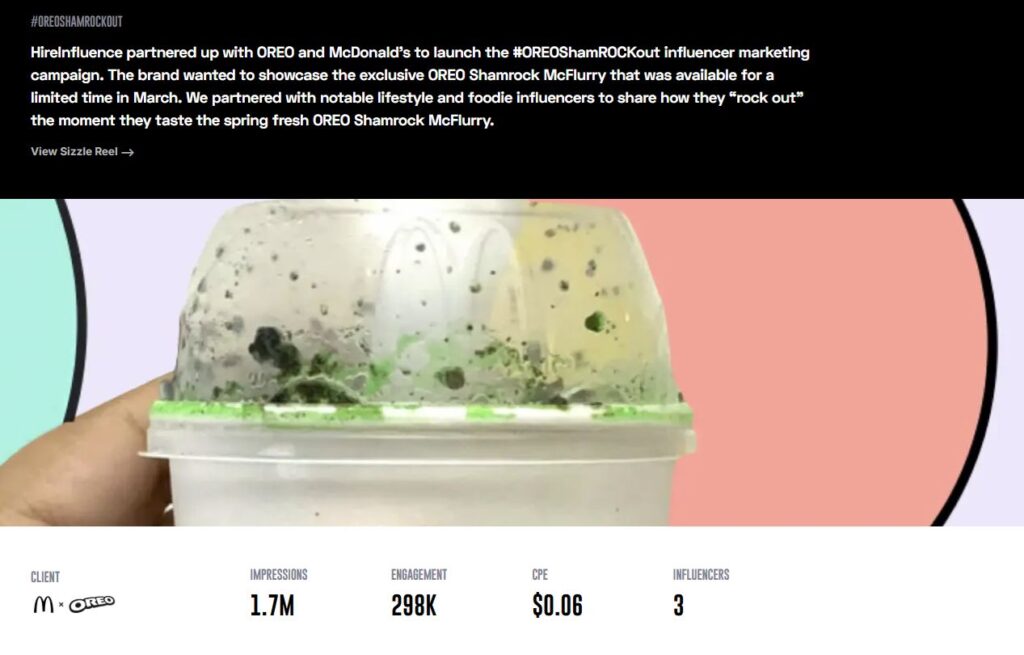
Additional programs across categories are documented in the agency’s work portfolio, including the Oreo and McDonald’s #OREOShamROCKout collaboration that achieved a $0.06 cost per engagement.
Across these programs the common thread is not a platform or a format; it is a hiring process that matched verified creators to defined objectives before the first post went live, then measured what the match produced.
How to Evaluate an Agency Before You Hire Influencers
Five questions separate disciplined hiring partners from list brokers.
First, ask how creators are sourced and verified. The answer should describe audience authenticity analysis and synthetic-account screening, not just database size. Given that 13 percent of influencer-driven buyers already report purchasing through AI personas, a partner without a screening methodology is exposing the brand to a risk the data says is growing.
Second, ask how tier mix is determined. A credible partner should explain when macro reach, micro credibility, and celebrity moments each earn their cost, reflecting the survey’s finding that audiences concentrate around the 100,000 to one million follower band.
Third, ask how commerce is wired into campaigns. Since more than half of influencer purchases move through direct links and storefronts, the agency should describe its approach to trackable infrastructure and platform-native checkout, not just content deliverables.
Fourth, ask how creative briefs protect authenticity. The 60 percent recall advantage disappears when content reads as scripted advertising, so the partner should articulate how it balances brand requirements with creator voice.
Fifth, ask what attribution will look like in the first reporting cycle, and request examples with real numbers. Strong answers reference tracked link performance, creator-level conversion reporting, and earned media value calculations rather than screenshots of impressions. Budget questions belong in this conversation too, and the agency’s cost of influencer marketing guide outlines the variables that determine creator compensation and program investment before contracts are drafted.
The Influencer Hiring Model Behind Award-Winning Programs
HireInfluence has operated as a full-service influencer marketing agency since 2011, with a team of more than 25 people across 10 or more states and offices in Houston and The Woodlands, Austin, Los Angeles, and New York. The agency runs enterprise engagements starting near the $100,000 level for brands including Microsoft, Southwest Airlines, Coca-Cola, Walmart, Grammarly, and McDonald’s, and it has held an exclusive TikTok Shop Lite Program partnership since July 2024, a direct advantage for programs built around the storefront purchasing behavior the 2025 research documented. Recognition includes the 2026 U.S. Agency Awards Digital Marketing Agency of the Year and the 2024 MUSE Creative Awards Marketing Agency of the Year, with platform-specific depth documented on the agency’s Instagram influencer marketing agency page and its TikTok influencer marketing resource.
Founder and CEO Jason Pampell launched HireInfluence in 2011 after managing content rights, licensing, and strategic media partnerships for Forbes and Billboard, and he brings more than 30 years of leadership experience in sales, marketing, and team building for Fortune 1000 organizations. That background shapes the HireInfluence team’s approach to hiring creators: media partnerships built on verification, clear terms, and measurable value. Brands ready to move from evaluating the process to running it can reach the agency through its contact page, with additional background available in the about section.
The 2025 consumer data ultimately reduces the hiring question to a single standard. Half of influencer followers spent real money through creators in 2025, an average of $372 each, and they did it through the creators they actually trust. Brands that hire influencers with verified audiences, calibrated tiers, integrated commerce, and accountable measurement will capture that spending. Brands that buy reach and hope will fund it.