
The default instagram reels strategy at most enterprise brands is to take the vertical video already produced for another platform and post it again, and a 2026 study of 24.3 million posts drawn from 375,118 accounts indicates that this move imports the one format that travels worst. Reels generate nearly 30% fewer views and 14% fewer interactions than the equivalent video on TikTok. The pattern reverses entirely for carousels, where Instagram produces 4.7x more views and 5.8x more interactions than the same format on TikTok. Within Instagram, Reels still earn more than four times the interactions of a single-image post, and average Reels watch time more than doubled year over year to 8.5 seconds. Static posts collapsed over the same period, with reach down 21.96%, interactions down 25.41%, and engagement down 45.98%. Brands responded by publishing 24.04% more content. The conclusion the data forces is uncomfortable and useful: a Reel is not a TikTok video with a different caption, and the two platforms should never be planned as one.
Table of Contents
Why Cross-Platform Performance Data Drives Instagram Reels Strategy
The economics of repurposing are seductive. One shoot, one edit, four platforms. The creative team is relieved, the media team gets coverage, and the reporting deck fills with impressions. What the practice actually does is take a format optimized for one distribution system and enter it into a second system that ranks it differently, then judge the result against benchmarks borrowed from the first.
The Metricool analysis separates those systems cleanly. Reels underperform TikTok video by nearly thirty percent on views and fourteen percent on interactions, while Instagram carousels outperform TikTok carousels by 4.7 times on views and 5.8 times on interactions. Both facts are true simultaneously, which means neither platform is simply better. Each rewards a different thing. A brand that ports its TikTok library to Reels has chosen, without deciding to, the format where Instagram is weakest relative to its competitor, while leaving unused the format where Instagram is overwhelmingly strongest.
That does not mean Reels should be abandoned, and reading the data that way inverts the point. Inside Instagram, Reels earn more than four times the interactions of a single-image post, and static content is in freefall: reach down nearly twenty-two percent, interactions down more than twenty-five percent, and engagement down forty-six percent in a single year. Reels remain the discovery engine and the only format reliably delivering a brand to people who do not follow it. The instruction is not to publish fewer Reels. It is to stop treating them as recycled inventory and start building them for the surface that will distribute them.
The watch-time figure defines what building for the surface means. Average Reels watch time more than doubled year over year, and it arrived at 8.5 seconds. Doubling sounds like progress until the absolute number registers. Eight and a half seconds is the whole of the attention a brand can expect on average, which means the creative decision that matters is made before a viewer has heard a full sentence. A hook designed to pay off at second twelve pays off to almost nobody. Product introductions staged after an establishing shot introduce the product to an audience that already left. Most brand Reels are structured like short films and consumed like glances.
The publishing figure explains why the pressure keeps rising. Brands increased output by roughly twenty-four percent year over year, which means every additional Reel enters a feed more crowded than the one it was planned for. Volume is not a strategy in that environment, it is an arms race that the platform’s own distribution logic will not reward, since attention is allocated to what holds viewers rather than to what appears most often. Views also concentrate within the first three days of publication, which converts amplification from a monthly budgeting exercise into a seventy-two-hour operational decision. A brand that reviews performance weekly has already missed the window in which its best content could have been funded.
What Enterprise Brands Should Expect From an Instagram Reels Partner
Program strategy and design. The agency has to assign each platform the format it actually rewards rather than distributing one asset everywhere, which means planning Instagram and TikTok as separate systems with separate creative from the outset. That determination belongs inside dedicated campaign services before any production is commissioned.
Creator sourcing and verification. The agency has to select creators whose native strength is the format the program requires, since a creator whose audience responds to their carousels will not automatically transfer that response to a Reel. Verification means examining format-level performance for each creator rather than a blended engagement rate that conceals which surface is doing the work. A creator who has never published a Reel that outperformed their own median is not a Reels creator, whatever their aggregate numbers suggest.
Platform and commerce integration. The agency has to design a purchase path that survives an eight-second attention window, because a viewer who leaves at second nine has not read a caption, tapped a bio link, or absorbed a promotional code delivered at the end of the clip. The offer has to be legible inside the same seconds the hook occupies, or it is being made to an audience that has already moved on.
Creative direction and content production. The agency has to brief for the first two seconds with an intensity that feels disproportionate and is not, and it has to produce natively rather than reformat. A UGC overview explains the production model that makes native volume affordable at enterprise scale.
Audience and segment-specific execution. The agency has to recognize that Reels reach beyond a creator’s followers by design, which means the audience receiving a Reel is frequently meeting the brand for the first time. Content that assumes familiarity, references a prior campaign, or opens on a brand asset rather than a reason to keep watching is speaking to the smaller half of the room. Segment planning should account for the fact that discovery formats deliver strangers and feed formats deliver acquaintances.
Cross-platform orchestration. The agency has to decide deliberately what travels between platforms and what is rebuilt. Brands running short-form programs on both surfaces can consult the firm’s TikTok influencer marketing resource for the adjacent channel, where the same vertical clip is distributed by a different logic and therefore demands a different edit, a different hook, and a different measure of success.
Paid amplification. The agency has to make amplification decisions inside the first seventy-two hours, since views concentrate immediately and a post that has stopped accumulating attention cannot be rescued by budget. That responsiveness requires a specialties and services capability operating on a daily rather than monthly rhythm.
Attribution and measurement. The agency has to report by format and by platform separately, because blending them produces an average that describes no actual decision a brand can make. Separating them depends on an analytics capability instrumented before launch rather than reconstructed afterward.
Program Delivery Across Reels and Creator Campaigns
Format discipline shows up in outcomes. The #OREOShamROCKout activation for Oreo and McDonald’s delivered 1.7M impressions at $0.06 cost per engagement, efficiency that only appears when creative earns attention rather than purchasing it. The #CoatYourThroat program for Ricola reached 20.5M people across 26M impressions with 18 influencers, sustained a 13.17% engagement rate, and drove 62,500 MikMak retail clicks, documented in the Ricola case study.
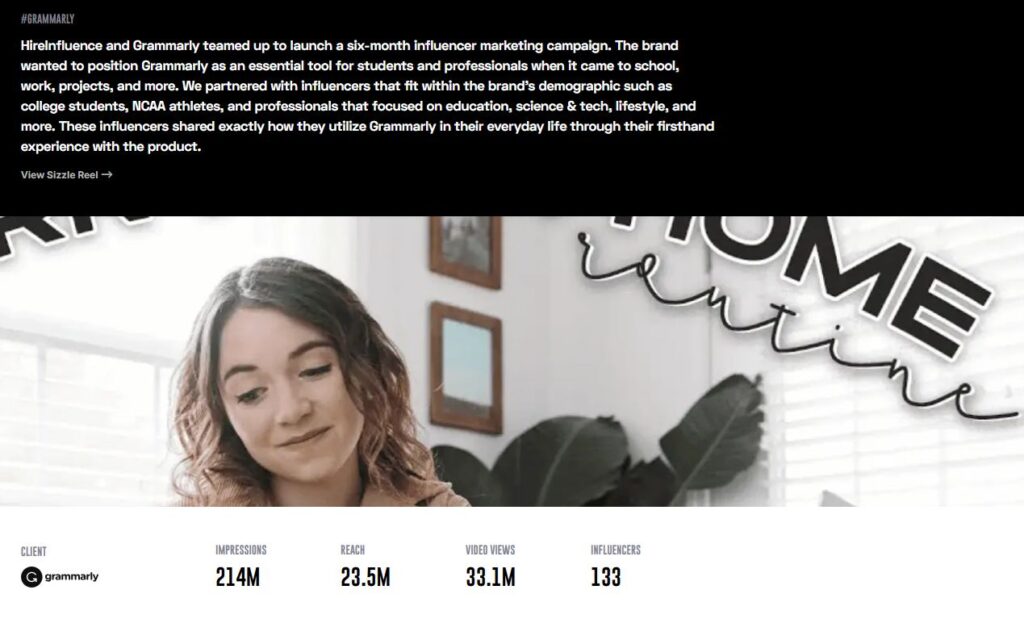
The Grammarly creator program coordinated 133 creators to produce 214M impressions and 33.1M views with $15M in earned media value, a result that depends on a creative library deep enough that no two videos open the same way.
The #MyMTVStyle campaign for MTV generated 16.1M impressions and 216,600 engagements at $0.01 cost per view and a $1.50 CPM, and the #SouthwestSaysAloha program for Southwest Airlines produced 56M impressions and 3M engagements. Additional programs appear in the work portfolio. Across every one of them, the cheapest attention belonged to the campaigns where creators built for the surface instead of adapting to it.
How to Evaluate an Instagram Reels Agency
First, ask whether the agency plans Instagram and TikTok as one program or two. The agency should treat them as separate systems, explain that the same format performs inversely across the two platforms, and be prepared to recommend different creative for each.
Second, ask what the agency does in the first two seconds of a Reel. The agency should have an explicit position on the opening frame, justified by the reality that average watch time is measured in single-digit seconds, and it should be able to show work where the payoff arrives immediately.
Third, ask how quickly amplification decisions are made. The agency should operate inside a seventy-two-hour window, because views concentrate in the first three days and budget applied afterward is buying a post the audience has already passed over.
Fourth, ask how the agency evaluates a creator’s format-level performance. The agency should refuse to rely on a blended engagement rate and should show which formats each creator’s audience actually responds to.
Fifth, ask what a Reels program costs and what moves the number. The agency should separate native production, creator fees, content volume, usage rights, and amplification into distinct lines and reason from a published cost of influencer marketing guide rather than from a repurposing assumption that treats production as already paid for.
The HireInfluence Model for Instagram Reels Programs
Founded in 2011, HireInfluence is a full-service enterprise influencer marketing agency with 25+ people across 10+ states, working from four offices: Houston and The Woodlands in Texas, Austin, Los Angeles, and New York. The firm has run programs for Meta, Microsoft, Ricola, Walmart, Coca-Cola, and Grammarly on a six-figure engagement floor, which reflects the native production capacity that a format-specific strategy demands.
HireInfluence has been a TikTok Shop Lite Program partner since July 2024, a vantage point that makes the differences between short-form surfaces concrete rather than theoretical, since the same creator and the same clip produce measurably different outcomes on each. The agency was named Marketing Agency of the Year at the 2024 MUSE Creative Awards and Digital Marketing Agency of the Year at the 2026 U.S. Agency Awards.
Before founding the firm in 2011, Jason Pampell spent years managing content rights, licensing, and strategic media partnerships for Forbes and Billboard, disciplines built on the recognition that an asset’s value is set by the context it is placed in rather than by the asset alone. The same recording is worth one thing in a film and another in an advertisement. The same vertical video is worth one thing on a discovery feed and another on a decision platform, and the brands that recognize this stop paying to reformat and start paying to rebuild. The HireInfluence team plans each surface on its own terms and negotiates rights that permit purpose-built creative rather than universal reuse. Brands can reach the firm through its contact page or read more about its history in the about section.
The study leaves the strategic instruction unambiguous. When one format underperforms across the platform border and another outperforms by a factor of five, the brand publishing identical assets in both places has not achieved efficiency. It has selected, by default, the worst available version of both strategies.