
Enterprise brands evaluating a six figure influencer program tend to ask for a deliverables list, and a 2026 study of 84 client-side marketers who run influencer programs at their organizations suggests the deliverables were never the variable. On average, 30% of influencer marketing spending goes to the agency and 70% reaches the influencers themselves. Only 51% of marketers report full visibility into the exact amounts their agencies pay creators on their behalf. Despite that, 73% say they are satisfied with their current agency compensation agreements, and more than half intend to change their compensation approach within the next twelve months. Creator ad spending is meanwhile growing roughly four times faster than the media industry overall. Read together, those figures describe a market in which buyers are satisfied with arrangements they cannot see into, and are preparing to change them anyway.
Table of Contents
Why the Visibility Gap Reframes the Budget Question
A deliverables list answers a question about volume. It says how many creators, how many assets, how many impressions. What it cannot say is where the money went, and the ANA data indicates that roughly half of enterprise marketers do not know. That is a remarkable finding in a discipline that spent the last decade demanding accountability from every other channel. The same organizations that will interrogate a media agency’s rebate structure have accepted, in influencer, an arrangement where the split between working and non-working spend is not reliably disclosed.
The satisfaction figure is the part that should give a buyer pause, because 73 percent satisfied and 51 percent sighted cannot both be measuring the same thing. Satisfaction under those conditions is not an assessment of value. It is an assessment of experience, and experience is a poor proxy for price when the price is partly invisible. A brand can be genuinely pleased with the work, the responsiveness, and the results, and still have no basis for judging whether the terms were good, because the information required for that judgment sits on the other side of the table. That more than half of respondents plan to change their compensation approach within a year suggests the industry has noticed the contradiction even where individual buyers have not. Intending to change an arrangement one is satisfied with is not incoherent. It is what happens when a buyer realizes that satisfaction was never the test.
The 30 and 70 split is the most useful number in the study for anyone scoping a program, because it converts an abstract budget into a structure. A six-figure commitment is not one hundred thousand dollars of creator activity. It is, at the market average, roughly seventy thousand reaching creators and thirty thousand funding the operation around them. Whether that is a good trade depends entirely on what the thirty is doing. If it buys sourcing, verification, rights management, measurement, and the labor of running a program, it is infrastructure, and infrastructure is the reason the other seventy is not wasted. If it buys account management and a quarterly deck, the same percentage describes a very different purchase. The number is identical in both cases, which is exactly why the number on its own tells a buyer nothing. What it does is locate the question. It says the argument is about thirty thousand dollars and what that thirty thousand is made of, and no deliverables list has ever been organized to answer that.
This is why the honest answer to what a six-figure program buys is a structure rather than an inventory. Two programs at identical spend can differ more than two programs an order of magnitude apart, because the variable is not scale but what the non-working portion is actually funding. Verification is the clearest example. Confirming that an audience is real is labor that produces no visible deliverable, appears nowhere on an asset list, and determines whether every impression downstream of it was real. A brand comparing two proposals on deliverables will systematically prefer the one that spent less on the thing that made the deliverables true. That is not a failure of diligence. It is what happens when the comparison instrument rewards what is visible and the decisive work is invisible by nature. The buyer is not being careless. The buyer is being shown the wrong document.
The growth figure closes the argument on timing. A channel expanding at four times the rate of the media industry overall is a channel whose governance is being outrun by its budget, and that gap is where information asymmetry becomes structural rather than incidental. The category is arriving at the scrutiny other media disciplines reached years ago. The brands that will handle it best are the ones already asking what their thirty percent does, rather than the ones that will be asked by finance first.
What Enterprise Brands Should Expect From a Six Figure Influencer Program Partner
Program strategy and design. The agency has to explain what the non-working portion of the budget is building before the first creator is approached, because a program whose infrastructure is undefined will spend the money regardless and account for it afterward. This is where dedicated campaign services either constitute a program or merely staff one.
Creator sourcing and verification. The agency has to treat audience verification as a funded line rather than an assumed courtesy, since it is the least visible thing the fee pays for and the one that decides whether the other seventy percent bought anything at all.
Platform and commerce integration. The agency has to build the connection between creator activity and the systems that record outcomes, because that plumbing is invisible on a deliverables list and decisive in a results conversation.
Creative direction and content production. The agency has to specify what production the fee covers and what it does not, and the boundary between contributed and commissioned material described in the UGC overview is where budgets most often turn out to have meant different things to the two parties.
Audience and segment-specific execution. The agency has to allocate against segments rather than spreading a budget evenly, since an equal split across dissimilar audiences is not neutrality, it is an unexamined decision funded at full price.
Cross-platform orchestration. The agency has to run one program across channels rather than billing several, and adjacent reading such as this TikTok influencer marketing resource illustrates how per-channel scoping quietly multiplies the non-working share. Orchestration is a cost structure before it is a calendar.
Paid amplification. The agency has to keep media spend distinguishable from creator fees and from its own compensation, because the three collapse easily into a single number and a brand that cannot separate them cannot evaluate any of them. A specialist specialties and services capability is what keeps those lines apart.
Attribution and measurement. The agency has to price its measurement openly rather than folding it invisibly into a management fee, since instrumentation is the part of the program a brand is least equipped to audit and most dependent on. An analytics capability with an undisclosed cost is a visibility problem wearing a technical label.
Program Delivery Across Six Figure Influencer Programs
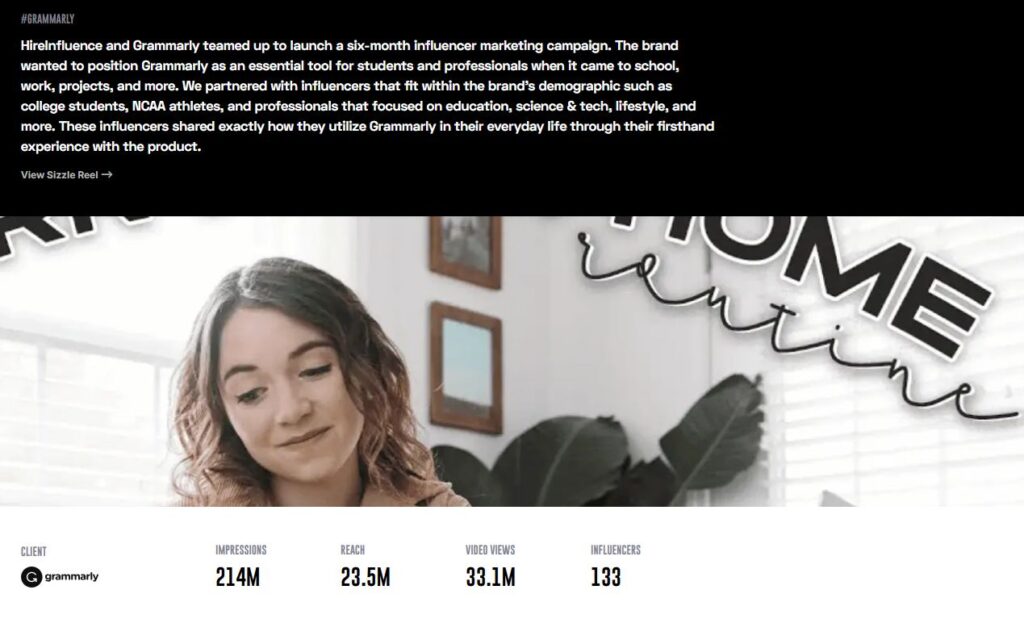
Program delivery is where the non-working portion of a budget either shows its work or does not. The Oreo and McDonald’s #OREOShamROCKout activation reached 1.7M impressions at $0.06 cost per engagement, and a unit cost that specific is only producible by a program that tracked its own spending closely enough to state it. The Southwest Airlines #SouthwestSaysAloha program generated 56M impressions and 3M engagements. The Grammarly creator program ran 133 creators to 214M impressions, 33.1M views, and $15M in earned media value, a roster size at which sourcing and verification stop being tasks and become the operation.
The MTV #MyMTVStyle campaign produced 16.1M impressions and 216,600 engagements at $0.01 CPV and $1.50 CPM. The Ricola case study traces the full structure: 26M impressions and 20.5M reach at a 13.17% engagement rate across 18 influencers, resolving into 62,500 MikMak retail clicks. Eighteen influencers producing that outcome is the argument for what the non-working spend is for, since a figure like that is a product of selection rather than volume. Additional programs sit in the work portfolio.
How to Evaluate a Six Figure Influencer Program Agency
First, ask what share of the budget reaches creators. The agency should state the split without negotiation, and should be able to explain what the remainder funds.
Second, ask what the non-working portion buys. The agency should name the specific functions, and should be able to identify which of them produce no visible deliverable.
Third, ask whether the brand can see what each creator was paid. The agency should treat that as a reasonable request rather than a commercial intrusion, and should have a standing mechanism for it.
Fourth, ask what happens to the fee if the program shrinks. The agency should be able to describe how compensation tracks scope, and should not present a structure that is indifferent to the outcome.
Fifth, ask how the number was built rather than what it is. The agency should decompose the figure into creator fees, production, rights, measurement, and management, and the reasoning behind those components is set out in this cost of influencer marketing guide.
The HireInfluence Model for Six Figure Influencer Programs
HireInfluence has operated as a full-service enterprise influencer marketing agency since 2011, and its about section records a team of 25 or more across 10 or more states, with offices in Houston, The Woodlands, Austin, Los Angeles, and New York. The firm works at a six-figure engagement floor, and the floor exists for the reason this research describes rather than as a positioning statement: verification, rights management, and measurement are staffed functions, they consume the non-working share whether or not a brand can see them, and a program priced below the cost of its own infrastructure has to economize on the parts nobody inspects. Programs have run for Walmart, Microsoft, Meta, Grammarly, Coca-Cola, and Ricola. The firm was named Marketing Agency of the Year at the 2024 MUSE Creative Awards and Digital Marketing Agency of the Year at the 2026 U.S. Agency Awards, and it has been a TikTok Shop Lite Program partner since July 2024. Brands scoping a program at this level can reach the team through the contact page.
Founder and CEO Jason Pampell spent years managing content rights, licensing, and strategic media partnerships at Forbes and Billboard before founding the firm in 2011, and the transferable lesson is one this research states in different words. A licensed asset’s value is decided entirely by the terms attached to it, never by the asset itself, and the party that cannot read the terms is not participating in the negotiation. That is why licensing desks are built around disclosure rather than trust. The counterparty who says the arrangement is fair and declines to show it has said only the first half of a sentence. A brand that is satisfied without being sighted has agreed to the same half.
The benchmark research makes the final case on its own terms. When 73 percent of buyers are satisfied and only 51 percent can see what their money paid for, the question of what a six-figure program buys has an answer that no deliverables list will ever contain.